New poll highlights JD Vance’s challenge with Jewish voters ahead of 2028

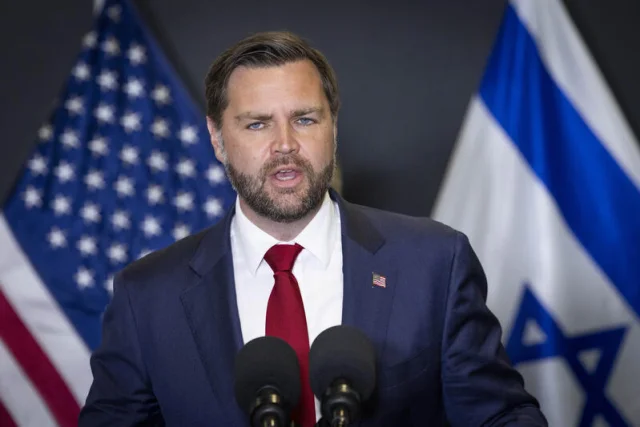
U.S. Vice President JD Vance is facing significant skepticism from Jewish voters, according to a new national poll – an important data point to ingest if he decides to seek the presidency in 2028.
The survey of 800 Jewish registered voters finds that just 14% view Vance favorably, while 82% do not. Granted, a strong majority of Jewish voters are liberal, but even among Jewish Republicans, Vance receives only a 61% favorable rating.
That may sound like a decent number until you compare it with other Republican leaders. Among Jewish Republicans, President Donald Trump is viewed favorably by 89%, while Secretary of State Marco Rubio scores an eye-popping 93%. Will Rubio even run? That’s a discussion and article for another day.
The survey, commissioned by the nonpartisan Jewish Voters Resource Center and conducted by Democratic polling firm GBAO Strategies, offers an early take on the vice president’s standing. Vance may be viewed as the potential heir to the MAGA movement, but support for Trump does not automatically transfer to him. Vance knows that.
When it came to President Trump’s support among Jewish voters in 2024, it was actually very strong. According to Pew Research, Trump received 35% of the national Jewish vote in 2024 – the strongest Republican presidential performance among Jewish voters since the 1980s. Pew also found that 31% of Jewish voters identified as Republicans.
In short, Trump expanded the GOP’s share of the Jewish vote enough to matter, especially in a close national election. That is where Vance’s numbers become politically significant.
Presidential elections are decided state by state, and Jewish voters are concentrated in several important battlegrounds. Pennsylvania is the clearest example. Estimates vary depending on the geographic definition used, but studies place the Jewish population of the greater Philadelphia region at approximately 250,000 to 350,000. That includes large communities in Philadelphia and its surrounding suburban counties, with the broader metropolitan region extending into southern New Jersey.
In a state frequently decided by narrow margins, even a modest shift – or a drop in turnout – can make a difference. The same basic calculation applies in other competitive states with sizable Jewish communities, including Michigan, Arizona, Georgia and Nevada. The Jewish vote WILL matter.
Vance understands the stakes and knows that his relationship with Jewish Republicans remains complicated. Earlier this month, he addressed the Republican Jewish Coalition (RJC) behind closed doors, calling Israel an essential American ally and condemning antisemitism. Several attendees said the appearance eased some concerns. Still, Vance declined to distance himself from Tucker Carlson, whose rhetoric and decision to host Holocaust denier Nick Fuentes have angered Jewish conservatives.
As a matter of fact, here is what Vance specifically said to the RJC in Vegas that gave some Jewish Conservatives pause since he went out of his way not to go after Carlson.
“I recognize a lot of people in this room might disagree with things that Tucker Carlson or Megyn Kelly or Joe Rogan has said, but – just to hone in on Fuentes and Rogan, I think these are two very, very different categories of people, both with their reach, but also within the ideas that are in their actual head."
Vance then continued: "President Trump did not build the greatest coalition in politics by running his supporters through 'endless, self-defeating purity tests.' He says, 'Make America great again because every American is invited ...I didn't bring a list of conservatives to denounce or to deplatform, and I don't really care if some people out there – I'm sure we'll have the fake news media denounce me after this speech. But we have far more important work to do than canceling each other."
Days later, Vance joined Trump for a White House meeting with prominent Hasidic leaders from New York and New Jersey. Those back-to-back events suggest a deliberate outreach campaign, even as major disagreements over Israel, foreign policy and Carlson remain unresolved.
The contrast between Vance and Rubio is impossible to miss. Rubio’s 31% overall favorability is not overwhelming, but it is more than double Vance’s 14%. Among Jewish Republicans, Rubio’s 93% favorable rating demonstrates a considerable gap between the two possible 2028 contenders.
Obviously, the poll is not a prediction about 2028. It is a snapshot taken more than two years before the election, and political attitudes can change dramatically. But that doesn’t mean snapshots can’t expose political vulnerabilities.
The Jewish vote will be crucial, not just for Democrats but for Republicans too. Trump demonstrated that a Republican can expand the GOP’s share of the Jewish vote. The unresolved question is whether Vance could retain that support. Right now, the numbers show that he has considerable ground to make up.
You might also like to read this: