The Strait of Hormuz and getting it straight


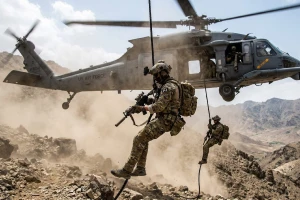
It is thought that the President of the United States is improvising in his dealings with Iran, according to his aides [1]. The POTUS contradicts himself regularly, which is justified by administrators as a strategy to confound opponents [1]. In the latest move, the U.S. is blockading all ships approaching or departing Iranian ports, but not any ships to or from non-Iranian ports [2]. The idea of blockading Iran is nothing new, as it has been considered as a means of pressuring Iran since the 1980s. Deployed near the Strait of Hormuz are an aircraft carrier (USS Abraham Lincoln) and multiple guided-missile destroyers [3]; eight guided-missile destroyers have been so positioned [4]. US warships operating in waters near Iran are exposed to Iranian attacks, but are equipped with AEGIS defense systems and can be accompanied by aircraft [4]. The blockade could be enforced by interdicting ships with boarding teams carried by helicopter from US warships [3].
Geography & Economics
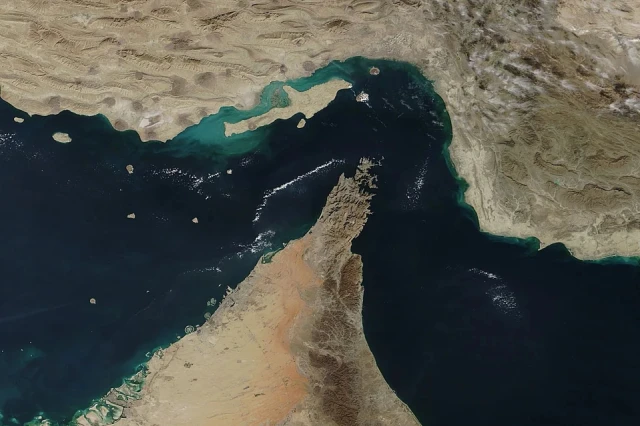
The Strait of Hormuz is a natural bottleneck for shipping, as it is 22 nautical miles at its narrowest point [5]. The economic significance is that 27% of global oil trade and 22% of global liquefied natural gas trade transits the strait [5]. Normally there are two shipping lanes, one in each direction and each two miles wide, separated by a buffer of another two miles [5]. As stated, the blockade is specifically for trade in or out of Iranian ports [2]. For Iran, none of its natural gas is exported by shipping; all of its natural gas exports are by pipeline to neighboring countries. Iran has the third largest proven oil reserves in the world, after Venezuela and Saudi Arabia. Despite abundant resources and significant output of crude oil, Iran imports gasoline because of generally outdated and inefficient refineries. With U.S. sanctions on Iran’s oil exports, China has become the major purchaser of oil from Iran. It has been found that tanker ships exporting oil from Iran with undeclared destinations have ultimately been destined for China [6].
Supply Chain of Materials for Weapons
Iran has been procuring materials for its ballistic missiles from China [7], such as ammonium perchlorate as an oxidizer comprising about 70% of the propellant for solid-fuel ballistic missiles [8]. Other constituents include the binder, metal powder, stabilizers, curing agents, and burn-rate modifiers. The constituents are intermixed in large mixers to a viscous slurry, which is poured into the rocket motor casing, and the loaded casing is then placed in a large oven for curing the propellant. The rocket motor casing functions both as storage for the propellant and as the combustion chamber when ignited, allowing for a more compact design. Another advantage of solid-fuel ballistic missiles is readiness, as the propellant is integral as manufactured [9]. Aside from eliminating Iranian missile production facilities, another option for stopping Iran’s production of ballistic missiles is breaking the supply chain of materials for the missiles.
Getting it Straight
In situations involving war and considering the unpredictability of the U.S. Commander-in-Chief, there are compounded variables. Many pundits have made predictions that by now have already been proven wrong, and more can be expected. The question is where to get reliable news and commentary. The aspirations of the writer of this article are citing credible sources, having objective analysis, and most importantly, comparing to the scriptures. Proverbs 30:5 – Every word of God proves true.
References
[1] 2026, April 01. Live Updates: Trump aides said to believe he’s mostly improvising, rather than following clear plan on Iran. The Times of Israel.
[2] 2026, April 12. U.S. Central Command. Press Release: U.S. to Blockade Ships Entering or Exiting Iranian Ports.
[3] Schmida, B., N. Morrison, A. Fattah, A. Borens, K. Campa, W. Doran, and A. Ganzeveld. Iran Update Special Report, April 13, 2026. Institute for the Study of War.
[4] Cicurel, A. 2026, March. The Eroding Shield: Air Defenses Against Iran. The Jewish Institute for National Security of America.
[5] Ratner, M., P. Brown, L. W. Rosen, and C. Thomas. 2026, March 11. Iran Conflict and the Strait of Hormuz: Impacts on Oil, Gas, and Other Commodities. U.S. Congressional Research Service.
[6] U.S. Energy Information Administration. 2024. Country Analysis Brief: Iran. U.S. Department of Energy.
[7] Thomas, C. 2025. U.S. Sanctions on Iran, Document IF12452. Congressional Research Service.
[8] Rezaei, B, R. Reddy, B. Schmida, A. Parry, C. Moorman, A. Borens, N. Morrison, and A. Ganzeveld. Iran Update: June 06, 2025, Information Cutoff: 2:00 pm E.T. Institute for the Study of War and the American Enterprise Institute’s Critical Threats Project.
You might also like to read this: