The inevitable border: Why a peace treaty with Lebanon will finally draw Israel's northern frontier



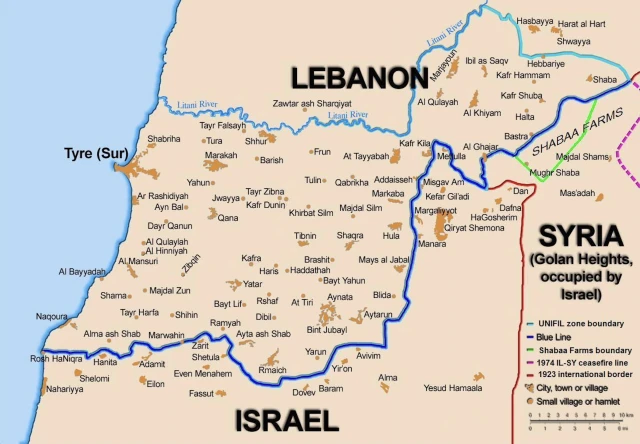
For decades, the northern border of the State of Israel has been defined not by a concrete wall of sovereignty but by a row of faded blue barrels and the whims of a departing United Nations peacekeeping force. The "Blue Line" has been a fiction of international diplomacy—a temporary line of withdrawal that allowed Hezbollah to stockpile 150,000 rockets just kilometers from kindergartens in Metula and Kiryat Shmona.
But the fiction is ending. As the direct talks concluded in Washington, D.C. on April 14, 2026, one thing became clearer than the Mediterranean sky over the Qana gas field: the temporary lines drawn by the UN in 2000 will soon be replaced by a permanent, internationally recognized border established by a formal peace treaty between Israel and Lebanon.
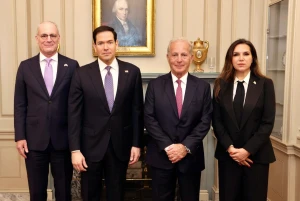
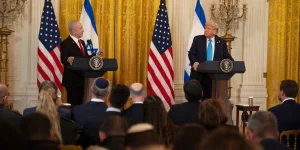
For the first time since 1993, Israeli and Lebanese officials sat across a table without intermediaries. The meeting between Ambassador Yechiel Leiter and his Lebanese counterpart Nada Hamadeh Moawad, hosted by U.S. Secretary of State Marco Rubio, was not merely a diplomatic photo-op. It was the death knell for the ambiguity that has allowed Iran's proxy to hold two nations hostage. While the mainstream media focuses on the "remaining hurdles," the truth is that the strategic trajectory has shifted irreversibly in Israel's favor.
The Blue Line Was Never a Border—And Israel No Longer Accepts It
Any historical analysis makes clear what the international community has conveniently ignored: The Blue Line is "not an international border." It was a hastily drawn line based on the 1923 and 1949 armistice lines, intended to confirm Israel's unilateral withdrawal from the Security Zone in 2000. For 26 years, that ambiguity served Hezbollah's narrative. It allowed the terror army to claim the Shebaa Farms as Lebanese territory—a claim even the UN rejected—to justify its "resistance" and its refusal to disarm.
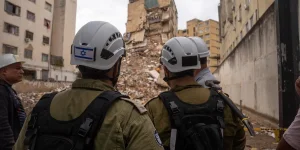
That era of strategic ambiguity is over. Operation Roaring Lion, launched in March 2026 following Hezbollah's rocket barrage in solidarity with Iran, changed the calculus. By encircling Bint Jbeil and systematically degrading Hezbollah's infrastructure, the Israel Defense Forces have created a new reality on the ground. You cannot negotiate a border with a ghost. Hezbollah's leadership, including Naim Qassem, may reject the Washington talks as "futile," but they are no longer the primary decision-makers in Beirut. The Lebanese state, however weak, is now being forced to choose between the abyss of state failure and the stability of a defined frontier.
Washington's Framework: The Path to Permanent Borders
The outcomes of the April 14 meeting are not trivial concessions; they are the scaffolding for a permanent treaty. Let us be clear about what Israel secured at that table:
Territorial Normalization through Working Groups: The establishment of three joint working groups is a de facto admission by Lebanon that the status quo is untenable. For the first time, Lebanon is sitting down to formally discuss the "five specific points in South Lebanon currently under Israeli control." This is not a discussion about withdrawal; it is a discussion about demarcation. Israel will not cede security zones without a formal border agreement. The working group on the Blue Line issues and "remaining points in dispute"—including Shebaa Farms and Ghajar—signals that these areas will be resolved as part of a final status map, not through Hezbollah's Katyushas.
The Detainee Gesture: The release of five Lebanese detainees is being framed as a gesture to the new Lebanese president. But in the context of Israeli diplomacy, it is a classic confidence-building measure that precedes a final-status agreement. It demonstrates that Israel is dealing with the Lebanese government in Beirut, not the bunker-dwellers in Dahieh. It is a move designed to strengthen the hand of Prime Minister Nawaf Salam against Hezbollah's narrative that "Israel only understands force."
Maritime Precedent: The 2022 maritime border agreement is the blueprint. That deal resolved a dispute over 860 square kilometers of the Mediterranean. It proved that even without formal diplomatic relations, a binding treaty on borders is possible. If Israel and Lebanon can agree on where the gas rigs sit, they can agree on where the fence sits. The land border is more complex, but the mechanism for resolution has been tested and proven.
Disarmament and the End of the Litani Fiction
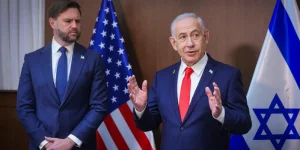
Critics will argue that Hezbollah's disarmament remains an insurmountable hurdle. They will point to the 7,300 Israeli airspace violations recorded by UNIFIL or the five fortified positions Israel maintains north of the line. But this perspective misses the point of the Washington talks. Israel's position, articulated by Prime Minister Benjamin Netanyahu, is non-negotiable: There is no ceasefire without disarmament, and there is no peace without a border.
Lebanon entered the talks seeking an immediate ceasefire. They left with a commitment to a "formal peace process." The distinction is vital. A ceasefire is temporary; it allows Hezbollah to rearm and wait for the next Iranian directive. A peace process demands a permanent border. And a permanent border inherently nullifies Hezbollah's raison d'être. If the border is settled by treaty, there is no "occupied" Shebaa Farms. There is no justification for an armed militia operating independently of the state.
The Israeli government understands that the Lebanese Armed Forces (LAF) are too weak to forcibly disarm Hezbollah today. But a treaty provides the legal and diplomatic cover for the LAF to deploy south of the Litani River as a sovereign army guarding a recognized frontier, not as UNIFIL's assistant. The upcoming withdrawal of UNIFIL, mandated by the Security Council for the end of 2026, is actually a catalyst. It removes the UN buffer that Hezbollah has exploited for cover. In the absence of blue helmets, the responsibility for the border falls squarely on Beirut. And Beirut knows it cannot control that border without a deal with Jerusalem.
Why the Treaty is Inevitable
The current conflict is a dual reality: fighting in Bint Jbeil alongside diplomacy in Washington. But history shows that Israel's borders are forged in the crucible of war and sealed at the negotiating table. The 1979 peace with Egypt followed the Yom Kippur War. The 1994 peace with Jordan followed decades of clandestine security cooperation.
The Blue Line will soon join the annals of history, much like the old armistice lines in Jerusalem. It will be replaced by a surveyed, agreed-upon, and internationally guaranteed border. It will be a border where the olive groves of Metula are not in the shadow of Hezbollah's observation posts, and where the children of Ghajar can live with certainty.
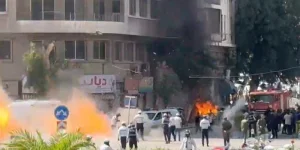
The road ahead is fraught with the violence of Hezbollah's desperation. But the diplomatic trajectory is set. As the working groups convene in the coming weeks, they are not just discussing the status of detainees or the shape of a barrel. They are drawing the final, sovereign line of the State of Israel. And for the first time in a generation, that line will be drawn with ink, not with blood and temporary blue paint.
You might also like to read this: