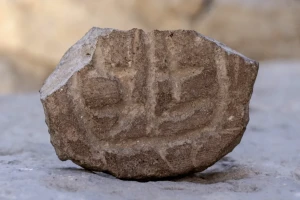
Archaeologists find 2,100-year-old Hasmonean-era sling bullet near Sea of Galilee
Bullet is unique for having the Greek word for ‘learn’ inscribed on its surface



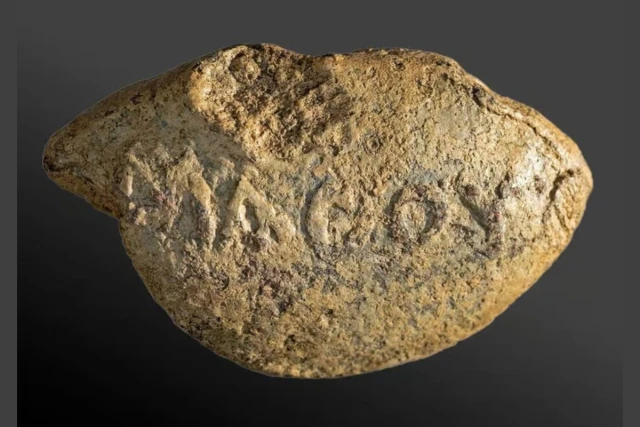
Archaeologists uncovered a 2,100-year-old sling bullet bearing an inscription in Greek while excavating at Hippos-Sussita National Park, on the eastern shore of the Sea of Galilee.
The lead sling bullet, with the word “learn” written in Greek, measures 3.2 x 1.95 centimeters and weighs 37.8 grams. It was found by archaeologists working with the University of Haifa.
The Greek inscription indicates it was likely used by Greek soldiers defending the city against soldiers from the Hasmonean army of King Alexander Jannaeus in 101 B.C.E.
At that time, the Hasmonean kingdom was expanding toward the Galilee and Golan regions, attempting to capture strategic cities as the Hasmonean dynasty sought to expand its size.
Hippos, a Greek city established in the 2nd century B.C.E., was located along a major road between the Sea of Galilee and inland settlements, making it a key defensive position.
The bullet was found near the city’s Roman-era necropolis, however, the archaeologists believe it predates the cemetery, belonging to the earlier Hellenistic period due to the Greek inscription.
Archaeologists have found dozens of similar sling bullets in the surrounding area, suggesting a conflict took place there, either with defenders holding that area outside the city or attackers coming under fire as they approached the city.
Interestingly, the projectile shows signs of impact, indicating it was used in combat.
“We don’t know whether it struck a rock or a person,” said Haifa University’s Michael Eisenberg, “but there was clearly a strong collision.”
Eisenberg, co-director of excavation at the site and one of the authors of the study, told the Times of Israel, “Sling bullets were made of lead, and were the most common munitions in the Hellenistic world. They were the cheapest ones, simple and very effective.”
In a paper published about the find in “Palestine Exploration Quarterly,” the authors noted that while sling bullets have been found with words engraved on them before, this is the first time that this particular Greek word has been found on a lead bullet.
Sling bullets were commonly inscribed with deity names, military unit names, names of cities, acclamations of victory, or even personal names. However, the study’s authors suggest the inscription was likely intended as a sarcastic remark, noting that such usage is commonly attested in the region.
With this interpretation, the word “learn” would bear the meaning of “learn your lesson.” Similar bullet inscriptions have been found in other sites outside of Israel, with words such as “receive [this]” or “take [this].”
You might also like to read this: