The spectacle of one “settler,” and what it does not represent



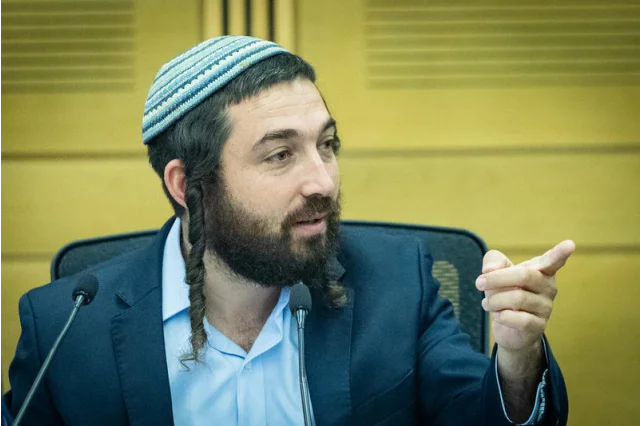
Thank you for clicking. Full disclosure: I wanted a title that would get you to read this. The subject is serious. The framing should be honest.
Full disclosure 2: I am a “settler,” the pejorative term used to describe (or defame) Israelis who live in Jewish communities over the Green Line, the 1949 armistice line between Israel and Jordan. There was no Palestine then. Jordan occupied and annexed the area. Israel restored control in the 1967 Six Day War. You may have heard the term Judea and Samaria or, also pejoratively, the “West Bank.” That is where I live. There are some 500,000 of us. Our presence here is not foreign colonialism or illegal. That is for a separate conversation.
The thing I want you to know is that while we are all called “settlers” and branded together as a group, we are not all alike by any means.
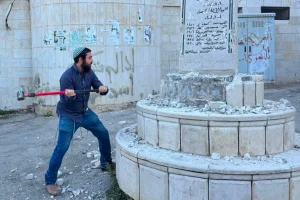
This past week, another “settler” and member of Israel’s Knesset, Zvi Sukkot, catapulted himself into global headlines by damaging a monument dedicated to local terrorist “martyrs” in a Palestinian Arab village, Madama. More on that shortly. Let me say this without qualification: Sukkot does not represent me, not in my way of thinking, not in my behavior, and not in the Knesset.
He does not represent most of the 500,000 Jewish residents of Judea and Samaria, not before the last election and certainly not now.
Two parallel and contradictory realities are at work. When right-wing violence erupts in Israel during a political campaign, it can excite a small demographic that is drawn to that kind of display. We are in the midst of a political campaign. Rather than appealing to voters outside his base, Sukkot appealed to the most unrestrained instincts of his own base, albeit in a way that is debased.
The second reality is how outsiders consume the most provocative, lurid, violent version of “settlers” as if it represents all of us, all of Israel’s religious-nationalist community, or all of Israel. The danger is twofold. Violence is rightly condemned. Sensationalizing it reinforces stereotypes, brushes over complex realities, and turns an individual action by a reckless politician into a voyeuristic anti-Israel spectacle.
People outside Israel may have seen the headline or a 60-second news or social media clip about this, but they need to know the realities. First, Israelis are having a deep conversation about this, across political boundaries, throughout the media, and over the water cooler.
Domestically, I hope this will contribute in a constructive way. I also hope it will contribute to considering who to vote for, or who not to vote for, in the coming election just two months away.
At the same time, Israel’s detractors are using this as “proof” of repeated tropes and allegations of Israeli genocide, ethnic cleansing, and apartheid, none of which are true. I hope they will read this and realize most Israelis condemn Sukkot’s behavior for a variety of reasons. It is proper to condemn specific actions and individuals. It is not proper to use this to define all of us in broad strokes, or to make up claims using words whose meaning has been so watered down as to become meaningless. That is neither accurate, honest, nor constructive.
That most Israelis condemn this behavior and would never even think of doing something like this makes the case all the more glaring. It is a one-off, a perversion, not the norm and not accepted. That is the reality.
Even if there were tens or hundreds of people who would actually do this, the problem is that there are so many such monuments, public parks, schools, and other sites celebrating terrorists and inciting violence within the Palestinian Authority that it would literally be a never-ending battle. The reality is that we don’t do it. The fact that there are hundreds of such locations celebrating and inciting terror is not the reason we don’t.
The reasons we don’t are because it is stupid, dangerous, not our place nationally, and certainly not our place personally. Not any individual’s place, and not an elected official’s. It is counterproductive for a host of reasons: because it is lawless, because it is not how we should behave, because it ties up military resources to enable it, because it is terrible publicity, and because nothing in doing so changes the terror culture the Palestinian Authority embraces, glorifies, and celebrates. If anything, it makes that culture more strident.
That is the story: the reality of who our neighbors are, and the fact that they glorify, celebrate, and incite violence and terror. That is the story that is lost here. It is not a culture or theology that can be changed or rationalized with.
The names and crimes of the terrorists whose names were on the Madama “Martyrs Monument” should be the story. Three examples of the home-grown celebrated terrorists are Yaman Tayeb Ali Faraj and Shadi Nassar, both affiliated with the Popular Front for the Liberation of Palestine (PFLP), and Hamdan Hussein Mahmoud al-Najjar. Collectively, they are responsible for or perpetrated terror attacks against Israel that left several dead and dozens wounded. Other Madama “martyrs” were killed in the 1968 Battle of Karameh, where PLO/Fatah terrorists fought alongside Jordanian troops in a battle that left scores of Palestinian Arab terrorists and Jordanian troops dead.
Yes, the terrorists and the acts they committed are vile. Sukkot claimed he acted after the IDF did not remove the monuments despite his demands to do so, arguing they glorified murderers of Jews and would inspire future terrorism among local children. Maybe that is true. But he had no right or authority to take private action, and certainly not under IDF escort. Israel is a robust democracy. Sukkot and his party could have demanded the monument’s removal in the Knesset, through the IDF, or via the courts. Israel has proper, legal remedies for such things.
The IDF said the visit was coordinated as a “tour of monuments,” but that the destruction was done deceptively.
Because Sukkot’s actions were so debased, the incident drew proper, immediate, and widespread condemnation, including from Prime Minister Netanyahu, who called it “unacceptable,” from within his own Religious Zionist Party, and of course from the opposition. One fellow Religious Zionist Party Knesset member, Ohad Tal, questioned whether this was somehow a campaign event. “I want to understand. Was this move coordinated with the campaign? Is there some deep strategy behind it that I am completely missing, or have we simply decided to commit political suicide once and for all? I’m genuinely asking.”
There are other problems with not just what happened but how it went down. The army should not have allowed it to begin with. Once it was clear what was happening, it should have been stopped. Whoever approved it should be fired. Allowing a military escort took soldiers away from the actual mission of the IDF, which is defense. This was only an offensive operation. It put Israelis in danger.
What if terrorists in Madama had opened fire, wounding or killing Sukkot and his entourage, or the soldiers protecting him? For what? By doing this and taking troops to provide the security needed, did he make anyone truly safer, or did he just put everyone at even greater risk?
Sukkot should be removed from the party, but that probably will not happen. Even though party leader Bezalel Smotrich disagreed with the actions and chided Sukkot, he will probably not have the nerve to shake his party’s base of support and risk losing votes even over a principled stand. However, as head of the Religious Zionist Party, Smotrich should realize that what happened was not only not religious, but a hilul hashem, a public desecration of God’s name.
Not only was Sukkot’s action not religious, it was also not Zionist. The restoration of Jewish sovereignty, for Jews to live as an independent nation in our ancestral land, is not a license for lawless behavior against others.
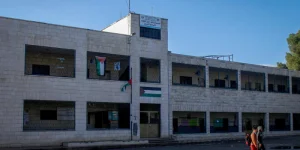
There are very good reasons for Israel to oppose the existence of monuments and other public spaces celebrating terrorists and inciting terror. The PA school across from my home has a mural of PLO terrorist leader Yasser Arafat. That is child abuse. Rather than going in to destroy the monument, why did Sukkot not go in and make a video to go viral about who the terrorists on the monument were, and make the case for its removal? Why don’t people come to my balcony to see the sick message Palestinian Arab children are taught by celebrating Arafat in any way?
The PR damage and other mistakes that were done are irreversible, but that is not the reason why it was bad. It was bad because it is wrong.
You might also like to read this: