Why kites from Gaza are reigniting fears along Israel’s border






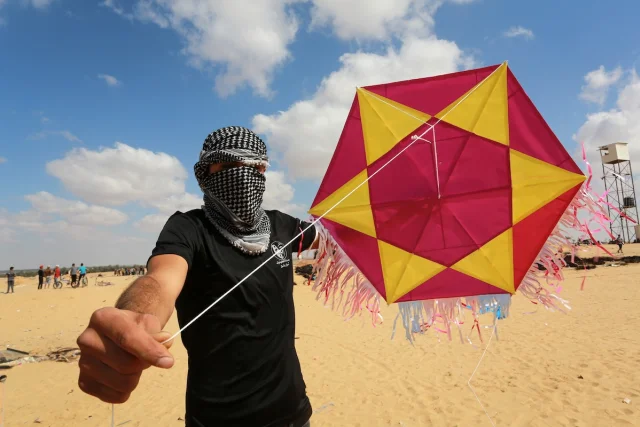
NETIV HAASERA, Israel—Kites drifting from Gaza into southern Israel have alarmed residents in the Gaza Envelope who view them as anything but innocent and, rather, a slide back toward a confrontation with Hamas.
“Having those kites again tells me a story, and the story it tells me is that nothing changed,” said Hila Fenlon, a farmer and lifelong member of the moshav. “It's Hamas doing what Hamas is doing. And, unfortunately, it’s the Israeli government doing what the Israeli government is doing – and that is to ignore the risk that is facing us.”
In the last week, 12 unarmed kites – ostensibly an odd clarifier – floated into Israel, rekindling memories of the kites and balloons launched by Hamas in 2018 that were in fact armed with incendiary materials.
Back then, Fenlon asked the army what if those kites were drones.
“I didn’t get an answer,” Fenlon told journalists during a tour of the moshav on Monday. “If you ask me, the same way Hezbollah (in Lebanon) is using explosive drones to be very accurate weapons against targets… the kites are checking the ability and response of the army.”
Whether these recent kites are meant to test Israel’s defenses – or even whether they were launched by Hamas – is unknown. But Fenlon, who spent years watching Hamas adapt its tactics, views them as the same accumulation of security failures that led to Oct. 7.
KITE TERRORISM OR CHILD'S PLAY?
Some Israelis are sympathetic, yet guarded.
“The kites probably started as a game, but we’re not taking any chances,” said Rafi Babian, head of security for the Sdot Negev Regional Council.
“These kids (in Gaza) have nothing to do. Their parents are at home, are upset. It's not like they have tablets,” he said while briefing a group of reporters on the perimeter of Kibbutz Nahal Oz.
“For a long time now, we stopped bringing balloons to children’s birthday parties,” he said, recalling the economic and psychological damage the kites and balloons caused in 2018.
Later that day, another kite was found tangled in a tree on Nahal Oz not far from where this interview was conducted.
The view is quite different in Gaza, where footage circulating shows children holding signs reading “Our kites are not weapons” and “Stop targeting our joy,” while one child sobbed, “They want to deprive us of the thing we love.”
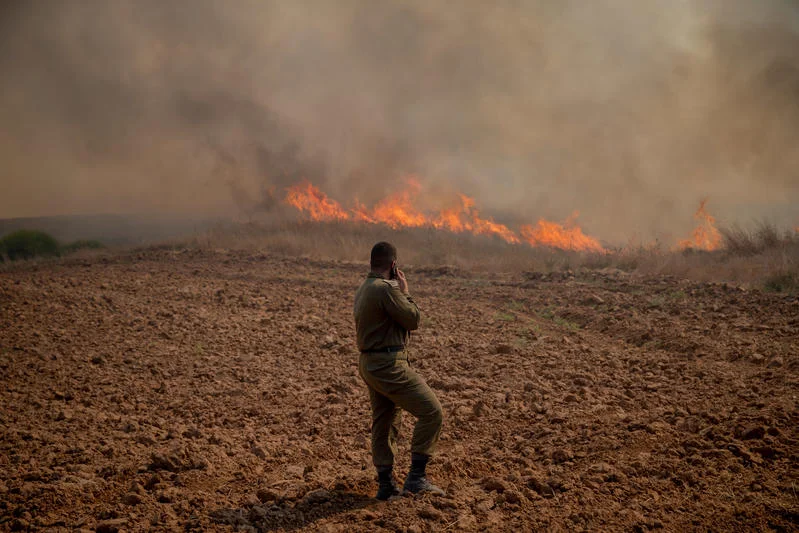
Prime Minister Benjamin Netanyahu and Defense Minister Israel Katz threatened Gaza with “forceful actions” and expulsion of the population in areas from which “kites, drones and balloons are launched.”
In light of this, Hamas called on Gazans to ground the kites. Hamas Spokesman Hazem Qassem accused Israel of using the kites as a pretext for military “aggression.” At least two children were killed in Israeli strikes on Monday, though it was unclear if these attacks were in response to kites.
An official on U.S. President Donald Trump’s Board of Peace called on both Hamas and Israel to de-escalate.
“All militant activity in Gaza must stop, including the flying of kites,” the official said on condition of anonymity. “Israel, too, must comply with the ceasefire. Military action cannot extend beyond responding to genuine and imminent threats.”
WARNING LIGHTS, FAMILIAR FEARS
For Israelis, the kites have added to a general unease. A watchdog group comprised of bereaved families and Oct. 7 survivors released a report this week claiming that Hamas is repositioning for another attack, the “warning lights” unheeded by Israeli officials.
“A disaster doesn’t begin the moment the enemy crosses the border. It begins when the warning signs are before our eyes, but the system doesn’t connect the dots,” said the October Council.
Based on interviews with troops, field observers, civilian security coordinators and senior defense officials, the document compares Israel’s lack of preparedness on Oct. 6, 2023 to current conditions.
A report by Israel’s Channel 12 quoted soldiers and observers echoing these allegations.
“We’re really seeing that they know we won’t fire on them. The Gazans aren’t idiots. In the end, they’re constantly testing us and seeing if we react or not. It’s just like before October 7,” one soldier told Channel 12.
In an attempt to quell fears, Israel Defense Forces (IDF) Chief of Staff Eyal Zamir visited an observer outpost, telling them their reports were valued. He also visited residents of the Gaza Envelope to reassure them the military has implemented lessons from Oct. 7.
“The IDF will not return to the doctrines that prevailed on Oct. 6,” he said.
This comes as the Board of Peace is set to implement the next phase of the ceasefire after nearly three years of a devastating war in which 70,000 Gazans were killed. This includes disarming Hamas while the Israeli army withdraws.
'WE DON'T WANT TO RAISE THEM LIKE THIS
Many Israelis are skeptical this will succeed and fear that reducing the army’s presence in Gaza will leave them exposed. Eitan Sagron, born and raised in Sderot, survived years of rocket fire and Oct. 7, but the kites were an unwelcome déjà vu.
“Everything was kind of good until Oct. 7. This is stuff that I didn’t think was ever going to happen here,” he told ALL ISRAEL NEWS.
Now, he is considering moving.
“We have little kids now, and we don’t really want to have to raise them like this,” he said.
Babian said he will sleep with his shoes on until Hamas is completely disarmed.
“All of the other points for the Gaza peace plan can be easily accomplished once Hamas is disarmed, even for the Israeli side,” he said.
On a sandy bluff, Netiv HaAsara overlooks the Mediterranean to the west and peers into Gaza where, before the 2005 disengagement, Fenlon could see the three Israeli communities located there.
Since then, Netiv HaAsara has been the frontline. The moshav lost 20 members on Oct. 7.
“Life has taught us we need a buffer zone between us and our … neighbors,” she said, careful not to use the word “enemies” when referring to Gazans.
Fenlon recalls when the first rocket launched from Gaza inside Israeli territory landed on her farm in 2001 as she stood there.
“I was 9 months pregnant, looking at the rocket and knowing my reality has changed,” she recalled. “If it was just one rocket I could have moved on with my life. But the next day was another rocket and then another and another. And they came every single day for 13 years.”
For that she blames the Israeli government: “Twenty-five years of rockets and tunnels and letting the other side do whatever they want with no response.”
Fenlon, who used to ride her bike to the beach in Gaza, is uncertain whether the rift between Israelis and Palestinians in Gaza can be healed.
“They need help as well,” she said, pointing to Gaza. “The greatest weapon Hamas has is the misery of the Palestinian people… And that means the more the Palestinian people suffer, the greater their victory.”
Which means, she said, Hamas needs another war.
“They did it way before Oct. 7 and will start again in the future,” she said.
Support our independent, on-the-ground reporting from Israel. Become a $5/month Ally.

You might also like to read this: