‘Terror will not win’: New book tells peacemaker Yaron Lischinsky’s story through his own lens
In his own words and photographs, the slain Israeli's vision for peace lives on




More than a year after Israeli Embassy staffers Yaron Lischinsky and Sarah Milgrim were murdered outside the Capital Jewish Museum in Washington, D.C., a new book is seeking to tell a different part of their story – not about how Lischinsky died, but how he looked at the world.
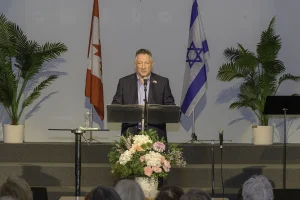
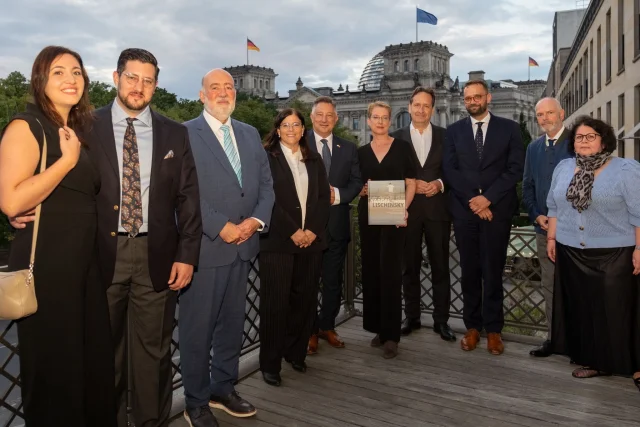
Glimpses from the Life of a Peacemaker is a collection of photographs and reflections Lischinsky shared on social media, alongside six essays from those who knew him. Tuesday's book launch in Berlin, Germany, brought together Lischinsky’s family and friends, Israel’s ambassador to Germany, the World Jewish Congress and the American Jewish Committee.
“Yaron believed in everything his murderers despise: a better future for all, reconciliation and peace,” Ambassador Ron Prosor said, reflecting on the event in a post on 𝕏.
Last night, together with the World Jewish Congress and the American Jewish Committee, we presented a book of Yaron Lischinsky’s photographs in his memory. I had the privilege of teaching him as his professor in international relations and later — because of his outstanding… pic.twitter.com/tdMcuMJXMJ
— Ambassador Ron Prosor (@Ron_Prosor) September 2, 2026
A modern-day peacemaker
What others may have seen in Lischinsky professionally, his family had long seen on a personal level.
While his role as a research assistant at the Israeli embassy was connected to diplomacy and peace, that wasn’t what inspired the book’s title. Lischinsky's brother, Hanan Lischinsky, news desk manager at ALL ISRAEL NEWS, said the title emerged in the process, as those closest to his brother reflected on a pattern that had run through his life.
“He always was unconsciously a peacemaker,” Hanan reflected. “Even between us siblings – we are five siblings – he was always the one who liked fighting the least. He always tried to prevent fights.”
The Abraham Accords were especially meaningful to Lischinsky.
“He was very passionate about the Abraham Accords. He was very proud to meet the representatives of other Middle Eastern nations, of Israel’s neighbors,” adding that Lischinsky was looking forward to renewed normalization talks with Saudi Arabia.
That outlook would also have extended to current negotiations with Lebanon in Rome, work that falls directly within Lischinsky’s department at the embassy.
“It’s his exact department,” Hanan said, noting that Lischinsky’s boss, with whom he worked closely, is among those leading the negotiations. “He would have been very excited about this. He would have been involved in it.”
Still, he emphasized that Lischinsky’s approach to peace was not naïve.
“He wasn’t a hippie. He wasn’t blindly following peace,” Hanan said, explaining that Yaron believed Israel would have opportunities to pursue normalization with Saudi Arabia, Lebanon and Syria.
Turning Lischinsky’s thoughts and photographs into ‘his book’
The idea for the book came shortly after Lischinsky’s murder.
Lina Eisenberg-Dvir met Lischinsky in Jerusalem in 2021 when he joined an Israeli-German youth organization she co-founded with her husband. The connection grew into a close friendship.
After his murder, she found herself scrolling through his social media as she struggled to process the news.
“I tried to take my mind off it by scrolling through his social media,” she recalled.
Lina described Lischinsky as having a “special sense of aesthetics" and “great passion” for photography.
“With his camera he often saw things that remained hidden from others,” she said, adding that he had a talent for accompanying his posts with quotes or with biblical verses. That’s when the idea came to her: “I knew we had to publish it – in whatever form.”
The family was in no state to begin a memorial project themselves, Hanan said, but they were touched by the idea.
“The basis of the book is what he himself chose to upload on Instagram,” Hanan said. “We’re saying we are the editors, but the author really is Yaron.”
For Eisenberg-Dvir, that distinction is essential.
“The way he speaks through this book is simply breathtaking,” she said. “That’s why this book isn’t a ‘commemoration book to Yaron’ – it’s Yaron’s book. He is the author.”
“I believe he also somehow understood the beauty he captured through his camera on a spiritual level—in the sense that God’s hand is present in all of what surrounds us,” Eisenberg-Dvir said. “I hope that his book inspires people to carry forward the thoughts he shared with them.”
“He always had some kind of artistic way of expressing himself,” Hanan agreed. “Photography was the last expression of this in his life.”
Beyond Jerusalem streets, D.C. architecture and moments at the White House, Lischinsky’s photography often captured someone especially important to him: Sarah.
Yaron and Sarah, remembered together
Lischinsky and Milgrim were murdered together shortly before they were expected to become engaged. Hanan said remembering Sarah was inseparable from honoring his brother.
“I think in a way, it’s also honoring Yaron’s decision – of Sarah, of their future together,” he said. “It’s also a way of honoring Sarah herself, Sarah’s family.”
For Eisenberg-Dvir, the book’s final photograph of the couple speaks volumes.
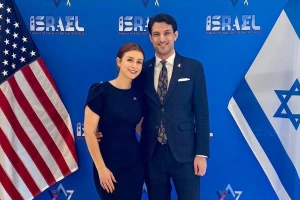
“What moves me the most is probably looking into Yaron and Sarah’s eyes in the last photo,” Eisenberg-Dvir said. “They´re so full of joy… That’s when I realize how terribly incomprehensible their murder still is to me.”
‘Terror will not win’
Prosor, who once taught Lischinsky international relations, said his murder showed the reach of antisemitism.
“The fact that Yaron was murdered in the U.S. capital, the only country outside Israel where we had long felt safe, shows just how dangerous the world has become for us,” he said.
Lischinsky’s father has increasingly been speaking with Christian audiences about antisemitism, Judaism and Israel.
“My father has really gone into this space of talking about antisemitism, to Christians specifically,” Hanan said, describing it as a typical Israeli response. “Terror will not win. We will not be defeated by something like this. We’re not going to just sit back and take it.”
Hanan said he has been deeply moved by the initiatives others have undertaken to honor Lischinsky, including the book, a plaque at his former school in Germany, and efforts to rename a street currently named after a Nazi figure.
“If you want to help someone who has lost someone, it’s such a good thing to do: to come to them with a project,” he said.
After tragedy, he explained, families may lack the energy or creativity to start a memorial initiative at the risk of being left without “something tangible to hold onto.” Someone else stepping forward can make the difference.
For Lischinsky’s family, Glimpses from the Life of a Peacemaker became exactly that: a tangible legacy that allows Lischinsky’s own photographs and words to continue speaking for him.
Please take a moment to join believers worldwide praying for Israel right now. Add your light to the live prayer map—and show the world one more watchman praying for the peace of Jerusalem.

You might also like to read this: