









PM Netanyahu suffers another political setback as Dobronsky drops bid for Knesset seat
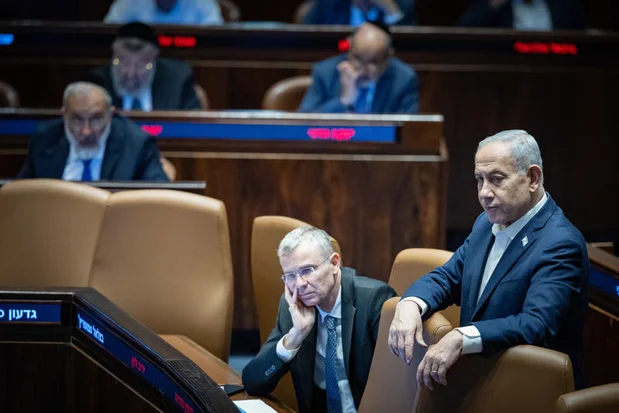
Israeli Prime Minister Benjamin Netanyahu suffered another setback on Tuesday as tech entrepreneur Oren Dobronsky announced that he was giving up a reserved spot on the Likud’s Knesset slate, saying he preferred to serve as a professional minister rather than as a member of the Knesset.
Dobronsky, whom Netanyahu had selected for a reserved spot in the top portion of the Likud slate, announced his decision in a Facebook post overnight between Monday and Tuesday. He said he had agreed with Netanyahu to serve as a professional minister responsible for artificial intelligence if a Netanyahu-led government is formed, rather than run for the Knesset.
“The prime minister asked me two months ago to join the Likud team in the coming elections, and that is what will happen,” Dobronsky wrote in the post on Facebook.
“The prime minister offered me the position of minister for AI affairs and a reserved spot in the top 10 of the list. Nevertheless, I preferred to serve only as a professional minister, where I can contribute the most from my experience, and not to be on the list itself as a member of Knesset, and that is what we agreed,” he explained.
Looking ahead, Dobronsky said he plans to continue working with Netanyahu and the Likud Party on artificial intelligence policy.
“I intend to work hand in hand with Prime Minister Netanyahu, as part of the Likud team, to make sure that the State of Israel becomes an AI superpower.”
Dobronsky’s decision comes as Netanyahu faces mounting pressure to finalize the Likud slate ahead of Tuesday night’s deadline for submitting party lists. The Likud has been embroiled in an internal dispute over Netanyahu’s reserved slots, with the party’s internal court intervening after Netanyahu missed a Monday night deadline to publish the names of his preferred candidates.
The withdrawal also leaves Netanyahu with more reserved slots to fill as he seeks to shape the Likud slate ahead of the Oct. 27 Knesset elections. Other candidates have also reportedly declined offers to join the slate, although the reasons have varied.
An internal maneuver by the Likud Party secretariat to try and force Netanyahu to proceed with the process was harshly criticized by close Netanyahu ally Ilan Bombach, Likud’s legal adviser, who said, “Only 115 minutes were allocated to study a petition consisting of dozens of pages and appendices, receive instructions, establish the facts, formulate a position and submit a legal response. This was despite the fact that, as far as the respondent knows, the petition itself had already been submitted at around 12 p.m.”
“The situation is particularly serious because the decision was issued ex parte, without first requesting the respondent’s position and even created a new operative outcome regarding the voting mechanism in the Secretariat. This response is therefore being submitted under protest, solely out of caution, and without exhausting the respondent’s arguments or waiving any procedural or substantive claim,” Bombach said.
The dispute has fueled tensions among Likud lawyers, operatives and activists as the party works to finalize its slate. The internal battle comes as Netanyahu faces a broader political challenge from opposition figures, including former IDF Chief of Staff Gadi Eisenkot, who is running independently ahead of the election.
Netanyahu is also facing renewed scrutiny over his handling of the Oct. 7, 2023, Hamas massacre following revelations reported on Tuesday that he had received intelligence from the United Arab Emirates about a possible Hamas attack days before the assault.
The reports come just days after Netanyahu faced criticism over his claim that security officials did not wake him on the morning of Oct. 7 until hours after the attack began.
The Prime Minister’s Office subsequently released a minute-by-minute account showing that Netanyahu received his first update about the attack at 6:29 a.m. and spoke with his military secretary again at 6:44 a.m.
Popular article:
interview Easter message of resurrection hope amid war at Jerusalem's Garden Tomb

biblical commentary Let my people go: a Passover message for today

4 IDF soldiers killed, 2 wounded in fighting in southern Lebanon, as Israel eliminates dozens of Hezbollah terrorists

Receive latest news & updates
A message from All Israel News
Help us educate Christians on a daily basis about what is happening in Israel & the Middle East and why it matters.
For as little as $10, you can support ALL ISRAEL NEWS, a non-profit media organization that is supported by readers like you.
Latest articles:

North American Jewish organizations to recruit 100 professionals to combat antisemitism

‘No need’ for pre-election Iran strike, IDF chief says as gov’t, opposition trade blame for potential escalation – report

terror attack 2 Israeli soldiers killed, 2 terrorists eliminated in Hebron shooting; IDF says much larger attack was prevented

analysis A people dwelling securely? Israel’s strategic standing, 3 years after Oct 7

Hamas on wheels: What I found in Dearborn reveals a troubling history and a battle over Israel