







Western immigrants leading large surge in aliyah to Israel
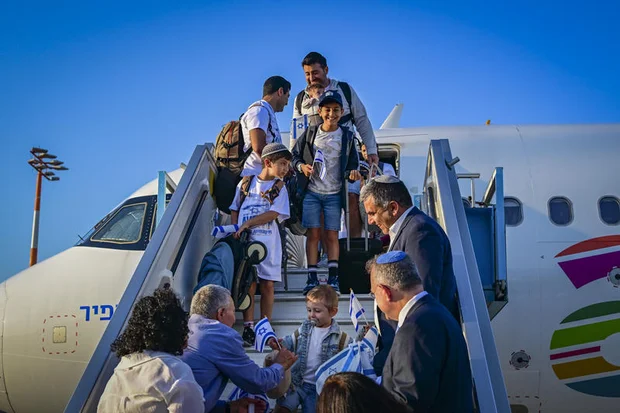
More than 20,000 Jewish people from more than 100 countries made aliyah (Jewish immigration) to Israel over the past Hebrew calendar year, with immigrants from Western countries accounting for a growing share of the newcomers, according to a new report released ahead of Rosh Hashanah by Israel’s Aliyah and Integration Ministry and the Jewish Agency for Israel.
The report also found historically high numbers of Jews in Western countries taking steps toward making aliyah, suggesting that the trend of immigration from countries such as the United States, France, Britain, Australia and Canada could continue to grow.
“More than 20,000 new immigrants are celebrating their first Rosh Hashanah at home, in the State of Israel,” Aliyah and Integration Minister Ofir Sofer said. “Precisely in a complex and challenging year, the choice to make aliyah and build a future here is a powerful Zionist and national statement. The trend of aliyah from Western countries is expected to continue and strengthen, and this is a national opportunity that the State of Israel cannot afford to miss.”
According to the report, the largest numbers of new immigrants came from Russia, France and the United States. A total of 5,685 immigrants came from Russia, 4,364 from France and 3,333 from the United States.
Other notable contingents included 975 new immigrants from Great Britain, 797 from Ukraine, 491 from Belarus, 440 from Canada, 247 from Australia, 243 from Argentina, 241 from Georgia, 210 each from Germany and South Africa and 200 from Brazil.
While the number of people who completed the aliyah process remains significant, the report also highlighted the growing number of Jews beginning the process by opening files with the Jewish Agency’s Global Aliyah Center in Jerusalem.
In 2025, most new aliyah files continued to be opened by Jewish citizens of Western countries. Australia saw an 89.7% increase in files opened, while Britain saw a 68% increase. France recorded a 31.5% increase and the United States a 17.1% increase. Canada saw a 10.7% increase, while South Africa recorded a 14.3% increase.
The report cautioned, however, that opening an aliyah file does not necessarily mean that a person will ultimately move to Israel.
Tel Aviv absorbed the largest number of new immigrants over the past year, with 2,762 newcomers, followed by Netanya with 2,224, Jerusalem with 2,134, Haifa with 1,504 and Ra’anana with 1,042.
The profile of the new immigrants was also notable. Almost two-thirds were under 35, with nearly half of that group under 18.
Younger immigrants are generally better positioned to adapt to Israel’s culture and economy and to learn Hebrew, making language instruction and other preparation an important part of the aliyah process.
The Jewish Agency and other organizations that assist with aliyah therefore offer Hebrew and other preparatory classes to potential immigrants in their countries of origin before they arrive in Israel. These programs are often presented at public events designed to encourage and prepare Jews interested in making aliyah, with dozens of such events held in cities worldwide in 2025.
Housing and employment are also key challenges for new immigrants. Programs have been established to help professionals fast-track their Israeli licensing, an especially important issue in the healthcare sector, where Israel has a chronic shortage of doctors, nurses and pharmacists.
Israeli government ministries and agencies have adopted a range of reforms in recent years to make it easier for qualified professionals to integrate into the Israeli workforce, while aliyah organizations continue to support new immigrants as they establish their lives in the country.

Please take a moment and join others who are praying for Israel at this very moment by adding your light on the live prayer map with a simple click at prayforisrael.live.
Popular article:
interview Easter message of resurrection hope amid war at Jerusalem's Garden Tomb

biblical commentary Let my people go: a Passover message for today

4 IDF soldiers killed, 2 wounded in fighting in southern Lebanon, as Israel eliminates dozens of Hezbollah terrorists

Receive latest news & updates
A message from All Israel News
Help us educate Christians on a daily basis about what is happening in Israel & the Middle East and why it matters.
For as little as $10, you can support ALL ISRAEL NEWS, a non-profit media organization that is supported by readers like you.
Latest articles:
North American Jewish organizations to recruit 100 professionals to combat antisemitism

‘No need’ for pre-election Iran strike, IDF chief says as gov’t, opposition trade blame for potential escalation – report

terror attack 2 Israelis critically wounded, 2 terrorists killed in Hebron shooting; IDF says larger attack was prevented

analysis A people dwelling securely? Israel’s strategic standing, 3 years after Oct 7

Hamas on wheels: What I found in Dearborn reveals a troubling history and a battle over Israel