UN & human rights groups are silent as Iranian regime blasts Israeli civilians with cluster munitions
Human Rights Watch, which has often highlighted illegal use of cluster munitions, has been silent





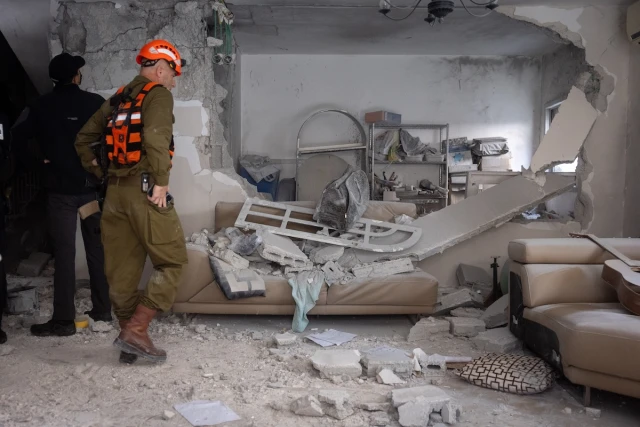
In recent days, the Iranian regime has markedly stepped up the use of ballistic missiles with cluster munition warheads against Israeli population centers. Cluster munitions are widely banned for being inherently indiscriminate.
However, rather than an international outcry, there has been a deafening silence among UN organizations and NGOs, who are usually quick to identify ostensible "war crimes" by Israel, despite attempts by the IDF and Israel’s Foreign Ministry to draw attention to the attacks on Israeli civilians.
“The Iranian regime targets civilians on purpose,” the ministry wrote in a recent post on 𝕏. “Iran is using cluster warhead missiles that explode mid-air and scatter explosives across a wide area. These weapons aren’t designed for precision. The Iranian Regime is using them to kill as many civilians as possible.”
Cluster munitions fired towards civilians by the Iranian regime, moments before striking Israel.
— Israel Foreign Ministry (@IsraelMFA) March 12, 2026
The Iranian regime continues its attempts to hit as many civilians as possible.
This is who the Iranian regime targets: civilians. pic.twitter.com/1HyyUdsp7e
The Jerusalem-based NGO Monitor on Sunday highlighted the suspicious silence from Human Rights Watch (HRW), which has been quick to condemn Israel for ostensible violations of international law, and has often condemned the use of cluster munitions in other instances in the past.
“The org regularly calls for a ‘global ban on cluster munitions,'” NGO Monitor President Gerald Steinberg told the Jewish News Syndicate (JNS).
.@HRW has spent years campaigning against cluster munitions: publishing reports, lobbying gov't, & supporting an int'l treaty.
— NGO Monitor (@NGOmonitor) March 15, 2026
But when Iran uses cluster munitions against 🇮🇱 civilians, @HRW has has been silent.
🧵Some facts about HRW’s double standard on cluster munitions. >> pic.twitter.com/lFKKjKdWr2
“HRW’s deafening silence on Iran’s targeting of Israeli civilians with cluster munitions highlights their hypocrisy.”
“Human rights are only important when they can be weaponized to demonize the Jewish state. HRW’s highly selective version of international law exposes the immoral objectives behind the principled facade,” Steinberg said.
Coverage by some major media outlets has not fared much better.
Update from CENTCOM Commander on Operation Epic Fury: pic.twitter.com/oGJ3QJBz5o
— U.S. Central Command (@CENTCOM) March 16, 2026
Rather than focusing on Iran’s tactics, The New York Times framed U.S. Central Command Adm. Brad Cooper’s criticism of Iran’s strikes as another opportunity to critique the Trump administration’s stance, headlining the article, “Admiral’s Comments Undercut Pentagon’s Cluster Munition Policy.”
Cooper stressed that the warheads that spread cluster munitions over a broad area are “an inherently indiscriminate type of munition.”
Cluster bombs: What they are, why they’re extremely dangerous, and what people in Israel need to know right now: pic.twitter.com/WkRiW8XCbi
— LTC Nadav Shoshani (@LTC_Shoshani) March 16, 2026
“We join countries across the region in condemning this aggression,” he added.
The article’s author, NYT journalist John Ismay, continued by noting, “The first Trump administration, however, defended the use of cluster munitions in a policy that remains in effect today.”
Cluster munitions are not banned per se. Under international humanitarian law, their use is allowed, given certain restrictions, such as a strict distinction between civilian and military targets.
The Iranian regime is firing cluster bombs at Israeli civilians.
— Israel Foreign Ministry (@IsraelMFA) March 10, 2026
Their deliberate and repeated use against civilians shows that the Iranian terror regime is seeking to maximize civilian deaths and harm. pic.twitter.com/loN4vC5gwx
Israel, Iran, the U.S., as well as Russia and China, are not party to the 2010 Convention on Cluster Munitions, which bans the use of these munitions for member states.
A potentially lawful use of the munitions came in the last known instance they were used by U.S. troops, when warships launched Tomahawk cruise missiles with explosive cluster warheads at al-Qaeda camps in Yemen. In this case, the spread of the submunitions serves to kill hostile forces in a large geographic area, like a military camp.
In past years, both the first Trump administration and the Biden administration sent large shipments of older cluster munitions to Ukraine for use in the war against Russia.
The Iranian regime targets civilians on purpose.
— Israel Foreign Ministry (@IsraelMFA) March 4, 2026
Iran is using cluster warhead missiles that explode mid-air and scatter explosives across a wide area.
These weapons aren’t designed for precision.
The Iranian Regime is using them to kill as many civilians as possible. pic.twitter.com/2z2Sniu2xn
On the one hand, intercepting the cluster munitions has posed a challenge for Israeli air defenses; on the other hand, the smaller sub-munitions are less dangerous than the conventional warheads that can weigh a ton.
Most of Iran’s ballistic missiles with cluster warheads carry about 24 submunitions, each typically weighing around one-and-a-half kilograms.
When the missile approaches its target, the warhead opens, spreading the submunitions over a large radius. Israel’s long-range anti-missile systems are designed to intercept the entire missile at a greater height, while the short-range systems like Iron Dome often don’t have enough time to intercept each of the bomblets, or are overwhelmed by their number.
IRANIAN REGIME BOMBS ISRAELI SCHOOL
— Israel War Room (@IsraelWarRoom) March 13, 2026
Security camera footage shows a cluster bomb from an Iranian ballistic missile falling inside a school in central Israel this evening.
Thankfully, the school was empty. pic.twitter.com/dikvUtf0Af
Sometimes, the interceptor manages to hit the main missile, but if it doesn’t precisely hit the warhead, the submunitions can still be released.
A recent CNN analysis of two separate cluster munition attacks found that the impacts were spread out across an area of seven and eight miles, respectively.
Breaking:‼️
— LTC Nadav Shoshani (@LTC_Shoshani) February 28, 2026
Iran intentionally fired missiles that contained cluster sub-munitions at a densely populated civilian area in Israel. Cluster weapons are designed to disperse over a large area and maximize the chances of a harmful strike. Iran goes to great lengths in trying to… pic.twitter.com/tgtYJ7M8dU
However, their explosions are much less forceful. Taken together with the curious fact that most of these attacks have come at night, when most Israelis are close to their home-base shelter, they have so far not caused many casualties and relatively slight damage.
Nevertheless, the explosion of a submunition last week killed two construction workers, who were not protected by a shelter at the time.
Another challenge posed by the cluster warheads is the fact that often, a certain percentage of the submunitions don’t explode immediately, leaving behind explosives that can go off much later, and necessitating intensive scans of a large area to rule out the danger.
Want to help more people find our reporting from Israel? Leave a quick Google review of our website HERE .
You might also like to read this: