








As Iran increases use of cluster munitions against Israel, legal debate intensifies
Neither Israel nor Iran is a signatory to the 2008 Convention on Cluster Munitions
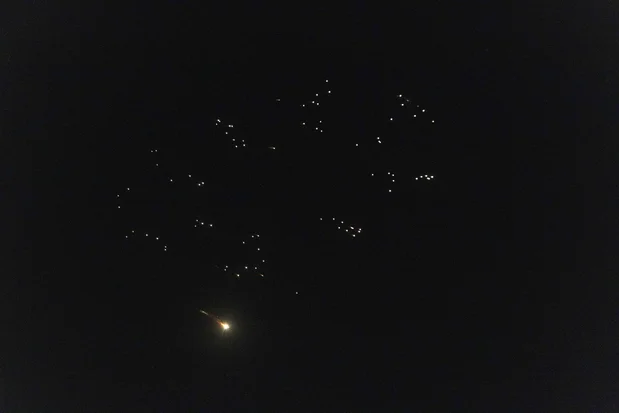
The IDF Home Front Command announced on Tuesday that 50% of the ballistic missiles launched by Iran in the current war have contained cluster munition warheads.
The large-scale use of cluster munitions represents a shift from its strategy during the 12-day Israel-Iran war last June, when the regime launched only a few such missiles.
Previously, the Islamic Republic launched missiles with warheads ranging from 500-1,000 kgs (1,100-2,200 lbs), intended to devastate a single target. The cluster warheads, being used more frequently in recent days, contain dozens of explosive munitions, which can spread out over a radius of around 10 kilometers (6 miles).
These cause less damage upon impact, but often split before interception, meaning they have a higher impact rate.
The use of such munitions could represent an attempt to increase the civilian casualty rate to create pressure on the Israeli government to end the war sooner.
The Iranian regime is firing cluster bombs at Israeli civilians.
— Israel Foreign Ministry (@IsraelMFA) March 10, 2026
Their deliberate and repeated use against civilians shows that the Iranian terror regime is seeking to maximize civilian deaths and harm. pic.twitter.com/loN4vC5gwx
"The cluster munitions will not do a great deal of structural damage or penetrate proper bomb shelters. However, they are hard to stop, and they are very dangerous to soft targets and civilians," James Devine, an associate professor in the Department of Politics and International Relations at Mount Allison University, told Business Insider.
"I doubt they will be a game-changer, but they will increase the political pressure on the US and Israel."
However, the use of such cluster munitions has drawn condemnation from the Israeli government and many Israel-supporters, who say the usage violates international law.
AGPI: International law (2010) prohibits cluster munitions, bans its use, development, production, acquisition, stockpiling, and transfer. 50% of ballistic missiles fired at Israel by Iran contain cluster bomblets. Yesterday, two people were killed when a cluster bomb munition… pic.twitter.com/RtAsoEuy2Y
— Avi Abraham Benlolo (@AviBenlolo) March 10, 2026
Some commentators have noted that neither Israel nor Iran is a signatory to the 2008 Convention on Cluster Munitions, so neither is legally bound by the treaty’s ban on those weapons.
Israel and Iran are not the only countries to avoid signing the convention. The United States, Russia, China, India, and Turkey have also chosen not to sign the convention, recognizing that cluster munitions are effective in certain tactical situations, when targets are spread over a larger area than single warhead munitions can effectively target.
Nevertheless, using these weapons against civilians is prohibited under international humanitarian law and constitutes a war crime. To determine whether the use of such a weapon falls into the category of "war crime," experts consider the principles of distinction and proportionality.
The party firing the weapon is required to distinguish between legitimate military targets and civilian targets, while the choice of the weapon and target should be weighed against the expected civilian harm.
This means that indiscriminate attacks in areas with a high civilian population, or even deliberately firing cluster munitions at residential areas, would be considered a war crime.
Popular article:

interview Easter message of resurrection hope amid war at Jerusalem's Garden Tomb

biblical commentary Let my people go: a Passover message for today
4 IDF soldiers killed, 2 wounded in fighting in southern Lebanon, as Israel eliminates dozens of Hezbollah terrorists

Receive latest news & updates
A message from All Israel News
Help us educate Christians on a daily basis about what is happening in Israel & the Middle East and why it matters.
For as little as $10, you can support ALL ISRAEL NEWS, a non-profit media organization that is supported by readers like you.
Latest articles:
North American Jewish organizations to recruit 100 professionals to combat antisemitism

‘No need’ for pre-election Iran strike, IDF chief says as gov’t, opposition trade blame for potential escalation – report
terror attack 2 Israelis critically wounded, 2 terrorists killed in Hebron shooting; IDF says larger attack was prevented
analysis A people dwelling securely? Israel’s strategic standing, 3 years after Oct 7
Hamas on wheels: What I found in Dearborn reveals a troubling history and a battle over Israel