Oil prices surge after Iranian attacks on facilities in Gulf states, fears of extended war
Despite attacks, Iranian FM Araghchi says ‘relations are good with Persian Gulf states’



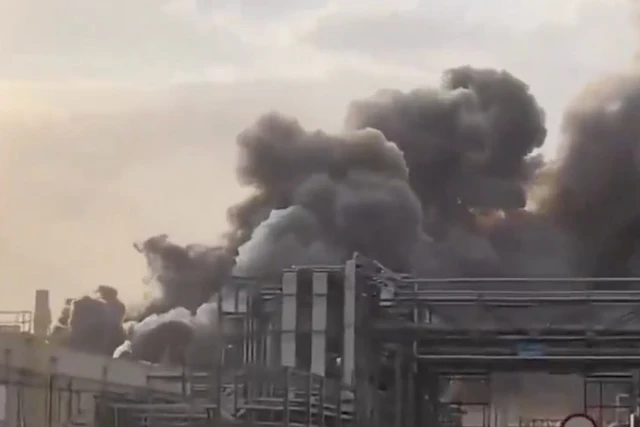
Oil prices climbed as market trading began late on Sunday after the Iranian regime responded to strikes by the U.S. and Israel with attacks on oil facilities in the Gulf states and threats to close the Hormuz Strait.
Fears of an all-out war were fueled further by statements from Iranian President Masoud Pezeshkian, who said on Sunday that the killing of Ayatollah Ali Khamenei by the U.S. and Israel constitutes “an open declaration of war against Muslims.”
“The assassination of the highest political authority of the Islamic Republic of Iran and a prominent leader of Shiism worldwide… is perceived as an open declaration of war against Muslims, and particularly against Shiites, everywhere in the world,” Pezeshkian said in a statement aired on Iranian state TV.
“The Islamic Republic of Iran considers it its legitimate duty and right to avenge the perpetrators and masterminds of this historic crime,” he added.
Brent crude oil, the international standard, hit $79.40 per barrel on Monday morning, a 52-week high. WTI, the US benchmark, climbed by 8% to $73 a barrel, while Dutch natural gas, the European benchmark, surged 23%.
The military action carried out by the U.S. and Israel has brought a renewed focus on global oil supplies, as Iran is a significant oil producer and the Gulf nations, taken together, hold the world's largest reserves.
Oil markets are preparing for sharp spikes following U.S. President Donald Trump’s announcement that the military operation would continue until all objectives are achieved.
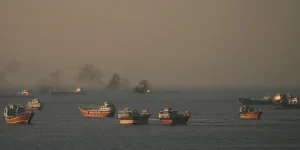
Another area of significant concern is a possible closure of the Strait of Hormuz by the Islamic Republic’s naval units, or through the use of mines. Traffic there has come to a near standstill following attacks on three oil tankers over the weekend. Several major shipping companies announced they were halting traffic through the strait following the attacks.
A prolonged disruption of traffic through the strait, which carries about 20% of global oil and liquid gas traffic, could lead oil prices to spike above $100 per barrel, leading to further economic woes in many parts of the world.
Traders appear to be anticipating that the supply of oil from Iran and elsewhere in the region could slow significantly over the coming days.
Amrita Sen, founder and director of research at Energy Aspects, told CNBC that she expects oil prices to remain around $80 per barrel for some time, as the conflict continues.
She also stated that while she believes the U.S. and Israel have sufficient military assets in place to prevent a total blockade of the Strait of Hormuz, the real danger is likely the targeting of individual ships, as happened over the weekend.
“This is something we’ve warned right throughout to our clients,” she told CNBC.
On Monday morning, Saudi Arabia’s state-owned Aramco shut its Ras Tanura refinery following an Iranian drone strike. While the fire from the strike was quickly contained, according to reports, the company decided to temporarily close the plant as a precaution.
JUST IN :
— GeoPulse Analysis (@a8d_moh) March 2, 2026
Saudi Arabia's Aramco oil refinery following Iranian strike pic.twitter.com/q501pf5c8v
The facility is one of the largest oil export terminals in the world, and the shutdown is likely to have an impact on oil prices. The strike is reminiscent of the 2019 strikes on Aramco’s Abqaiq processing facility and Khurais oil field, which led to a halving of the Saudi oil output over a couple weeks.
The drone attack came after eight countries in OPEC+ announced on Sunday that they would increase production of crude oil in response to the disruption caused by the start of the conflict.
On Monday afternoon, the Qatari Ministry of Defense announced that an Iranian drone had targeted QatarEnergy facilities, leading to the halt of liquefied natural gas production at the Ras Laffan plant.
— وزارة الدفاع - دولة قطر (@MOD_Qatar) March 2, 2026
The attacks indicate that Iran is targeting critical infrastructure and energy-export facilities in the Gulf as part of an asymmetric warfare strategy. They also contradict statements by Iranian leaders, such as Foreign Minister Abbas Araghchi, who told Qatar’s Al Jazeera that the Islamic Republic was not targeting its Arab neighbors, but was only retaliating against the U.S. facilities in those nations.
“Our relations are good with the countries on the other side of the Persian Gulf and we have no problems with them,” he claimed.
He also tried to distance the regime government from the strikes, saying, “We have already told our Armed Forces to be careful about the targets they choose. Our military units are now, in fact, independent and somewhat isolated, and they are acting based on general instructions given to them in advance.”
You might also like to read this: