Boeing teams with Israeli Technion to develop low-carbon jet fuel





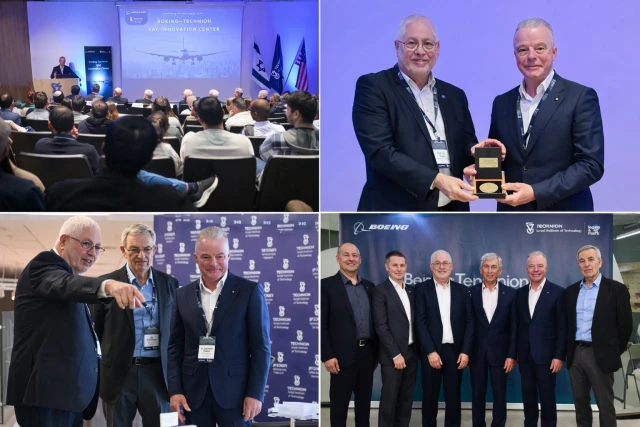
American aircraft giant Boeing has decided to partner with Israel’s Technion to develop a low-carbon jet fuel known as sustainable aviation fuel (SAF). The overall aim of the cooperation is to reduce greenhouse gas emissions while simultaneously addressing the air industry’s need for cost-effective energy needs. Boeing has earmarked millions of dollars for the project for the next three years.
Located in the northern Israeli city of Haifa, the Technion Israel Institute of Technology has often been compared to the Massachusetts Institute of Technology (MIT) in the United States.
Dr. Brendan Nelson, president of Boeing Global, praised its Israeli partner, the Technion.
“If there is one country in the world capable of solving civil aviation’s emissions challenge, it is Israel, led by the Technion – the Israeli MIT,” Nelson stated during a visit last week. “We are pleased to partner with Technion and other stakeholders in the SAF Innovation Center to support Israel’s aerospace industry."
Technion President Prof. Uri Sivan welcomed the strategic cooperation with Boeing as a “historic collaboration of national importance” for Israel’s economy, energy, civil aviation and security.
“Through this collaboration, Technion experts are taking on a tremendous mission: to develop technologies for producing clean fuels through sustainable processes, thereby making a significant contribution to aviation – and no less importantly, to human health and the environment,” Sivan stated.
Boeing has set a strategic goal that all its commercial airplanes will be flying on only SAF by 2030. Sustainable aviation fuel can reportedly reduce carbon emission by up to 80% compared to current jet fuels. Boeing’s goal is ambitious because SAF constituted only 0.6% of the global aviation industry’s total jet consumption in 2025.
Boeing Israel President Maj. Gen. (res.) Ido Nehushtan who is a retired Israel Air Force commander, predicted that the cooperation between Boeing and the Technion would boost the development of advanced technologies in Israel that could in the longer-term be incorporated into new aerospace systems.
“Israeli industries are now leading suppliers to Boeing, and many Israeli systems integrated into Boeing products worldwide generate hundreds of millions of dollars annually,” the senior Boeing official stated.
Prof. Gidi Grader of the Technion’s Wolfson Faculty of Chemical Engineering, spoke to The Times of Israel news outlet about the challenges and developments in the industry.
“We undertook the challenge to start from CO₂ and hydrogen as we envision that in the future, the cost of green hydrogen is going to come down, just as the cost of a solar cell came down by orders of magnitude over the last 20 years,” Grader explained. “It is also the best raw material for large-scale production, which eventually will be needed, not in the short term, but in 25 years."
“In the coming three years, we are planning to establish the operation of an experimental fuel-testing facility at the Technion, which will be only the second of its kind in the world,” he revealed.
“It’s a fantastic opportunity to develop a technology that, if successful, could be implemented in a dispersed way and can be exported,” Grader concluded.
In November, the Technion reaffirmed its ties with Cornell Tech after New York’s new anti-Israel mayor Zohran Mamdani had threatened during the election to cut cooperation with Israeli institutions.
You might also like to read this: