Ancient 'Mount of Olives' lamp with Jewish Temple symbols discovered in Jerusalem
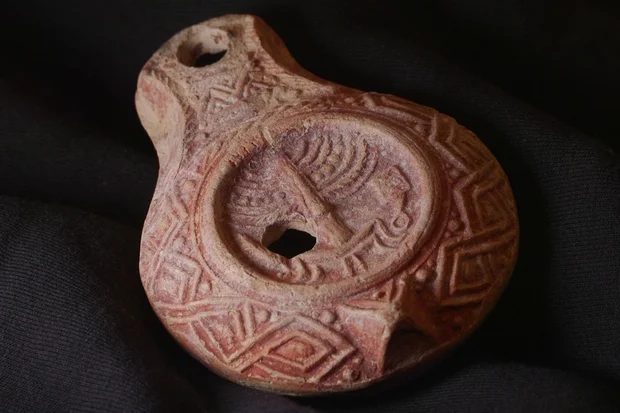
A rare 1,700-year-old lamp with Jewish Temple symbols has been uncovered in Jerusalem, the Israel Antiquities Authority (IAA) announced on Thursday.
Excavation Director Michael Chernin explained the importance of the ancient artifact he referred to as the Mount of Olives lamp.
"After the Roman Emperor Hadrian suppressed the Bar Kockba rebellion in 135 C.E., Jews were expelled from the city. The Mount of Olives lamp is one of the few material traces of a Jewish presence around Jerusalem in the 3rd-5th centuries C.E.," Chernin said.
"The exquisite artistic workmanship of the lamp, which was found complete, makes it outstanding and extremely rare,” he continued.
Chernin said the discovery of the ancient artifact is "particularly surprising,” acknowledging that there is "very little evidence of the existence of a Jewish settlement in and around Jerusalem from this period."
Benjamin Storchan, an IAA research archaeologist, assessed that the ancient lamp is of "the 'Beit Nattif' type, named after a production workshop identified in the 1930s near Bet Shemesh," a town west of Jerusalem.
Storchan further explained that "oil lamps with menorah decorations are exceedingly rare, and only a few similar Beit Nattif-type lamps can be found in the National Treasures archive. The choice of symbols on the lamp is not accidental. This is a fascinating testimony connecting everyday objects and faiths among ancient Jerusalem’s inhabitants. It seems that the lamp belonged to a Jew, who purchased it because of its religious affiliation and memorial to the Temple.”
"It is evident that the lamp maker dedicated a great deal of time and effort to its decoration," he added.
Storchan concluded by highlighting the level of refinement behind the production of the ancient lamp.
"The molds were made in two parts (upper and lower). To create the lamp, the potter pressed the clay into the molds and then pressed them together. Finally, the vessel was fired, and it could be used. This method of producing lamps in molds allowed for refined designs, as well as the addition of delicate and intricate decorations," he said.
Israeli Heritage Minister Rabbi Amichai Eliyahu welcomed the discovery of the ancient lamp, linking it to the Jewish holiday of Hanukkah.
"This unique oil lamp, which in an exciting manner bears the symbols of the Temple, connects the lights of the past with the Hannukah holiday of today and expresses the deep and long-standing connection of the nation of Israel to its heritage and to the Temple’s memory,” Eliyahu stated.
The Holy Land is, despite its compact size, filled with archaeological treasures from various periods. This is attributed to its long and complex history and its geographical position at the intersection between Asia, Africa and Europe.
Israeli archaeologists recently discovered an ancient Jewish oil lamp dating back to the 4th-6th centuries at the Zippori National Park in Israel’s northern Galilee region. The sites are linked to the life of Jesus and early Christianity.
Popular article:

interview Easter message of resurrection hope amid war at Jerusalem's Garden Tomb

biblical commentary Let my people go: a Passover message for today

4 IDF soldiers killed, 2 wounded in fighting in southern Lebanon, as Israel eliminates dozens of Hezbollah terrorists

Receive latest news & updates
A message from All Israel News
Help us educate Christians on a daily basis about what is happening in Israel & the Middle East and why it matters.
For as little as $10, you can support ALL ISRAEL NEWS, a non-profit media organization that is supported by readers like you.
Latest articles:

1969 Dutch Eurovision winner Lenny Kuhr moves to Israel – cites antisemitism, family ties

Israel bars French far-left leader Mélenchon in response to France's entry ban on settlement leader

Change Bloc divided over coalition with Arab or ultra-Orthodox parties after week of negotiations

Huckabee fires back as Senate Democrats target US-Israel intelligence ties: 'Shocking!'
Israeli blood test detects early breast cancer with 95% accuracy, assesses recurrence risk