Israel’s Tel Gezer: 3,000-year-old Hebrew tablet chronicles agriculture and Canaanite history






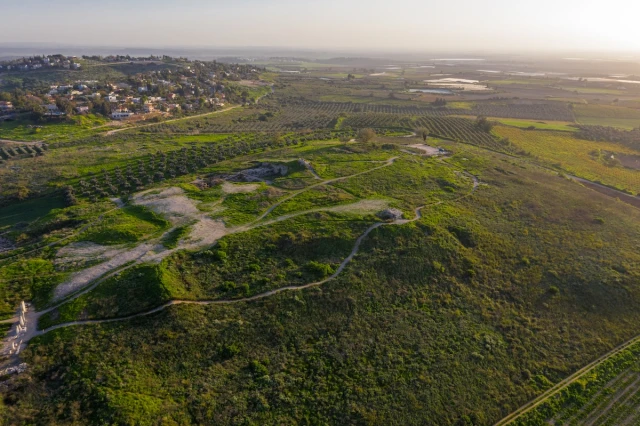
Located in the foothills of central Israel between Jerusalem and Tel Aviv, Tel Gezer is famous for an Iron Age relic found at the site known as the Gezer Calendar. Like a message in a bottle, the Gezer Calendar transports us back in time, allowing us to read words written in Israel when King Solomon was on the throne. What does the message say?
Tour guide Levi Simon shows ALL ISRAEL NEWS correspondent, Oriel Moran, around the site, starting with the Gezer Calendar.
Resembling something like a farmer’s things-to-do list, according to the translation of Seth L. Sanders, an expert in Semitic languages, the ancient inscription says:
A couple of months (yarêw, in the dual) of gathering
A couple of months of early sowing
A couple of months of late sowing
A month of making hay
A month of harvesting barley
A month of harvest and finishing
A couple of months of vine pruning
A month of summer fruit.
It is thought that, given the crude form of the letters in ancient Hebrew text, perhaps it was a writing exercise for someone learning. The name of the person who wrote it (which seems to have been written vertically) is possibly "Abi" or Abiyah.
The list includes 12 months, and historians have made educated estimations about which activity should be done in what month. At this time of year, according to best guesses, we are in the couple of months of “late sowing.”
The former rains, known as the “yoreh” in Hebrew, soften up the ground ready for the first round of planting, but in January or February, there was a second round of later planting in ancient Israel’s agricultural year. This was called the “lekesh” according to the Gezer Calendar, facilitated by later rains or “malkosh” which water the softer ground and bring a second harvest in the Spring.
The Gezer Calendar dates back to 925 B.C. and is one of the oldest known Hebrew inscriptions. “Hebrew, 3,000 years ago, would have looked something like this,” Simon explains. “This is a tablet recognizing the different agricultural periods of the year in Paleo-Hebrew – ancient Hebrew, which is closer to a Phoenician-style Canaanite Hebrew,” Simon explains. “It’s one of the oldest Hebrew texts that we have, and one of the oldest texts in the world on a tablet (and it) was found where we’re standing right now in Tel Gezer.”
However, Tel Gezer is even more ancient than its calendar, with at least a thousand years of history before Solomon got there. “We're going to see how the Canaanites lived,” Simon tells Moran.
“This is the largest Canaanite structure ever found anywhere in the world,” says Simon, explaining that the Canaanite civilization lived in the region even 4,500 years ago. A guard tower is still visible, which was used to protect the valuable water source, original mud bricks from 4,000 years ago, and a Middle Bronze Age water channel that is around 3,700 years old. The site also boasts one of the oldest gates in the world from the time of Solomon, roughly 3,000 years ago.
The Canaanites were mentioned in letters from rulers in Egypt, Anatolia, and Babylon, along with other places in the region during the Bronze Age, and of course, appear frequently in the Bible. God tells the Israelites to put an end to them with their pagan practices, like child sacrifice. However, in the Book of Joshua, we read that the Canaanites of Gezer remained living in the territory which was taken by the tribe of Ephraim:
“They did not drive out the Canaanites that were living in Gezer, so the Canaanites continued to live in the midst of Ephraim to this day, and became forced laborers” (Joshua 16:10).
“If we look just behind me over here, we can see the beautiful valley of Aijalon, where multiple battles happen,” Simon explains, saying it is the valley in which they were fighting when God stopped the sun to help His people:
“At that time Joshua spoke to the Lord in the day when the Lord gave the Amorites over to the sons of Israel, and he said in the sight of Israel, “Sun, stand still at Gibeon, and moon, in the Valley of Aijalon.” And the sun stood still, and the moon stopped, until the nation took vengeance on their enemies” (Joshua 10:12-13a).
“Tel Gezer is a strategic point based in the middle of the international trade routes going from Egypt to Mesopotamia,” Simon explained, “and we're at the foothills of the Judean mountains,” he added, noting where Solomon’s administrative center would have been.
There are also extensive remains from the Israelite period, and Simon takes Moran to what was once a classic Israelite house known as the four-roomed house. “These columns would have had cedar wood… It would have been a more rich person’s house, even though it doesn't seem massive. Most people didn't spend most of their lives inside the house,” he explains, walking through the remains, which have been partially reconstructed to give a better sense of what once stood there.
“The might and power of King Solomon can be seen before us by this triumphant gate,” Simon marvels, expounding on the importance of gatekeeping and protection in the ancient world. With Gezer being an important city, lying on the international trade route called the Via Maris, it was used to showcase Solomon’s kingdom and was a place from which covenants could be made and taxes collected.
Pointing to nine huge stones placed upright, Simon explained that the monoliths were erected to signify a covenant between nations. “This would be a bonding covenant to make sure that they would never go to war, and that they had open trade,” he says. “We are right now at a strategic and important crossroads between ancient civilizations and ancient trade routes.”
Now, thousands of years on, Israel is once again at something of a crossroads when nations are speaking of peace in the region after so much war and violence. Perhaps these great monuments to ancient agreements signify hope that peace is possible.
You might also like to read this: