Is this how a Holocaust begins?
As antisemitism surges worldwide, history’s warning signs are becoming harder to ignore
.jpg "Maayan Hoffman")



Not all genocides are carried out with gas chambers or by people wearing Nazi uniforms.
Jews around the world need to pay attention to the possibility that we are living in a “pre-Holocaust” moment and that the warning signs should not be ignored. If we fail to act now, the cost of waiting may be unbearable.
One of the clearest parallels is the vibrancy of Jewish life in the United States today and in Germany before World War II.
According to the Jewish Agency, about 7.2 million Jews live in Israel today, and many more live outside of it, including 6.3 million in the United States.
Jewish life in America began in the mid-1600s, but it did not flourish until after 1880. Waves of immigration arrived first from Germany, then from Eastern Europe, and later from Russia. Jews quickly integrated into secular society. They built communities, found opportunity, and became visible and influential across many fields. They succeeded as doctors, academics, and business leaders.
For decades, Jewish life in the Western democratic world has felt stable, accepted, and permanent. History, however, offers a sobering lesson. When Jews become too comfortable, danger is often closer than it appears.
In 1933, Europe was home to approximately 9.5 million Jews. They, too, were deeply embedded in society. They worked in respected professions, contributed to national culture, and saw themselves first and foremost as Germans, French, Poles, or Hungarians. Like many Jews today, they usually felt their national identity was stronger than their Jewish one.
Then everything began to change.
A report released this week by the Ministry of Diaspora Affairs and Combating Antisemitism found the highest levels of reported antisemitic incidents across the Western world, including in the United States, the United Kingdom, Australia, France, Canada and several European states. The United States recorded the highest number of incidents, with 273 cases documented.
That figure was more than double the number reported in the United Kingdom, where 121 incidents were recorded.
These were not minor or isolated events. While the overall number of antisemitic attacks declined slightly from 2024 to 2025, the severity of those attacks increased sharply. The ministry documented 815 severe antisemitic incidents last year, including the murder of 21 Jews. That compares with just one confirmed murder the year before.
The Bondi Beach attack in December was the deadliest incident recorded during this period, with 15 people killed. However, Australia had already suffered a series of violent antisemitic attacks leading up to the massacre. Days before the shooting, a report published by the Executive Council of Australian Jewry showed a nearly fivefold increase in attacks between 2023 and 2025, even as incidents dipped slightly between 2024 and 2025. At the same time, the report noted, “From early October 2024 to early February 2025, there were no fewer than eighteen major antisemitic incidents, including some of the most serious on record.”
The pattern has not been limited to one country.
On Wednesday, the day after International Holocaust Remembrance Day, an incident in New York occurred that had the potential to be deadly. A person intentionally drove a vehicle into the entrance of the 770 Eastern Parkway Chabad headquarters in Brooklyn. That building is often filled with hundreds, and sometimes thousands, of people.
Witnesses at the scene reported that the suspect was shouting for people to move out of the way before ramming the vehicle into the building.
Antisemitism is also becoming institutionalized.
The same Combating Antisemitism ministry report found that anti-Israel pressure is increasingly being implemented through major policy decisions, a high volume of United Nations resolutions, and the role of prominent influencers and networks in driving anti-Zionist and antisemitic narratives.
The United Nations condemned Israel more than a dozen times last year. The World Jewish Congress has repeatedly stressed that Israel is the only country subjected to a standing agenda item at the UN Human Rights Council.
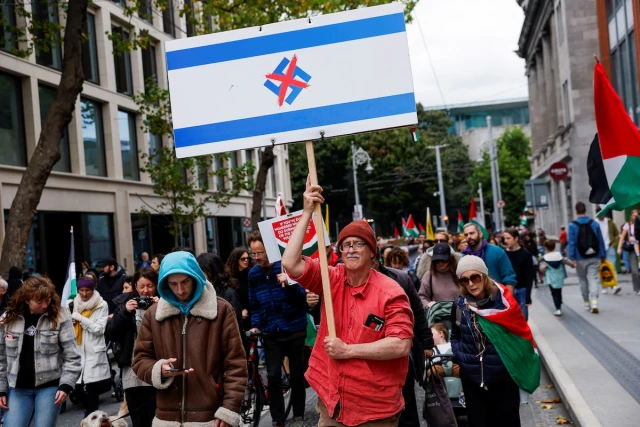
At the same time, antisemitic or anti-Zionist positions are no longer a barrier to political success, even in the United States. The election of New York Mayor Zohran Mamdani demonstrated that being openly anti-Israel was not only not a liability, but could help secure an electoral victory.
Since entering office, Mamdani has revoked several executive orders that supported Israel. He removed the city’s adoption of the International Holocaust Remembrance Alliance definition of antisemitism and eased restrictions on anti-Israel protesters.
He has also appointed pro-Palestinian activist Ramzi Kassem as his chief counsel, among other controversial selections. According to the Anti-Defamation League, at least 20% of Mamdani’s appointees have ties to anti-Zionist groups.
On the political Right, similar patterns are emerging.
Media figure Tucker Carlson, who reaches a combined audience of more than 20 million followers, continues to promote antisemitic and anti-Zionist rhetoric with little consequence. Carlson has hosted known Holocaust denier Nick Fuentes and has accused Jews in the United States of dragging America into unnecessary wars, among other claims.
This week, Leo Terrell, chair of the U.S. Department of Justice Task Force to Combat Antisemitism, was in Israel for Minister of Diaspora Affairs and Combating Antisemitism Amichai Chikli’s annual antisemitism conference. During the event, Terrell received the Award of Honor for the Fight Against Antisemitism.
However, in a press briefing, he nearly defended the spread of antisemitic falsehoods.
“We have freedom of speech. We allow in our country hate speech, ugly speech,” Terrell said from the stage. “I don't care if someone yells ‘I hate Jews’ all day and night.”
Terrell argued that he does not support limiting a person’s right to hate and that he will defend the right of individuals to “say ugly things.”
When pressed by All Israel News about the connection between hate speech and hate crimes, Terrell rejected the link. He said, “If someone comes in here and says, I don't like black people or I hate Leo Terrell because he's black, I want to protect his right to say that.”
“We live in the United States of America,” Terrell continued. “Speech alone without criminal misconduct is not illegal. So you're asking me that hate speech leads to crime … I would challenge you that speech alone in America is illegal. It's totally, perfectly okay under the First Amendment.”
Research, however, suggests otherwise.
Multiple studies have documented a strong relationship between the spread of hate speech, both online and offline, and the occurrence of hate crimes.
As early as 2019, researchers from Cardiff University’s HateLab project found that when the number of “hate tweets” originating from a specific location increased, so did the number of racially and religiously aggravated crimes in that same area. These crimes included violence, harassment, and criminal damage.
A 2024 study published in Nature further showed that “attitudes precede behaviors,” concluding that while hate speech may not directly cause attacks, the spread of hateful content on social media creates fertile ground for the execution of hate crimes.
And several violent attacks, including the one at Pittsburgh’s Tree of Life synagogue, were preceded by perpetrators posting hateful, extremist, or racist content online.
The ministry’s report also found a sharp surge in antisemitic discourse online following the Bondi Beach attack in Australia. Volumes rose more than 400% on the day of the attack and remained significantly elevated throughout December, the ministry said.
In total, the report documented 124 million antisemitic posts on 𝕏 last year. While correlation does not mean causation, the data show a close alignment between the rise in online hate and the increase in real-world antisemitic incidents.
Last year, the Conference on Jewish Material Claims Against Germany published a report showing “fading knowledge of basic facts about the Holocaust” across eight major countries, including the United States, the United Kingdom, France, Austria, Germany, Poland, Hungary, and Romania. The same report found that a majority of respondents in every country surveyed, except Romania, believed that something like the Holocaust could happen again today.
The Holocaust itself did not begin overnight.
There were eight years between Adolf Hitler’s appointment as German chancellor in 1933 and the launch of the “Final Solution” in 1941, which continued until 1945. The industrial murder of Jews in purpose-built death camps only began in 1942. The years leading up to that moment were defined by escalating radicalization, discrimination, and violence against Jews, including Kristallnacht in 1938.
The people who carried out these crimes were not monsters detached from society. They were often regular, educated individuals.
As Elchanan Poupko, editor in chief of Wingate News, wrote on LinkedIn this week, “The people who committed the worst crime in human history were not faceless monsters or aliens from Mars. The Nazis who drove hundreds of thousands of children, women, people with disabilities, and older people into the gas chambers of Auschwitz were often highly educated and cultured people. If they lived today, they would probably write a paper for you on how they are doing this in the name of helping Palestinians, decolonizing Europe, national socialism, or some other word salad to justify their cruel barbarism.”
Poupko continued, “The young people had their minds poisoned by antisemitism and chose to commit the most heinous crimes in human history in the name of a greater good.”
That warning was echoed this week by Romanian Ambassador to Israel Radu Ioanid during an interview on ILTV Insider.
“I am not sure that history cannot repeat itself in one way or another,” he said.
Not every Holocaust looks the same.
As such, as Ioanid put it, “We need to be vigilant.”
Want to help more people find our reporting from Israel? Leave a quick Google review of our website HERE .
You might also like to read this: