President Trump: ‘Looks like Hamas is going to disarm’ in Gaza, US touts buy-back program for Hamas to hand over its weapons
IDF confirms: Rafah crossing to reopen on Sunday, only for pedestrians





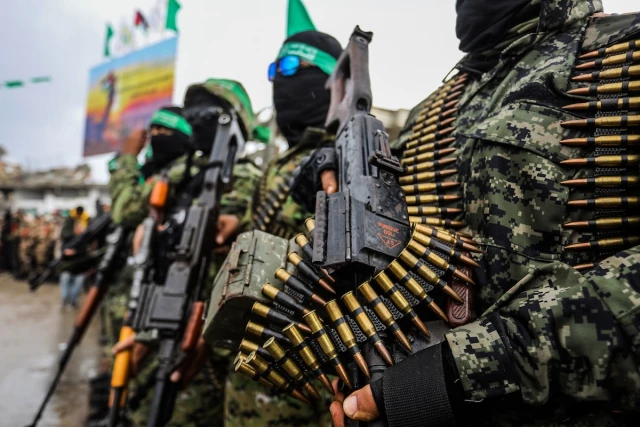
U.S. President Donald Trump claimed on Thursday that the terror organization Hamas would lay down its weapons in the Gaza Strip, despite consistent claims to the contrary by senior officials of the terror group.
During a cabinet meeting, Trump, speaking with Special Envoy Steve Witkoff – who was instrumental in mediating the ceasefire between Israel and Hamas – said the next step would be for the terrorists to have “no guns.”
“They’re going to demilitarize,” Witkoff confirmed, “because they have no choice. They’re going to give up their AK-47s.”
“A lot of people said ‘they’ll never disarm’ – looks like they’re going to disarm,” Trump concluded.
US President Donald Trump says it “looks like” Hamas will disarm. pic.twitter.com/xZ6uTnCMnt
— Al Arabiya English (@AlArabiya_Eng) January 29, 2026
Witkoff also noted that the second phase of the ceasefire had begun, after the remains of the final Israeli hostage, Ran Gvili, were located in the Gaza Strip by Israeli troops and returned for burial.
He stressed that the Trump administration had, “for the first time,” created a technocratic, “all-Arab” government while getting the “terrorists out” of the administration.
However, despite the optimistic statements by Witkoff and Trump, Hamas has insisted that, while it would accept handing over governance to the new National Committee for the Administration of Gaza (NCAG), it has not even discussed laying down its weapons.
Senior Hamas official Moussa Abu Marzouk said on Wednesday that Hamas had never agreed to disarm. “We haven’t discussed the weapons yet; no one has spoken to us directly about it. We haven’t spoken with the American side or the mediators on this issue, so we can’t talk about what it means or what the goal is,” he told Al Jazeera.
Doubling down, he said, “Not for a single moment did we talk about the surrender of weapons, or any formula about destroying, surrendering, or disarmament.”
However, he said that there was a possibility that during negotiations, “we will discuss which weapons will be removed, what will be removed, how they will be removed.”
Israel has consistently expressed skepticism that Hamas would disarm by any means other than military force, despite reports that the U.S. has been developing several proposals to achieve this.
On Wednesday, U.S. Ambassador to the UN Mike Waltz confirmed reports from the Times of Israel (TOI), suggesting that the U.S. plans to offer Hamas terrorists a “buy-back” program, either offering amnesty and money or new jobs in exchange for their weapons.
Arab diplomats further told the TOI that the mediating countries are pushing a plan to decommission Hamas’ weapons, beginning with storing heavy rockets and artillery in warehouses in Gaza, before moving on to lighter arms such as AK-47s.
📢UPDATE:
— COGAT (@cogatonline) January 30, 2026
In accordance with the ceasefire agreement and the directive of the political echelon, the Rafah Crossing will open this coming Sunday (February 1st) in both directions, for limited movement of people only.
Exit from and entry into the Gaza Strip via the Rafah… pic.twitter.com/jp8g3dP3Al
On Friday afternoon, the IDF's COGAT unit (Coordinator of Government Activities in the Territories) confirmed that the Rafah border crossing with Egypt would open on Sunday “in both directions, for limited movement of people only.”
“Exit from and entry into the Gaza Strip via the Rafah Crossing will be permitted in coordination with Egypt, following prior security clearance of individuals by Israel, and under the supervision of the European Union mission,” COGAT stated.
“The return of residents from Egypt to the Gaza Strip will be permitted, in coordination with Egypt, for residents who left Gaza during the course of the war only, and only after prior security clearance by Israel.”
The announcement also confirmed previous reports that the IDF will screen and identify individuals entering Gaza through a special corridor behind the crossing.
Meanwhile, the International Committee of the Red Cross completed on Thursday the transfer to the Gaza Strip of the bodies of 15 Palestinians held by Israel, following the discovery of Ran Gvili, whose body was found by Israeli soldiers rather than being returned by Hamas, as the ceasefire had stipulated.
The Red Cross said, “This marked the completion of a months-long operation that led to family reunifications and supported the implementation of the ceasefire agreement,” starting with “the release and return of 20 living hostages and 1,808 Palestinian detainees” last October.
On the ground in Gaza, Hamas terrorists have continued in recent days to cross the ceasefire line and attempt attacks on Israeli troops.
On Thursday, the Israeli military said it had “conducted a precise strike, in accordance with the ceasefire agreement, targeting a Hamas terrorist who was planning to carry out an imminent terror attack against IDF troops operating in the southern Gaza Strip.”
The IDF noted that “the terrorist posed an imminent threat to the troops” and that “steps were taken to mitigate harm to civilians, including the use of precise munitions, aerial surveillance, and additional intelligence.”
In a larger incident overnight, the IDF said on Friday morning that eight terrorists emerged from a tunnel in eastern Rafah, on the Israeli side of the Yellow Line, apparently in an attempt to ambush Israeli troops.
“Following the identification, the IAF struck and eliminated three of the terrorists. Later, additional strikes toward the areas where the remaining terrorists attempted to escape to were conducted. The results of the strikes are under review. IDF soldiers continue to conduct searches in the area in order to locate and eliminate all of the terrorists.”
You might also like to read this: