After Oct 7, does every diplomatic visit to Israel still need to include Yad Vashem?
.jpg "Maayan Hoffman")


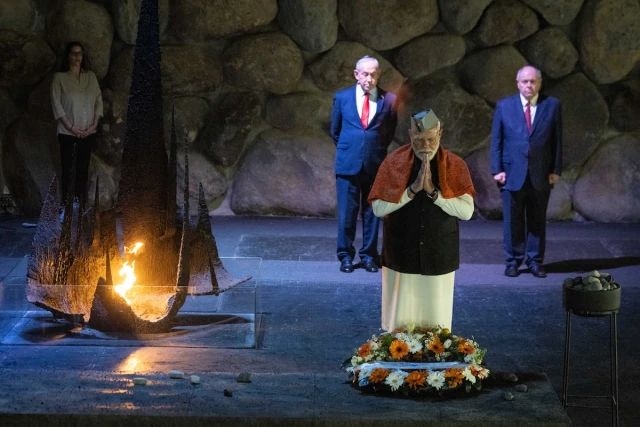
Should every major diplomatic leader who visits Israel be expected to stop at Yad Vashem, even in the aftermath of Oct. 7?
Nearly 78 years after its founding, Israel presents itself as a confident, independent democracy. It is a global player in technology, security, and diplomacy. Does anchoring every state visit in Holocaust remembrance risk bolstering the concept that Israel’s legitimacy rests solely on persecution rather than sovereignty?
At least one leading Holocaust scholar argues the opposite.
The choice, according to Dr. Marc Neugröschel, is not between memory and modern statehood. The two are inseparable. Visiting Yad Vashem is not a symbolic trace of the past, nor a diplomatic courtesy that can quietly fade with time. Neugröschel, a sociologist and a fellow at the London Center for the Study of Contemporary Antisemitism, said that visiting Yad Vashem is an essential moral act, especially now.
That argument took on renewed relevance this week.
On Thursday, Indian Prime Minister Narendra Modi visited Yad Vashem alongside Prime Minister Benjamin Netanyahu, according to the Prime Minister’s Office. They began in the Hall of Names, where Netanyahu showed Modi the names of his wife Sara’s relatives who were killed in the Holocaust. They then held a memorial ceremony, and Modi laid a wreath and placed a stone at the memorial to commemorate the victims of the Holocaust.
Modi later posted on 𝕏 about his visit.
“The Holocaust stands as one of humanity’s darkest chapters,” he wrote. “It is an eternal reminder of the need to uphold humanity, dignity and peace.”
Laid a wreath at Yad Vashem, the World Holocaust Remembrance Center. Grateful to PM Netanyahu for accompanying me during this visit.
— Narendra Modi (@narendramodi) February 26, 2026
Also visited the Hall of Names, a solemn space that preserves the memory of those who suffered and perished during the Holocaust.
The Holocaust… pic.twitter.com/fU8PrM9ZJu
The visit came toward the end of Modi’s first trip to the country since 2017. It is widely considered one of the most significant visits since the two countries established full diplomatic relations in 1992. During his speech to the Knesset, Netanyahu described India in the following terms: “In a world where antisemitism is rising, India stands out: A civilization where Jews were never persecuted by the state, only welcomed.”
While it is not a legal requirement, a visit to Yad Vashem is considered, according to Foreign Ministry protocols, an obligatory part of the official itinerary for international leaders and public figures. This usually includes a wreath-laying ceremony. The ministry says the purpose is to provide a critical educational and moral lesson.
However, Neugröschel argues that the visit carries an additional meaning. It is also a message of national revival.
“Jews were not only not tolerated in other parts of the world, but they were expelled and murdered,” Neugröschel told All Israel News. “The reason why this state was created is that the Jewish people needed a place to live. It was not something nice to have but essential for the survival not only of Jews as a collective, but also for certain individuals.”
Neugröschel noted that most Holocaust survivors could not simply return to their homes. In many cases, there were no family members left to reconnect with and no homes to return to. This, he said, is part of the central justification for the start of Israel.
He added that the trauma of the Holocaust did not stop with World War II or the defeat of the Nazis. Survivors, as well as their children and grandchildren, have continued to live with that pain.
“The obligation to them is to make sure that the victims were not forgotten, that their experiences were not forgotten, that their lives are remembered,” Neugröschel said. “Obviously, the State of Israel has to be at the forefront to fulfill this obligation.”
Yad Vashem is often mistranslated to mean “hand and name,” as it would in modern Hebrew, Neugröschel explained. However, he said it actually translates to “a memorial and a name.” Neugröschel, who also serves as a Holocaust educator for Yad Vashem, stressed the significance of that distinction.
The name comes from Isaiah 56:5: “I will give in my house and within my walls a monument and a name better than sons and daughters; I will give them an everlasting name that shall not be cut off."
The idea is that the people who perished in the Holocaust will not be forgotten. The memorial museum is an extension of that divine promise to the victims and to the stories of the survivors.
“So, Yad Vashem is not only a profound part of the reason why the State of Israel is necessary, but it is also a profound obligation to the people who suffered through the Holocaust,” Neugröschel told All Israel News. “Today, most people don't actually really understand what the Holocaust really was. Many people don't know anything about the Holocaust, even among those people who have heard about the Holocaust.”
Beyond its meaning for the State of Israel and the Jewish victims, a visit to Yad Vashem also connects countries that see themselves as defenders of humanity and human rights. It works as an important reminder of the possible and dangerous power of evil in the world.
Netanyahu said that “Israel, like India, is a fortress of democracy, of freedom, and of human rights, in a wild region, teeming with dangers.” He added, “Our defensive war is a most just war. But it is not only a war on the battlefield. It is a war for the truth. It is a war for the future of humanity. And I must say, we see that in the battle for the future of humanity, antisemitism is once again rearing its head.
“We were there only 80 years ago, and we saw it: Antisemitism that starts with the Jews, and afterward endangers all of humanity.”
Netanyahu commended India and its prime minister for retaining friendship with Israel even “in the face of waves of antisemitism, and the lies hurled at us.”
Neugröschel noted that while some politicize the Holocaust and draw direct comparisons to the situation in Gaza or even to the massacre of Oct. 7, he said that misses the core lesson. The real danger, he argued, lies in forgetting.
“We have an obligation to commemorate the past for the future of humanity,” Neugröschel concluded.
That is ultimately the point.
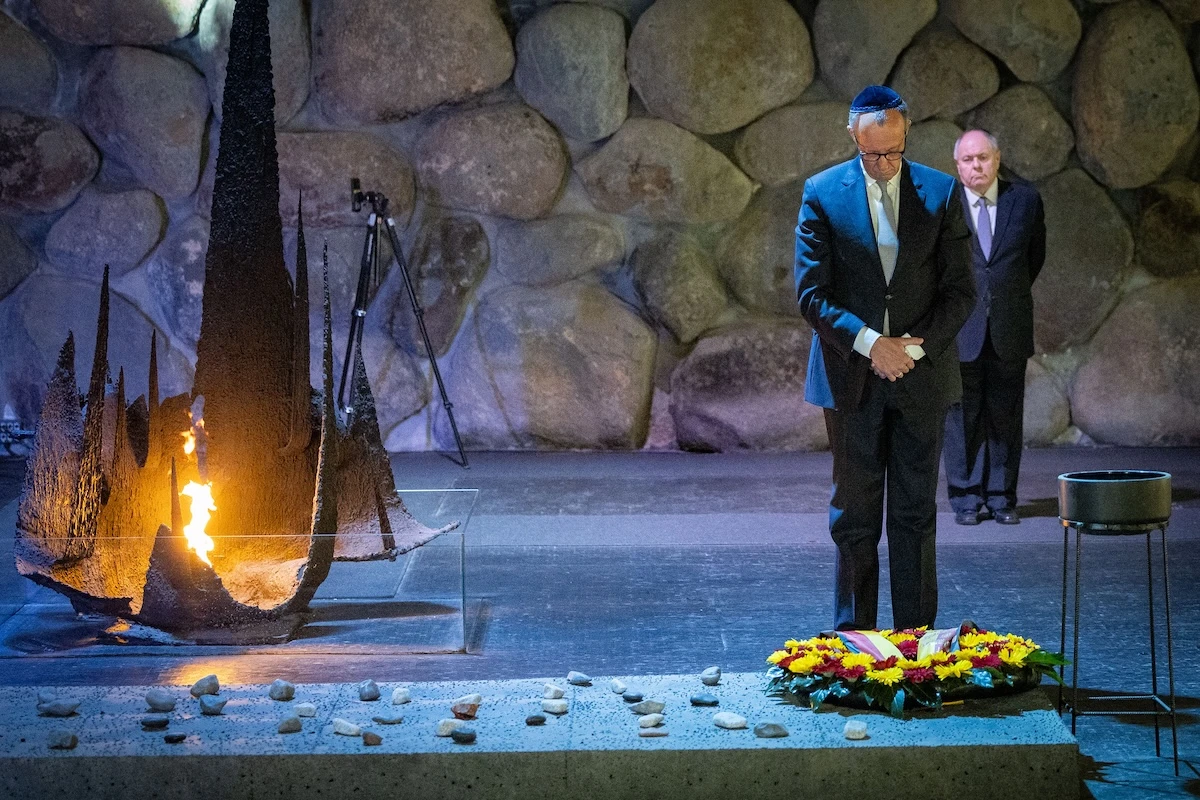
A visit to Yad Vashem may feel like an obligation, and in many ways it is. It could be just another stop on a diplomatic itinerary, another wreath laid, another photo taken. It is fair to question whether every visiting leader fully absorbs what they see there.
But the message is not ceremonial. The Holocaust was not only a Jewish tragedy. It serves as a warning about what happens when hatred is normalized, when antisemitism is ignored, and when the world looks away.
Oct. 7 did not emerge in a vacuum.
It followed years of incitement, denial, and the steady erosion of moral clarity about antisemitism and violence against the Jews and Israel. As the war in Gaza winds down, it becomes even more important to keep the memory of the Holocaust alive.
History shows that when antisemitism resurfaces, it rarely stops with the Jews.
You might also like to read this: