Historic rally in Tel Aviv sees thousands of Arab, Jewish citizens stand together against crime





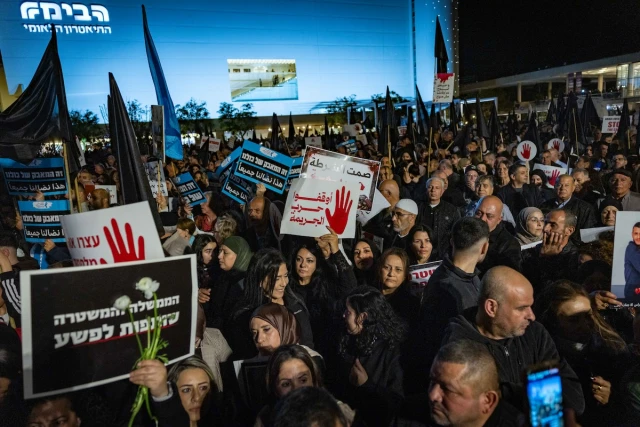
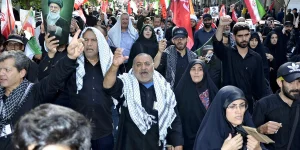
Nearly 40,000 Arab and Jewish protesters gathered at Habima Square in Tel Aviv on Saturday night in an unprecedented show of unity against the violence plaguing Arab communities.
The rally was organized by the High Follow-Up Committee, the leading body representing Arab citizens of Israel, in an effort to reach the Jewish public and mobilize support for Arab society’s struggle against organized crime. The crowd reflected an unusual blend of Arab community members and veteran Jewish demonstrators opposed to the right-wing government.
The protest is a response to the deadliest year on record for Arab society in Israel, with 252 people killed in crime-related violence in 2025.
Jewish protesters holding signs for their own causes stood alongside Arabs wearing kaffiyehs. A group of teenagers chanted in Arabic, “Hey police, hey police, Arab blood isn’t cheap,” as Jewish drummers accompanied them.
Black flags, which have emerged as the defining symbol of the movement against crime in Arab communities, were prominent among the protesters. Several signs, written in English, declared “Arab Lives Matter,” echoing the language of the U.S.-based Black Lives Matter movement.
According to the Times of Israel, the struggle intensified over the past two weeks, beginning with a local strike in the northern city of Sakhnin after a business owner’s shops were targeted in extortion-related shootings, and later spread to Arab communities nationwide.
Addressing the crowd, Sakhnin Mayor Mazen Ghnaim said, “We want personal security,” in response to the murders of 27 Arab citizens over the past month alone.
Municipal authorities in Arab towns chartered buses to bring many demonstrators to Tel Aviv. The protest followed the standard route of recent anti-government and hostage-deal rallies, moving from the Tel Aviv Museum to Habima Square. Despite road closures and metal barriers, police did not fully prevent counter-protesters from entering the area, and one man waving an Israeli flag was escorted out after confronting demonstrators.
While Arab and liberal Jewish lawmakers attended the protest, no sitting politicians spoke on the main stage, as organizers sought to keep the demonstration separate from party politics. High Follow-Up Committee chairman Jamal Zahalka spoke to the crowd, accusing Israel of “fueling crime organizations and criminals who murder, extort and threaten.”
Zahalka, a former Knesset member of Balad – an Arab nationalist party – addressed the large Jewish audience and led the crowd in a Hebrew chant: “Enough of the violence.”
He described the demonstration as a “cry against crime and against the government feeding it” and insisted that “it is time to cancel the silent agreement between the police and criminal organizations.” He also criticized the notion that crime is linked to culture, saying, “The false and racist argument that this [crime] is a cultural problem is not new,” and noted the same claim has been made against Mizrahi Jews in Israel and Black Americans.
Zahalka went on to explain, “This argument collapses with a simple comparison… socially and culturally, we [Arab Israelis] are very similar to the West Bank and Jordan, where the number of murders is less than one for every 100,000 people.” By contrast, the homicide rate exceeds 15 for every 100,000 Israeli-Arab citizens, according to the Times of Israel.
"The Democrats" party lawmaker Gilad Kariv said that Arab and liberal Jewish groups are working together to challenge the current coalition, with a particular focus on National Security Minister Itamar Ben Gvir, who is responsible for law enforcement policy.
Speaking to The Times of Israel, Kariv said there is a joint demand for Israeli Prime Minister Benjamin Netanyahu to dismiss Ben Gvir, though he believes that is unlikely and instead called for a complete replacement of the current government. “If a mother in Umm al-Fahm or Sakhnin feels [too] insecure to allow her child to go to the playground in the afternoon, it means we cannot be safe and feel secure here in Tel Aviv,” he said.
Meanwhile, the Hadash-Ta’al party chairman, Ayman Odeh, said the protest should serve as a “turning point” to bring Jewish and Arab Israelis together.
He said the demonstration could signal the beginning of Arab participation in protests against Israel’s current right-wing government, claiming the policies of Netanyahu are “a struggle for us all.”
Want to help more people find our reporting from Israel? Leave a quick Google review of our website HERE .
You might also like to read this: