Jesus of Nazareth in early Jewish literature – Hebrew book review


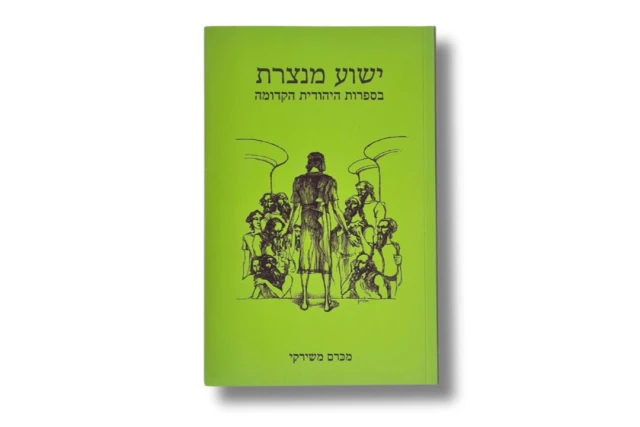
Published in 2023 by the Jerusalem Bible Society, "Jesus of Nazareth in Early Jewish Literature" is a pioneering academic study by Dr. Makram Mesherky that explores how the figure of Jesus (Yeshua HaNotzri) is represented in early Jewish writings. The book encompasses a broader analysis of literary, theological, and historical perspectives on Jesus in Jewish tradition. It was first released in Hebrew and subsequently translated into Arabic, signaling its relevance to diverse scholarly audiences.
The book is structured into two main parts, framed by an introductory chapter and a glossary designed to assist non-specialist readers with key terms and concepts. The introduction briefly explores how Jesus is mentioned in contemporary Roman and Jewish historical sources, setting the stage for the comparative analysis that follows.
Part One: Jesus in Rabbinic literature
The first part of the book examines how Jesus is portrayed in classical Rabbinic literature, particularly the Tosefta and the Babylonian Talmud. As the texts in question were written several centuries after the life of Jesus, Mesherky makes it clear that the aim is not to evaluate their historical accuracy. Instead, the focus is on how these texts reflect the evolving Jewish theological and cultural response to the rise of Christianity.
These sources contain scattered yet significant references to figures often associated with Jesus, such as Ben-Satada and Ben-Pandira. Many of these references were omitted from earlier printed editions of the Talmud but have resurfaced in modern editions such as that of Steinsaltz. Mesherky ensures academic rigor by consulting original Hebrew and Aramaic manuscripts, some of which are also reproduced in the Arabic version.
The Talmudic accounts are treated not as biographies but as complex expressions of rabbinic engagement with emerging Christian ideas. Jesus is portrayed in these texts as someone who opposes rabbinic authority and deviates from accepted norms—often within narrative frameworks that blend folklore, theological polemic, and moral commentary. For example, the stories of Ben-Satada and Ben-Pandira involve themes of sorcery, forbidden healing, and controversial teachings. Though anachronistic, these stories mirror real historical tensions between Rabbinic Judaism and early Christianity.
One notable passage analyzed by Mesherky involves Rabbi Elazar ben Dama, who is bitten by a snake and wishes to be healed by someone invoking the name of Yeshu ben Pandira. Rabbi Yishmael forbids it, illustrating rabbinic wariness toward external religious influences. Another account concerns the legal condemnation and execution of Yeshu the Nazarene, on the eve of Passover, for leading Israel astray – a narrative that also references the fate of his disciples.
Part Two: The Toledot Yeshu tradition
The second part of the study explores the Toledot Yeshu corpus – a body of medieval Hebrew polemical texts that offer an alternative and often satirical narrative of Jesus’ life and mission.
Whereas Rabbinic allusions are brief and fragmented, the Toledot Yeshu literature provides a more structured “counter-history,” reflecting the social and religious pressures experienced by Jewish communities living under Christian dominance. Public awareness of these texts began in the 17th century with scholars like Wagenseil and Huldreich, and grew in the 20th century with the discovery and comparison of additional manuscript traditions.
While not historically reliable in the conventional sense, Toledot Yeshu represents a distinctive literary genre. Mesherky reviews the identification of the three major groups of the tradition – Pilate, Helena, and Herod – and highlights recurring characters like Miriam and Ben Pandira, whose roles vary across versions. These texts often parody foundational Christian claims, including the virgin birth, miracles, and resurrection, serving as theological resistance literature that seeks to preserve Jewish identity.
The author concludes that the image of Jesus in Jewish tradition is multifaceted and shaped by theological boundary-making, collective memory, and polemical confrontation.
By analyzing both the fragmented Talmudic references and the more developed Toledot Yeshu texts, the study reveals the evolution of Jewish responses to the figure of Jesus – not merely as a historical person but as a theological and symbolic challenge.
This work of Mesherky stands out for its methodical documentation of primary sources and its balanced perspective, acknowledging both the historical distance and the emotive force behind these texts. Rather than attempting to harmonize Jewish and Christian narratives, Mesherky provides a lens through which the distinctiveness of Jewish perspectives on Jesus can be understood.
Through careful philological and contextual analysis, Jesus of Nazareth in Early Jewish Literature offers a valuable resource for scholars of Jewish studies, religious polemics, and intercultural understanding.
Key questions the book addresses:
- Why does the Talmud reject Yeshu (Jesus), even though he was once considered a “son and disciple”?
- How reliable is the Toledot Yeshu literature?
- Was the historical Jesus a sorcerer, a miracle worker, or something else?
- What historical and theological value does ancient Jewish literature hold in comparison to the New Testament?
- Why, when, and how did the name “Yeshua” become “Yeshu”?
About the author
Dr. Makram Mesherky is an Israeli Christian Arab minister who specializes in comparative religious texts. He earned his Ph.D. at the University of Haifa with a dissertation on “Jesus in Early Muslim Thought,” focusing on the Qur’an and early post-Qur’anic literature. He has written more than twenty books and numerous articles in fields including evangelism, biblical backgrounds, Rabbinic and Muslim literature, apologetics, and linguistics. His interdisciplinary research draws from biblical languages, epigraphy, agriculture, and ancient customs – areas of knowledge that significantly enrich the analysis in this volume.
The book is available for purchase through the Bible Society in Israel.
Want to help more people find our reporting from Israel? Leave a quick Google review of our website HERE .
You might also like to read this: