With Iran negotiations ongoing, Trump says 'We'll see what happens' regarding potential strike
The U.S. President admits to keeping Gulf partners in the dark, ‘we can’t tell them the plan’


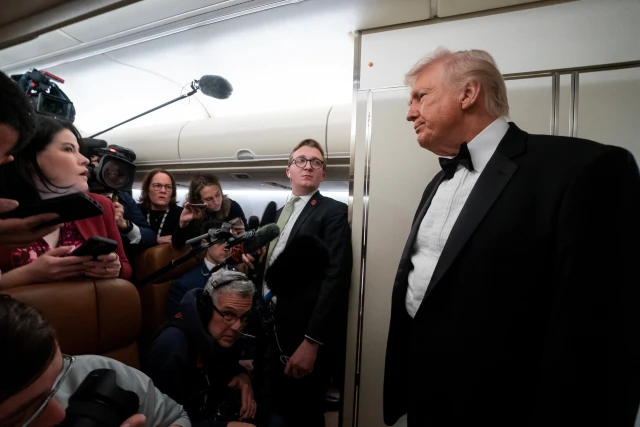
U.S. President Donald Trump has continued to say very little regarding the possibility of an American strike on Iran, even as the U.S. builds up military assets in the region.
Speaking to reporters on a flight to Florida, the president declined to say whether he had made the decision to strike, but said the U.S. is prepared for any decision.
Asked by a reporter, if he had made a final decision on Iran, President Trump responded, “I certainly can't tell you that, but we do have very big, powerful ships heading in that direction, as you know. I can't tell you, you know. But I hope they negotiate something that's acceptable.”
The president also responded to the comment by the Saudi Arabian defense minister, who said that backing off from attacking Iran would only embolden the regime.
“Some people think that, and some people don’t,” President Trump said. “If you could make a negotiated deal that would be satisfactory, with no nuclear weapons, they should do that. But I don’t know that they will.”
“But they are talking to us,” Trump stated. “Seriously talking to us.”
At the same time, Fox News reported that President Trump is keeping Gulf partners in the dark regarding his plans for Iran. Answering questions in the White House on Saturday, Trump said,
‘‘Well, we can’t tell them the plan. If I told them the plan, it would be almost as bad as telling you the plan – it could be worse, actually.’’
President Trump continued, saying, ‘‘But, look, the plan is that [Iran is] talking to us, and we’ll see if we can do something. Otherwise, we’ll see what happens.”
He also noted that the U.S. has a large fleet of naval vessels in or heading to the region. “We have a big fleet heading out there, bigger than we had – and still have, actually – in Venezuela.’’
When asked if he had given Iran a deadline for reaching an agreement, Trump responded, “Only they know for sure.”
Former IDF spokesman Lt. Col. Jonathan Conricus, told Iran International’s “Eye for Iran” podcast, that he believes the U.S. will conduct strikes in Iran.
“I think it’s only a matter of time before the US will conduct strikes against the Islamic Republic,” Conricus said, noting that, “most of those capabilities and assets are in place and are ready to be deployed.”
Meanwhile, Iranian Foreign Minister Abbas Araghchi said last Wednesday that his country would be willing to make an agreement which prohibits nuclear weapons, which he claims Iran has never wanted.
Araghchi posted a warning to 𝕏, writing, “Our brave Armed Forces are prepared – with their fingers on the trigger – to immediately and powerfully respond to ANY aggression against our beloved land, air, and sea.”
However, he also claimed a willingness by the Iranian regime to negotiate.
“At the same time, Iran has always welcomed a mutually beneficial, fair and equitable NUCLEAR DEAL – on equal footing, and free from coercion, threats, and intimidation – which ensures Iran's rights to PEACEFUL nuclear technology, and guarantees NO NUCLEAR WEAPONS,” he continued. “Such weapons have no place in our security calculations and we have NEVER sought to acquire them.”
On Saturday, Araghchi reiterated the statement in a post regarding meetings with Turkish President Recep Tayyip Erdoğan and Foreign Minister Hakan Fidan.
“In our conversations, I reiterated that Iran has never sought nuclear weapons and is ready to embrace a fair and equitable nuclear deal that meets the legitimate interests of our people; this includes ensuring 'No Nuclear Weapons' and guaranteeing the lifting of sanctions,” Araghchi wrote.
In 2018, Israel’s Mossad intelligence agency brought back thousands of documents from Iran’s nuclear weapons program, which show that the regime was working to develop nuclear weapons in the early 2000s, before eventually halting its efforts.
At the same time, Ali Larijani, head of Iran’s Supreme National Security Council, said on Saturday that “Contrary to the hype of the contrived media war, structural arrangements for negotiations are progressing.”
The same day, Iranian President Masoud Pezeshkian told Egyptian President Abdel Fattah el-Sisi that “The Islamic Republic of Iran has never sought, and in no way seeks, war and it is firmly convinced that a war would be in the interest of neither Iran, nor the United States, nor the region.”
According to a report on Army Radio on Sunday morning, there is concern in Israel that President Trump could pursue a limited nuclear deal with Iran that leaves its ballistic missile program untouched.
With Iran recently announcing ballistic missiles that can theoretically reach western Europe, as well as demonstrating the use of hypersonic ballistic missiles during the 12-day Israel-Iran War, the Israeli defense sector is concerned that such a deal would allow Iran to continue to threaten the Jewish State, and begin to threaten European partners.
The Iranian backed Islamic Resistance in Iraq released a video over the weekend, apparently revealing an underground missile city of its own, similar to that of the Iranian military.
CONCERNING 🔴
— Open Source Intel (@Osint613) January 31, 2026
The Iranian backed Islamic Resistance in Iraq has unveiled for the first time an underground missile city.
This is a major escalation that brings strikes in Iraq far closer.
Very dangerous. pic.twitter.com/3pHuvKAYWO
If true, this would represent an significant threat escalation in regards to targeting U.S. forces and allies in the region.