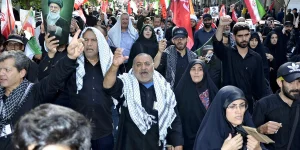
Explosions reported near Al-Quds Day march in Tehran amid ongoing US-Israeli strikes on Iran



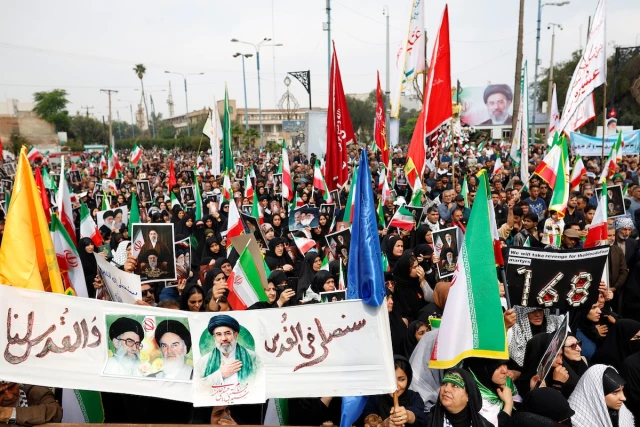
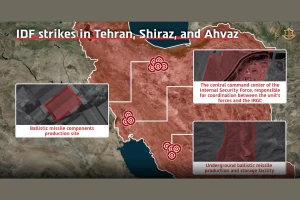
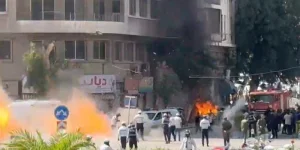
Iranian state media reported explosions near a square in Tehran on Saturday, where the Islamic Republic was holding its annual Al-Quds Day march. The blasts were likely linked to Israeli airstrikes, as the Israeli Air Force (IAF) has been conducting significant strikes against regime targets in the Iranian capital and elsewhere.
Quds Day was established in 1979 by Iran’s leadership as an annual political event focused on opposition to Israel, Zionism and Israeli control of its historical capital, Jerusalem. Senior Iranian officials reportedly present at the march in Tehran on Saturday included President Masoud Pezeshkian, Foreign Minister Abbas Araghchi and Supreme National Security Council Secretary Ali Larijani.
Also reported to have attended were Mohammad Eslami, head of the Atomic Energy Organization of Iran, Chief Justice Gholam-Hossein Mohseni-Eje'i and police chief Ahmad-Reza Radan.
Larijani, who has emerged as a senior spokesperson for the Iranian regime, blasted the United States and Israel.
"Trump doesn't understand that the Iranian nation is a mature, strong, and determined one. As American pressure grows, the nation's determination will strengthen. The Zionist regime's attacks towards the march is a sign of its hopelessness," Larijani said.
“These attacks are out of fear, out of desperation. One who is strong wouldn’t bomb demonstrations at all. It’s clear that it has failed,” he said.
Police chief Radan added: "The people came today to tell the enemy – we are not afraid of you. The people responded to the sound of the explosion with shouts of 'Allahu Akbar.' Before the eyes of the frustrated enemy, the nation will not leave the site, and victory nears."
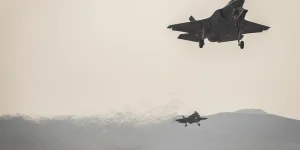
The United States and Israel launched a large-scale joint aerial offensive against Iran on Feb. 28. During the initial strikes, the IAF eliminated Supreme Leader Ali Khamenei and roughly 40 senior Iranian officials. Within the first 48 hours of the war, U.S. and Israeli air forces established near-complete air superiority over Iranian airspace.
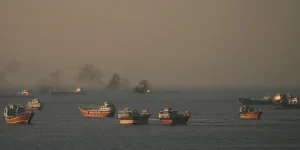
Despite the regime’s continued militant rhetoric, Tehran has already suffered major military losses. Much of Iran’s navy, air force, and key missile and nuclear assets have been damaged or destroyed in the ongoing campaign. U.S. and Israeli strikes have also dismantled large portions of Iran’s air-defense network, leaving the regime increasingly exposed to further attacks.
After just one week of war, U.S. CENTCOM Chief Admiral Brad Cooper announced that Iranian missile attacks against Israel, U.S. bases, and Gulf states had dropped by 90%, while drone attacks had fallen by 83%. The sharp decline in Iran’s offensive capabilities comes after sustained U.S. and Israeli strikes targeting Tehran’s missile and drone assets, with a particular focus on missile launchers.
IDF Chief of Staff Lt.-Gen. Eyal Zamir assessed at the time that Israel and the U.S. had neutralized some 60% of Iran’s missile launchers.
“This is a very significant achievement that reduces harm to the home front and saves many lives. However, this is an ongoing effort, and I emphasize that the threat has not yet been removed – every missile is lethal and poses a danger,” Zamir stated.
The Israeli military’s latest estimate is that around 75% of Iran’s missile launchers have been eliminated, making it increasingly difficult for the ayatollah regime to launch large-scale missile attacks.
You might also like to read this: