Time of peace? Growing Messianic expectations in Judaism at the threshold of a new era




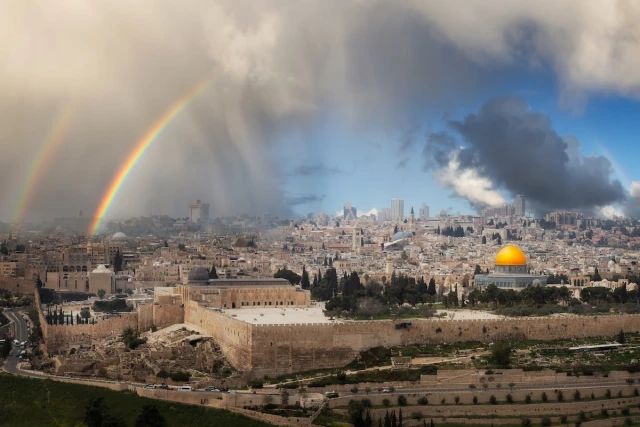
The Middle East is vibrating with tension. Less than two weeks separate us from the festival of Purim – that biblical moment when the Jewish people celebrate their deliverance from the destructive scheme of Haman, the antisemitic tyrant of ancient Persia, modern-day Iran. The parallel between the story described in the Book of Esther and present-day realities is unmistakable. The Iranian threat and the intensifying antisemitism at the global level understandably stir concern within Jewish communities.
Although the past two years of war have brought deep wounds, immense tragedies, and a global surge in antisemitism, Israel’s geopolitical position has been fundamentally transformed during this period. Much of the terror infrastructure that once posed a direct existential threat from the north and south has been fractured or destroyed, dismantling the paralyzing “ring” with which Iran had encircled the Jewish state for decades.
Israel today has emerged not merely as a defensive actor but as the Middle East’s unquestionable military and technological stabilizing force. Despite the storms, the foundations of the Abraham Accords have endured, and developments behind the scenes point toward a broader regional alignment that may eventually include Saudi Arabia – a shift that could reshape the future of the region.
What fills Israel’s adversaries with apprehension is the recognition that the Jewish state has not only survived multi-front pressures, but has become an indispensable global security partner. Should Israel ultimately prevail against the direct threat posed by the Iranian theocracy, such an outcome would represent not merely another military victory, but perhaps the dawn of a new and flourishing Middle Eastern era, one in which radicalism yields to modernization and peaceful cooperation.
Israel’s rise and the transformation of regional alliances now extend beyond conventional political analysis. In Israeli discourse, one increasingly hears the optimistic observation that the Jewish people living in the Land of Promise have not enjoyed such international standing and influence since the era of King Solomon. For many, this level of national strength and sovereignty signifies more than political success; it appears as another stage in a process of historic and perhaps biblical proportions.
This extraordinary historical moment – where the struggle for physical survival intersects with growing global recognition – has created fertile ground for intensified Messianic expectations within Jewish religious thought. For believing communities, the breaking of the “ring” and the restoration of national stature evoke ancient prophetic promises associated with redemption.
Time for peace?
In recent years, Messianic anticipation has become increasingly visible in Jewish religious circles. Within Lubavitch Hasidic communities, one often hears references to the words attributed to the last Rebbe, who, toward the end of his life, reportedly told Benjamin Netanyahu – before his first term in office – that he would be the final Israeli prime minister before the advent of the Messianic era.

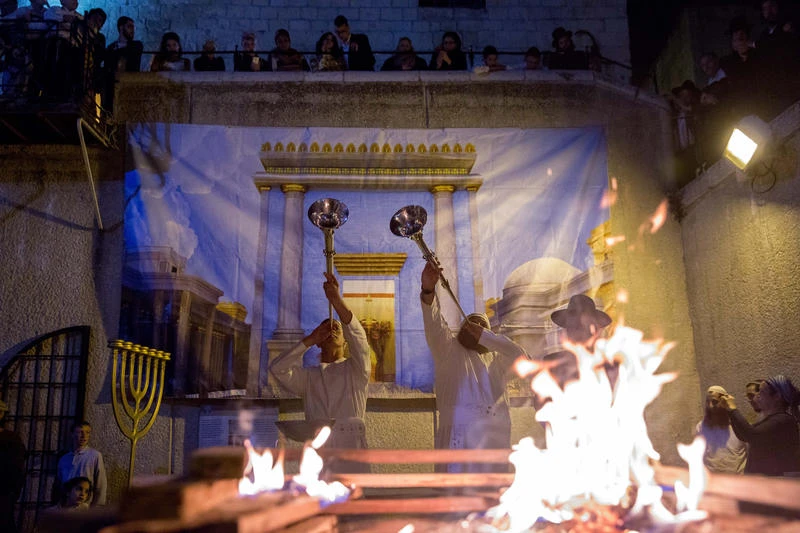
In parallel, within religious Zionist communities, efforts connected to the anticipated Messianic age – including discussions surrounding the rebuilding of the Third Temple and reports concerning “kosher red heifers” – have attracted considerable international attention. These developments have stirred debate not only among Jewish supporters and critics, but also within evangelical Christian communities and across the Islamic world.
Since last June's Israel-Iran war, discourse about the Messianic era has resurfaced even within ultra-Orthodox communities that traditionally avoid such speculation. A catalyst for this renewed discussion has been a notable rabbinic calculation based on a method referenced in the writings of the Vilna Gaon, the renowned 18th-century sage.
Central to this interpretation is the concept of the “28 times” found in the Book of Ecclesiastes. In light of this calculation, events unfolding in mid-2025 have been viewed by some not merely as geopolitical developments, but as markers of a potential civilizational turning point.
Mathematics behind the prophecies?
The line of reasoning draws upon the famous verses attributed to King Solomon:
“To everything there is a season,
A time for every purpose under heaven:
A time to be born,
And a time to die;
A time to plant,
And a time to pluck what is planted;
A time to kill,
And a time to heal;
A time to break down,
And a time to build up;
A time to weep,
And a time to laugh;
A time to mourn,
And a time to dance;
A time to cast away stones,
And a time to gather stones;
A time to embrace,
And a time to refrain from embracing;
A time to gain,
And a time to lose;
A time to keep,
And a time to throw away;
A time to tear,
And a time to sew;
A time to keep silence,
And a time to speak;
A time to love,
And a time to hate;
A time of war,
And a time of peace.”
(Ecclesiastes 3:1–8, NKJV)
A foundational idea within Jewish thought holds that the world – created 5,786 years ago, according to the Hebrew calendar – is destined to exist for 6,000 years in a state of active history, followed by a 7th millennium associated with sabbatical rest.
According to interpretations attributed to the Vilna Gaon, these 6,000 years are divided into 28 spiritual eras corresponding to Solomon’s “28 times.” Dividing 6,000 by 28 yields the length of each era: approximately 214.29 years. Reaching the 28th era requires the completion of 27 cycles, totaling 5,785.71 years.
The Hebrew year 5785, according to the Jewish calendar, began in the autumn of 2024. The fractional 0.71 part of a year indicated by the calculation fell precisely in June 2025 – exactly in the period when open warfare between Israel and Iran began. Within this interpretive framework, this period has been seen by some as marking the culmination of a “time of war,” symbolically opening the way for a potential “time of peace.”
War or peace?
The Israeli and global political reality, however, for the time being, appears to point in precisely the opposite direction. Europe is gripped by a rearmament fervor not seen for decades. Destruction has been ongoing for years on the Russian-Ukrainian front and in the rear areas.
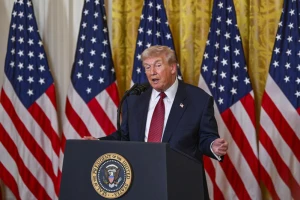
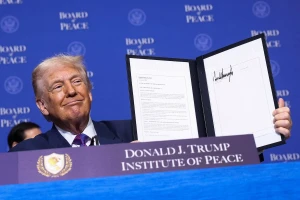
U.S. President Donald Trump is attempting to resolve global conflicts through peace-making deals, yet at the same time, the U.S. Navy is carrying out an unprecedented deployment toward the Persian Gulf.
Israel, meanwhile, is tensely preparing for another impending war against Iran.
The feeling that ‘history repeats itself’ inevitably arises. People are debating which is more likely: Trump’s second presidency bringing about a more peaceful era, or a third world war?
Radical change appears unavoidable. Israel and the entire world are in labor. Something is coming. War, or peace?
God knows.
Is All Israel News’ faithful reporting important to you? Be part of it—help us continue by becoming a $5/month supporting partner.
You might also like to read this: