Paris inaugurates Shimon Peres Square, honoring a legacy of diplomacy, France-Israel ties


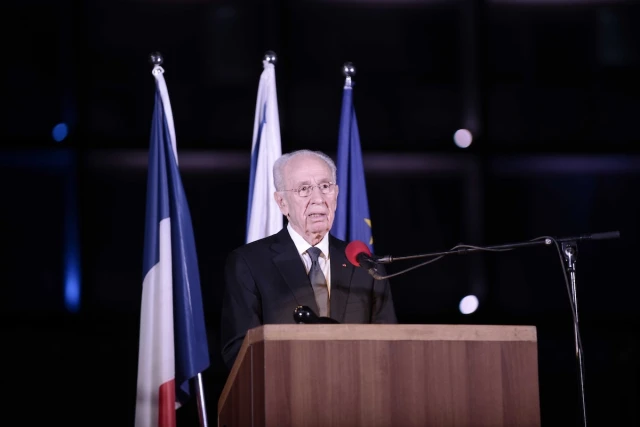
Under steady winter rain, the City of Paris this week inaugurated in the historic Marais District a square named after Shimon Peres, the former Israeli president and prime minister.
Located at the intersection of Rue Malher and Rue Pavée in the 4th arrondissement – roughly equivalent to a historic downtown district – the new "Shimon Peres Square" anchors his legacy in a neighborhood long associated with Jewish life and remembrance in the French capital. The ceremony gathered senior French and Israeli figures, including Paris Mayor Anne Hidalgo, former French President François Hollande, former Prime Minister Bernard Cazeneuve, Paris Centre Mayor Ariel Weil and Israel’s ambassador to France, Joshua Zarka.
Peres’ children, Tsvia Walden and Chemi Peres, unveiled the plaque bearing their father’s name.
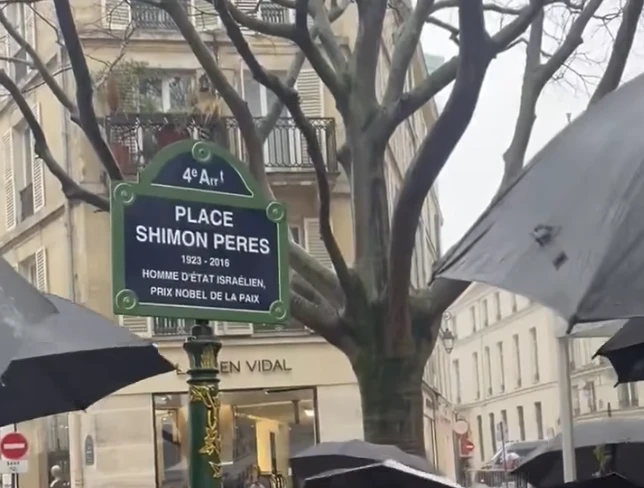
In their remarks, the family emphasized the deep attachment that Shimon Peres had to France and its culture. Walden described the tribute as Paris saluting “everything he represented” – hope for peace, social solidarity and loyalty both to one’s homeland and to humanity. Chemi said the naming of the square was profoundly moving, recalling his father’s role in building strategic ties with France that remain significant for Israel today.
For Hidalgo, Peres was a “visionary” and a “friend of Paris.” She framed the inauguration – following a 2025 vote by the Paris Council – as a tribute to a man of peace whose legacy resonates at a time of renewed international tensions. Hidalgo also warned that the resurgence of antisemitic hatred is “toxic to democracy,” giving the ceremony contemporary relevance beyond symbolism.
Hollande highlighted Peres’ central role in the Oslo peace process of the early 1990s, first as an Israeli foreign minister and later as prime minister. The agreements he signed with former Palestinian Authority President Yasser Arafat under U.S. auspices led to the 1994 Nobel Peace Prize, jointly awarded to Peres, Yitzhak Rabin and Arafat.
The former French premier recalled Peres as a leader who consistently pursued diplomatic openings, even during periods of deep mistrust.
Speakers and commentators also portrayed Peres as a bridge between cultures.
Writer Marek Halter has described informal meetings in Paris that helped prepare early Israeli-Palestinian contacts, underscoring Peres’ belief in dialogue. Known as a committed Francophile, he was at ease in Parisian intellectual circles and was attentive to other cultures, including Islam.
By inscribing his name into its urban landscape – alongside figures like Theodor Herzl and Bernard Lazare – Paris presents the new square as both a gesture of friendship toward Israel and a reaffirmation of its own civic ideals.
In a period marked by Middle East tensions and concerns over antisemitism in Europe, the Shimon Peres Square stands as a reminder of diplomacy’s enduring, if fragile, promise.
You might also like to read this: