Ancient shipwreck off Israel reveals rare 2,600-year-old iron cargo, shedding light on history of early trade




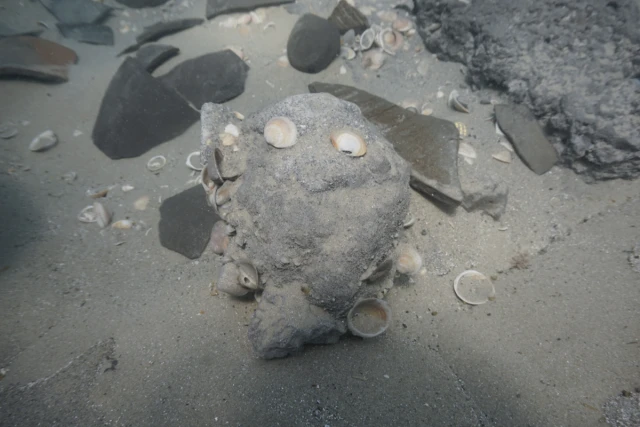
Researchers from Haifa University announced on Wednesday the discovery of a 2,600-year-old shipment of raw iron found in an ancient shipwreck in Dor Lagoon, off Israel’s northern Carmel Coast.
Known to archaeologists as “iron blooms,” the artifacts provide evidence that iron was traded in ancient times in this semi-finished form. The findings were published earlier this month in the journal Heritage Science.
“This was a tense period of constant conquest in the Southern Levant, and iron was a very important resource,” said Associate Professor Tzilla Eshel of Haifa University’s Department of Archaeology in an interview with The Times of Israel.
“If you produce blooms, that means someone is waiting for them on the other side, and has the technology and the ability to make them into something that is worth the effort — first and foremost, weapons,” she explained.
The archeologists are not certain of the ancient ship’s political affiliation due to the rapid political changes in the region between the end of the 7th and the beginning of the 6th century BCE.
“When I imagine these blooms sinking, I see someone waiting for a ship full of metal that will help them fight a war, only to see it sink in front of their eyes,” Eshel said. “However, we do not know which of the empires we can associate the trade with."
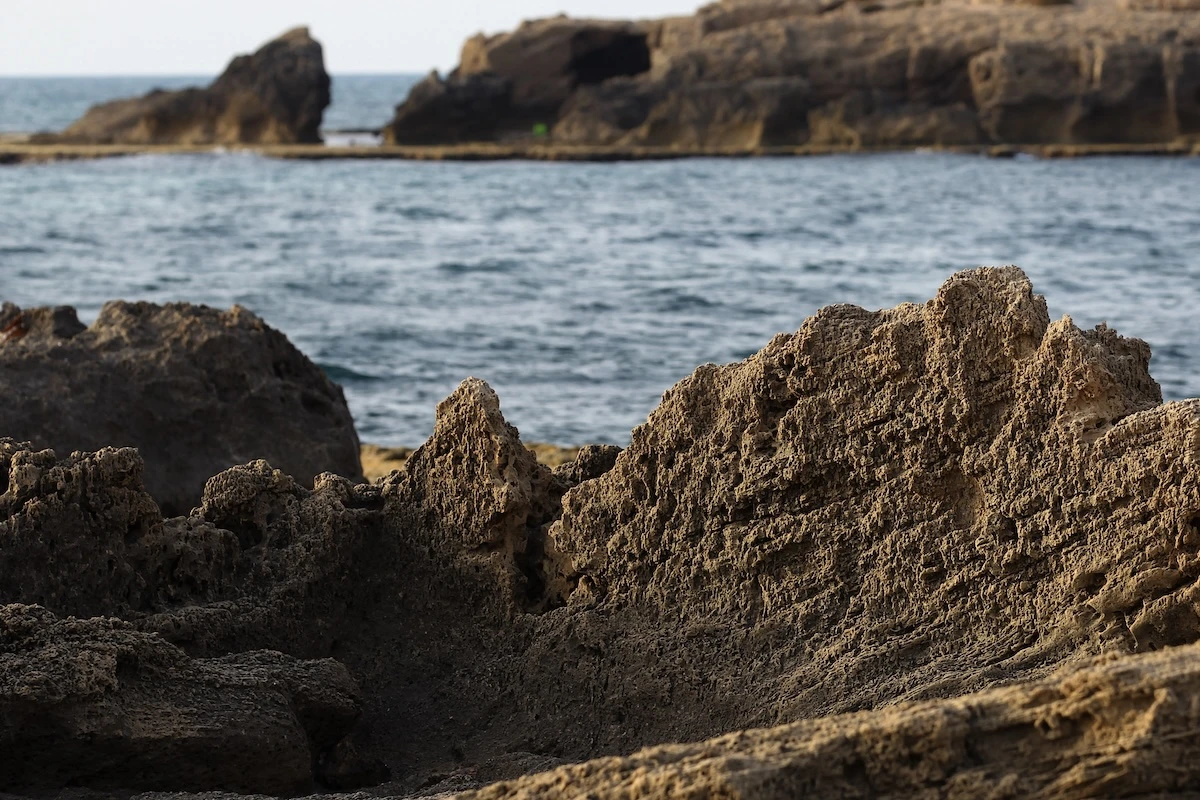
Prof. Assaf Yasur-Landau from the University of Haifa and Prof. Thomas Levy from the University of California, San Diego co-directed the team of maritime archeology students who made the discovery.
“They looked like rocks,” Levy recalled. “Assaf, though, realized that we must be dealing with some form of archaeometallurgical phenomenon."
Eshel emphasized the significance of iron in ancient civilizations.
“To understand why [iron blooms] are so rare, we have to understand what the difference is between iron and other metals,” she said. “Iron is one of the most abundant metals on Earth, and still, it came into use much later in history than other metals like silver, copper, gold, and bronze."
“[Scholars] thought that blooms were not traded because it would be a waste of energy to let them cool off [without finishing the process],” Eshel revealed. “We never found full iron blooms like this, and at sea."
Prof. Aren Maeir from Bar-Ilan University, who was not part of the study, argued that it increased knowledge of Iron Age trade networks.
“I think the main lesson we can take from this and many other studies is how much we have to look in detail into the whole question of connectivity during this period,” he said.
“I wouldn’t be surprised if, in the future, we find more evidence of even longer range and more complex connections between the Levant and various places to its West and East, and South,” Maeir concluded.
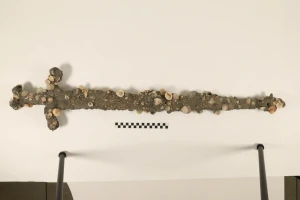
Many historical artifacts have been uncovered over the years off Israel’s northern coast. A 12th-century Crusader sword was discovered last month by a Haifa University student off the Dor Beach in northern Israel. The discovery sheds more light on the interactions between Christian Europeans and the Holy Land in the Levant.
“In the Middle Ages, the sword became a symbol of knighthood and of the Christian faith,” said Dr. Sarah Lantous, of the University of Haifa’s Department of Maritime Civilizations.
You might also like to read this: