Why Syrian Kurds were disappointed when Israel did not come to their aid – and why Israel didn't
It seems that realpolitik and US pressure won out against risky support for Syria's Kurds



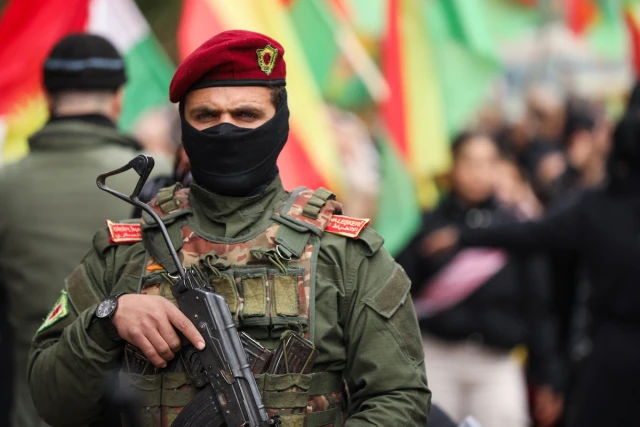
About a decade of Kurdish self-rule and near-autonomy in Syria ended in January 2026, when troops belonging to the new government led by a former Islamist terror leader overran the Kurdish forces that had managed to free northeastern Syria from ISIS and had established control over most areas east of the Euphrates River.
Many Israelis, including the several hundred thousand Kurdish Jews in the country, have positive feelings toward the Kurdish people.
They are the largest people group in the world without their own state and like Israel, a fellow minority in the Middle East.
The government takeover of the Kurdish region in Syria was accompanied by emotionally charged cries from Kurdish voices, as well as some Israelis, who repeatedly urged the Israeli government to intervene and help on behalf of the Kurds.
“This is the Kurds’ October 7 moment,” an unnamed Kurdish analyst told The Jerusalem Post, adding that Kurdish people across the region “are calling on the Israeli government and Jewish people all over the world to intervene on their side, militarily, diplomatically, and in any realm they can.”
#BREAKING A convoy of Syrian internal security forces has entered the city of Qamishli as part of the deal with the Kurdish forcs pic.twitter.com/Jm6n6pZmYI
— Guy Elster גיא אלסטר (@guyelster) February 3, 2026
But despite Israeli Foreign Minister Gideon Sa’ar having raised the alarm about this issue several months back, Israel’s ambassador in Germany, Ron Prosor, was one of the only official voices to comment on the January offensive at all.
“The Kurds were the West’s most reliable partners in Syria, and they share many of our values,” he argued. “They made enormous sacrifices and did the West’s ‘dirty work’ in the fight against ISIS. Now is the moment when they need our support.”
But no support came, despite repeated Turkish accusations of cooperation between the Kurds in Syria and Israel.
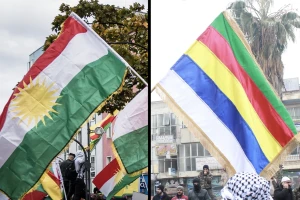
In fact, Israel’s officialdom offered probably even less public criticism than during the massacres against the Syrian Alawites – who historically have certainly not had friendly relations with Israel – let alone the kind of tangible support Israel offered to the Syrian Druze, whose relatives serve in the Israeli army.
A former spokesperson for Syria’s Kurdish forces told KAN News, “There is profound disappointment with Israel among the population of northeastern Syria," echoing accusations that Israel approved the Syrian government's offensive after talks in Paris under U.S. mediation led to an agreement between the countries to establish a “joint fusion mechanism.”
A convoy of Syrian Internal Security Forces has begun entering the Kurdish-majority city of Qamishli in northeastern Syria, according to Syrian State Media. pic.twitter.com/ZVoNmyZetz
— Ariel Oseran أريئل أوسيران (@ariel_oseran) February 3, 2026
We don’t know for sure what caused the radio silence from Israeli officials, which certainly looks like a coordinated policy, possibly directed by the prime minister himself.
But several considerations could have caused Israel to stay relatively silent on this issue and deny the Syrian Kurds the military support Israel has given the Druze.
Complex relations between Israel and Syrian Kurds
The Kurdish people are, of course, not a unified bloc. While the friendly relations between Israel and the Iraqi Kurds are well-known and probably led many to demand Israeli action, the relations between Israel and Syria’s Kurds are somewhat more complicated.
The Kurds of Syria form the smallest community among the four major Kurdish population centers in Turkey, Iraq, Iran, and Syria. Unlike the Kurds of Iraq, with whom Israel has a long history of warm but clandestine contacts to fight common enemies, the Kurds of Syria have been ideologically and institutionally affiliated with the Turkey's Kurdistan Workers' Party (PKK), a terror group with a history of enmity toward Israel.
This doesn’t mean that all Syrian Kurds follow the PKK’s strange ideology, which is a mix of socialism and Kurdish nationalism with a dash of cult of personality around its leader, Abdullah Öcalan, though, in recent years, the PKK-affiliated People's Defense Units (YPG) has been the Syrian Kurds' dominant party and militia.
As an originally Marxist-Leninist group, the PKK fought the Turkish government while demanding a Kurdish state, but has also been hostile to Israel since its founding. In the 1980s, the PKK had training camps in Lebanon’s Bekaa Valley, where its operatives fought against Israel alongside Lebanese and Palestinian terrorists.
This is what caused Israel to take a nuanced position regarding the Kurdish people. In 2017, Israeli Prime Minister Benjamin Netanyahu reiterated the official stance that the State of Israel regards the PKK as a terror organization but stressed “it supports the legitimate means of the Kurdish people to obtain their own state.”
The now-defunct autonomous region in northeastern Syria, called Rojava in Kurdish, was carved out during the Syrian Civil War amid the heroic battles of its military, the Syrian Democratic Forces (SDF), whose core was made up of YPG troops.
Kurdish security forces in Osman Sabri square in Qamishli city, northeast Syria (Rojava) are waiting to receive central government forces shortly pic.twitter.com/DTOoEW3eO6
— Fazel Hawramy (@FazelHawramy) February 3, 2026
Rojava’s most prominent leader is the chief of the SDF's military, Mazloum Abdi, a former high-ranking member of the PKK.
Unlike the Turkish parent organization, Abdi and the SDF have toned down the rhetoric against Israel, but Abdi’s statements in the wake of October 7 were still relatively cold toward Israel.
In November 2023, Abdi called Hamas’ attacks on Israeli civilians “totally unacceptable” and condemned them “wholeheartedly,” while adding that “Israel’s response and the staggering number of civilian deaths among the Palestinians… are no less unacceptable.”
Realpolitik: The threat from Turkey & US pressure
The Kurdish desire to secure independence has long been among the most strategic and sensitive issues for the Turkish state, which many in Israel see as the (Israeli) nation's largest threat in the near future.
In 2024, the Turkish government reached a deal to end the PKK’s activities, and Öcalan called on all PKK affiliates, including those in Syria, to lay down their weapons.
Turkey sees the dissolution of Rojava and the integration of the SDF into the central Syrian government – whose most important patron sits in Ankara – as a core strategic goal with huge implications for its internal stability.
The toppling of the Assad regime in Syria in December 2024 – through active help from Ankara – has also brought Turkey to the doorstep of Israel’s northern border, complicating any potential Israeli military actions to help the Kurds in faraway northern Syria.
Unlike its assistance to the Druze, who live in southern Syria, close to the Israeli border, the Kurdish regions all lie along the Turkish border and have been subject to direct Turkish military interventions in the past.
Another factor limiting Israel’s freedom of action is that U.S. President Trump has repeatedly touted Turkish President Recep Tayyip Erdoğan as one of his most important allies, and the U.S. has signaled that it relies on him, as well as the new Syrian government, to provide stability in the region.
Amid the ceasefire negotiations between Damascus and the Kurds, the Qatari outlet Middle East Eye reported that the U.S. special envoy for Syria, Tom Barrack, accused Abdi of attempting to drag Israel into the conflict, warning that this could inflame tensions between two key regional U.S. allies, Turkey and Israel.
A recent op-ed written by former Israeli National Security Advisor Tzachi Hanegbi offered potential clues to Israel’s strategic outlook on Syria, which may have led decision-makers to conclude that assisting the Kurds is not currently in Israel’s interest.
Hanegbi, who might have met Syrian President Ahmed al-Sharaa last year, was fired by Prime Minister Netanyahu last October, with news reports claiming that disagreements over Gaza and the Israeli strike against Hamas in Qatar – but not over Syria – led to the sacking.
Writing on Ynet News, Hanegbi argued for a “diplomatic move in … the Syrian arena, with the aim of swiftly reaching a comprehensive security agreement between Israel and Syria.”
According to his op-ed, which doesn’t mention the Kurds, “Israel’s primary concern is that Syria could become a [Turkish] proxy state on our northern border.”
Hanegbi argued that “the most effective way to thwart such a scenario is to maximize the benefits Syria stands to gain from linking up with President Trump’s Middle East peace initiative and from cooperation with Israel.”
Israel must insist on three principles in any agreement with Syria, Hanegbi urged, including the protection of the Druze community, preventing “deployment of state forces hostile to Israel in areas that threaten our freedom of action in distant arenas,” which is likely a nod to Israel’s use of Syria as an aerial corridor toward Iran, and “the demilitarization of southern Syria.”
Despite many Israelis’ emotional sympathy for the historical plight of the Kurds, it looks like Hanegbi’s realpolitik way of thinking has won the day in Israel.
In the end, the Kurdish disappointment at not being treated like the Druze was caused by false expectations, according to Ceng Sagnic of the Jerusalem Center for Foreign Affairs and Security.
Sagnic explained that Israel doesn't have a strategic security interest in the Syrian Kurds and, therefore, this arena is subordinated to overriding security interests.
“There is no shared border, no geographic continuity, and therefore a military alliance is not realistic,” he said.
You might also like to read this: