Israel faces ‘milk crisis’ as dairy farmers boycott production over finance minister’s plan to shake up ‘communist’ industry
Smotrich seeks to deregulate dairy industry, lower consumer prices




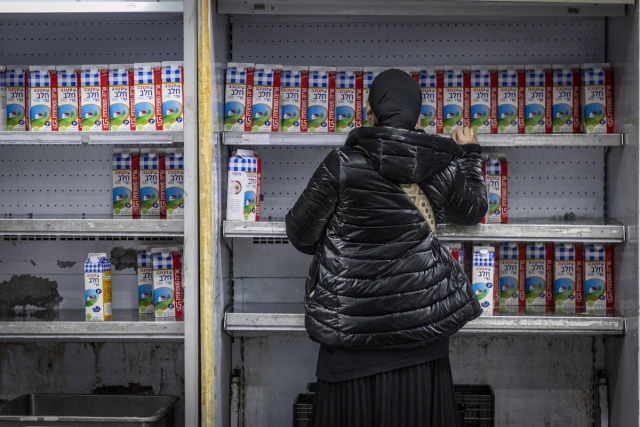
The Israel Dairy Board said on Tuesday it would halt the supply of raw milk to dairy producers in protest of the Finance Ministry’s proposed industry reforms, raising concerns about a potential nationwide shortage of dairy products.
On Tuesday evening, the Dairy Board had agreed to resume its supplies following a request from Agriculture Minister Avi Dichter, but plans for a large protest convoy to Jerusalem on Wednesday were unaffected.
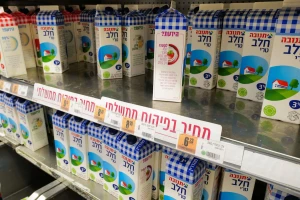
Several supermarkets had already begun implementing purchasing limits per customer on dairy products, Israeli media reported on Tuesday.
“Already now, in some retail chains, we’re seeing many products – mainly price-controlled milk – running out from the shelves. Those who decide what will be on the shelves are the dairies, not the dairy farmers. This is an extremely unusual event. Since the founding of the state, this method has never been used,” Army Radio correspondent Einav Karner told Kol Barama Radio.
The controversy stems from Finance Minister Bezalel Smotrich, who plans to lower the cost of living by breaking the centralized coordination mechanism for dairy production, a system that has its roots in the socialist past of the early state of Israel, and which he has denounced as “communist.”
Farmers have argued that the plan is rushed and would harm Israel's dairy production capabilities, as well as their livelihood.
Smotrich intends to cut local milk production by one-third, abolish existing tariffs that are meant to protect local production, lowering the price per liter by 15% as a result. The current system tightly controls the market via production quotas, a guaranteed target price, and protection from foreign competition through tariffs.
Israeli prices for dairy products are among the highest in the world and have regularly caused consumer protests. On the other hand, the temporary isolation of the nation during the war, marked by flight cancellations and weapons boycotts by some countries, has highlighted the importance of Israel's ability to produce essential domestic goods locally.
The broad plan was approved by the government in December and is now due for Knesset approval.
Speaking in the Knesset on Monday, Smotrich highlighted that three of Israel's largest dairy manufacturers – Tnuva, Tara and Strauss – control 85% of the market.
“I am announcing to the monopolies: if you stop producing milk, I will remove the tariffs on all dairy products,” Smotrich warned on Monday. “I am committed to the citizens of Israel – committed to ensuring there is milk for Israel’s citizens, committed to making things affordable here. No one will hold Israel’s citizens by the throat.”
Notably, the issue of the last remaining state-enforced monopolies has been pitting politicians from within the coalition against one another. Unlike most other Western nations, the political divide between free-market policies and more socialist financial policies in Israel runs not between left and right, but within most mainstream parties.
The separation between the political left and right in Israel is based much more on security issues, like support for a two-state solution. Therefore, the milk monopoly issue has set Smotrich and Prime Minister Benjamin Netanyahu against large parts of the Likud party. Netanyahu has long touted free-market policies and broke several monopolies during his tenure as finance minister
Netanyahu reportedly instructed officials to seek a compromise later in the legislative process that would preserve local production while opening the market to greater competition and lowering prices.
However, some Likud members, including Agriculture Minister Avi Dichter and the chairman of the Finance Committee, Hanoch Milwidsky, have voiced opposition to the planned reform.
On the other side, Knesset Member Dan Illouz wrote on 𝕏, “The Likud is supposed to be a national-liberal movement, not a branch of the agricultural lobby,” arguing that the reform “is an urgent necessity for lowering prices.”
“We all support Israeli agriculture and are proud of it, but the way to support it is not by closing the market and inflicting severe damage on the pocket of every citizen,” Illouz wrote.
During a nationwide protest last month, Israel Farmers Federation chair and secretary-general of the Moshavim Movement, Amit Ifrach, said, “Farmers and dairy farmers are the Iron Dome of the food security of the State of Israel. We will fight for our right to produce food security for the citizens of Israel and for the future of agriculture in the country.”
“We will not allow Smotrich to destroy production that has existed for 100 years, nor to trample the livelihoods of the dairy farmers and farmers who sit on Israel's borders, cultivating it to the very last furrow,” he warned.
Discussions about Smotrich’s proposed law are expected to continue in the coming days, as the Knesset’s legal advisor argues that the law should be split from a large package of proposals – called the Economic Arrangements Bill – and discussed separately.
You might also like to read this: