Israeli Navy continues buildup with 5 new amphibious landing ships amid growing threats from Turkey, Houthis





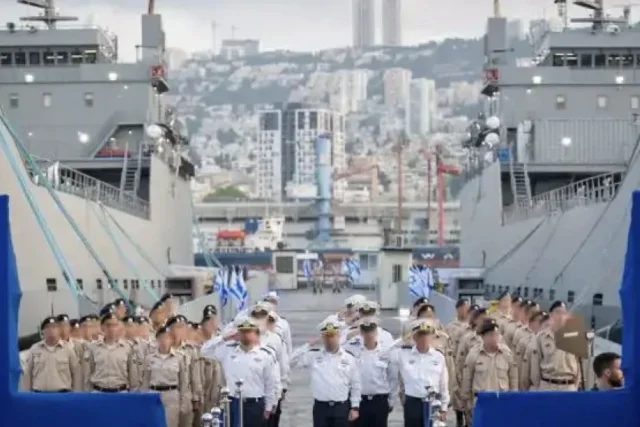
The Israeli Navy has always been the most overlooked and underfunded of the Israeli military’s three branches, but the escalating threats of the multi-front war have made a quick buildup more necessary than ever.
Israel Hayom reported that the Defense Ministry recently purchased five Triton boats, which are amphibious landing craft capable of quickly transporting soldiers, vehicles and logistical equipment to enemy shores, as the Navy weighs how to respond to future threats.
Senior military officials said the ability to quickly and safely deliver troops via sea will be key to future conflicts, though there have been no reports of such amphibious landings conducted by the IDF in recent years.
The Tritons join the INS Nahshon and INS Komemiyut, which arrived in Israel in 2023 and 2024, respectively. These two large landing ships can carry whole units and heavy equipment while serving as floating command centers, suggesting that the Navy intends to improve its force-projection capabilities far from Israel’s coast.
In 2024, the Navy said that the new vessels will “act as a central pillar in adapting the Israeli Navy to the modern and multi-arena battlefield.”
Force projection has largely been left to the Air Force, the spearhead of Israeli power for the last few decades. However, in a possible sign of things to come, in 2025 the Navy, rather than the Air Force, conducted strikes against the Houthi terrorists in Yemen, at a distance of over 1,000 km (620 miles).
According to Israel Hayom, the Israeli military is preparing to sustain long-term operations aimed at securing Red Sea shipping lanes and preventing missile attacks by striking Houthi targets – capabilities that cannot be provided by aircraft alone.
However, the main maritime threat to Israel lies in the Eastern Mediterranean, where NATO member Turkey has long sought to upgrade its air force by acquiring F-35 stealth fighter jets – all the while building a massive navy.
Since Turkey’s sharp pivot against Israel during the current war, Israeli politicians and experts have increasingly raised concerns over the hostile Turkish rhetoric, coupled with its military buildup. Turkey has also increased its influence in Syria, potentially giving it the ability to encircle northern Israel if it gains control from the sea as well.
Israel Hayom cited military officials who warned that if Israel truly decides it needs the capabilities to confront such a military threat from Turkey, it would need to launch a year-long, large-scale restructuring of the IDF, focusing on the navy.
Led by its flagship TCG Anadolu, the world’s first real drone carrier with a length of 232 m (761 ft), the Turkish navy dwarfs its Israeli counterpart. In addition to the giant Anadolu, it has 17 frigates – which are larger than any surface ship in the Israeli Navy – plus dozens of massive landing craft and other types of vessels.
Israel’s Navy only has the seven Sa’ar 5 and 6 missile corvettes as modern surface warships, along with eight older Sa’ar 4.5-class corvettes. The crown jewel is the six submarines, rumored to be nuclear-capable and armed with cruise missiles and torpedoes.
Earlier this year, the Navy revealed that during the war with Iran, one of its submarines set a new record for operating at the farthest distance from Israel in the history of the submarine fleet. The military also noted that submarines operated simultaneously in three arenas thousands of kilometers apart.
However, as in previous conflicts, Israel’s advantage is expected to rely heavily on technological capabilities, as its defense industry is unlikely to match Turkey’s scale in terms of manpower and production capacity.
The Sa’ar 6 has advanced radar and high-quality protection systems, including C-Dome, the naval version of the Iron Dome. Israeli companies have also been world leaders in producing unmanned maritime vessels (UMV), the naval counterpart to airborne drones and UAVs.
The Israeli Navy is expected to receive a seventh new submarine, the “Drakon,” later in 2026, while also developing drone carrier capabilities and a range of other strategic assets, according to Ynet News.
Vice Admiral Eyal Harel took command of the Israeli Navy in April. At the ceremony, IDF Chief of Staff Lt. Gen. Eyal Zamir noted that the military’s new multi-year plan will, “out of an operational necessity, expand the Israeli Navy and enhance its ability to operate with greater lethality, at greater depths and longer ranges, recognizing its long-range, lethal, and decisive capabilities, both overt and covert.”
You might also like to read this: