From praise to protests: Global reactions after Iran confirms Ayatollah Khamenei's death
Protesters try to storm US consular sites in Pakistan and Iraq



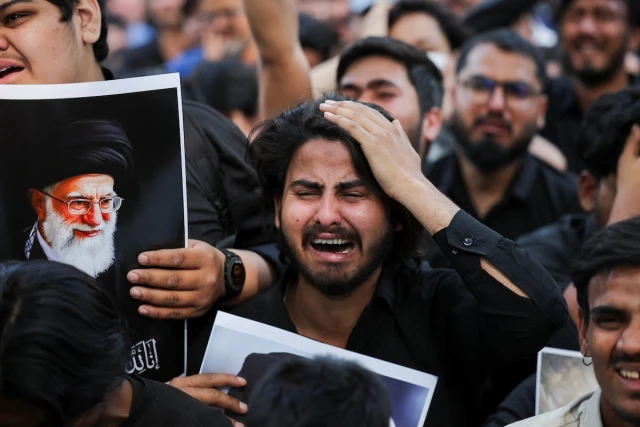
The official confirmation on Iranian state TV of the killing of Iranian Supreme Leader Ayatollah Ali Khamenei during an Israeli airstrike on Saturday caused strong reactions around the world.
While several of the United States’ allies expressed cautious optimism, other nations expressed concern, and the UN Security Council scheduled an emergency meeting to discuss the situation in Iran and the Middle East.
European leaders were mostly reserved in their reactions. In a joint statement, British Prime Minister Keir Starmer, French President Emmanuel Macron and German Chancellor Friedrich Merz called on the US and Iran to resume talks, while saying “the Iranian people must be allowed to determine their future.”
Macron later stated that France was “neither warned nor involved” in the strikes, while Britain's Defense Secretary John Healey told the BBC, "It is for the U.S. to set out the legal basis of the action that it took.”
The 22-nation Arab League called the strikes on Iran “a blatant violation of the sovereignty of countries that advocate for peace and strive for stability.” The Arab League has historically condemned both Israel and Iran for actions it says risk destabilizing the region.
Meanwhile, Morocco, Jordan, Syria, and the United Arab Emirates denounced Iranian retaliatory strikes, which had targeted several Gulf states, including Kuwait, Bahrain, Qatar, and the United Arab Emirates.
Canadian Prime Minister Mark Carney issued an uncharacteristic statement of support for the operation, in light of recent tensions with both the U.S. and Israel, saying, “Iran is the principal source of instability and terror throughout the Middle East.”
European Commissioner Ursula von der Leyen expressed cautious support for Khamenei’s removal, stating, "With Khamenei gone, there is renewed hope for the people of Iran. We must ensure that the future is theirs to claim and shape. At the same time, this moment carries a real risk of instability that could push the region into a spiral of violence.”
French government spokesman Maud Bergen welcomed Khamenei’s elimination, saying, “He was responsible for the deaths of thousands of civilians in his country and in the region, so one can only welcome his disappearance. It is now up to the Iranian people to choose their own destiny.”
European Union Foreign Policy Chief Kaja Kallas also expressed cautious optimism for the people of Iran.
“The death of Ali Khamenei is a defining moment in Iran’s history. What comes next is uncertain. But there is now an open path to a different Iran, one that its people may have greater freedom to shape,” she wrote to 𝕏.
The death of Ali Khamenei is a defining moment in Iran’s history.
— Kaja Kallas (@kajakallas) March 1, 2026
What comes next is uncertain. But there is now an open path to a different Iran, one that its people may have greater freedom to shape.
I’m in contact with partners, including those in the region that bear the… pic.twitter.com/s5CqUqHrWi
Australian Prime Minister Anthony Albanese said that Khamenei “will not be mourned.”
“He was responsible for orchestrating attacks on Australian soil. His passing will not be mourned,” Albanese told reporters on Sunday morning.
However, Russian President Vladimir Putin condemned the strikes as “a cynical violation of all norms of human morality and international law.”
In a note sent to Iranian President Masoud Pezeshkian, Russian President Vladimir Putin wrote, “Please accept my deep condolences in connection with the murder of the Supreme Leader of the Islamic Republic of Iran, Seyed Ali Khamenei, and members of his family, committed in cynical violation of all norms of human morality and international law.”
Likewise, the Chinese government said it was “highly concerned” by the strikes.
“Iran’s sovereignty, security and territorial integrity should be respected,” a Chinese Foreign Ministry statement said.
The official Ukrainian account on 𝕏, in contrast, posted a short note, saying, “Nothing beats the death of a dictator.”
Indonesia’s Ulema Muslim Clerical Council expressed “its deepest condolences for the death of Iran's supreme leader, Ali Khamenei, as a result of the Israeli-American attack on February 28.” It questioned the Indonesian government’s participation in the Gaza Board of Peace, saying, “The United States, which is playing a central role in managing the Palestinian conflict through the BoP (Board of Peace), faces a major question: is this strategy truly aimed at a just peace, or is it actually strengthening an unequal security architecture and burying Palestinian independence? Therefore, the MUI urges the Indonesian government to revoke its membership from the BoP.”
Indonesia is the most populous Muslim country, and had committed to joining President Trump’s Board of Peace, as well as sending troops to the Gaza International Stabilization Force (ISF).
North Korea's foreign ministry spokesperson said in a statement that the joint U.S.-Israeli strikes on Iran are "illegal aggression" and a violation of national sovereignty, state media Korean Central News Agency reported on Sunday.
Within the United States, there was also a range of reactions from members of Congress.
Democrat Rep. Yassamin Ansari (Ariz.), the only Iranian-American in Congress, called Khamenei the “epitome of evil” and said, “No one should mourn him and his death is a relief.”
However, she also cautioned that the strikes might not be enough to topple the regime.
“But removing one man does not dismantle a brutal regime,” she wrote on 𝕏. “Military force alone will not secure a democratic future for the Iranian people, and it risks putting U.S. troops in further danger if there is no serious plan for what comes next. An action of this magnitude demands strategy, clarity, and a credible path forward.”
Republican Senator Lindsey Graham, a longtime proponent of military action against Iran, praised the killing of Khamenei and President Donald Trump.
“The most recent statement by President Donald Trump confirming the death of the ayatollah and what is next is spot on,” Graham wrote to 𝕏. “As I have previously said, President Trump is moving into a league of his own as a Republican foreign policy president. With the historic success of this operation, called Epic Fury, he has, in my view, become the gold standard for foreign policy achievements as a Republican president.”
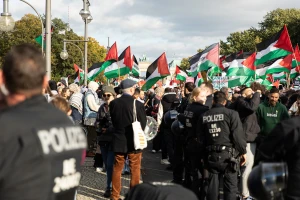
Meanwhile, protests and outrage were reported in both Iraq and Pakistan following the official announcement of Khamenei’s death.
In Karachi, Pakistan, a group of protesters breached the outer security layer of the U.S. consulate before being pushed back by security forces, who at one point opened fire on the protesters, Reuters reported. At least nine protesters were killed and another 34 suffered injuries, Karachi police said.
The death of Ali Khamenei is a defining moment in Iran’s history.
— Kaja Kallas (@kajakallas) March 1, 2026
What comes next is uncertain. But there is now an open path to a different Iran, one that its people may have greater freedom to shape.
I’m in contact with partners, including those in the region that bear the… pic.twitter.com/s5CqUqHrWi
Meanwhile in Baghdad, Iraq, police fired tear gas and stun grenades to scatter hundreds of pro-Iranian protesters who had gathered outside the Green Zone, where the U.S. embassy is located. Iraq has a large Shia Muslim population, which is largely supportive of the Iranian regime.
You might also like to read this: