









Explainer Economy and eschatology: Why does Iran lash out at all its neighbors?
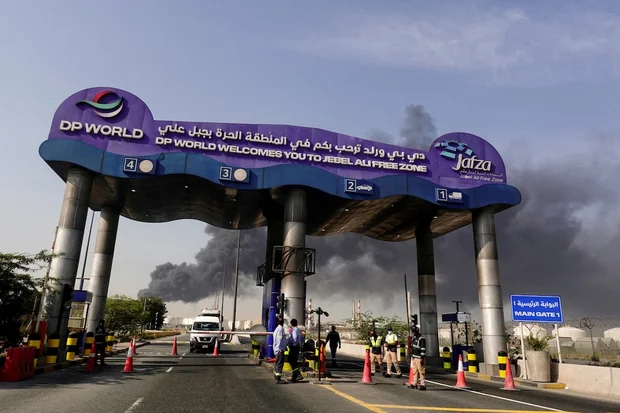
Instead of focusing its strikes on Israel and U.S. forces, the Iranian regime has attacked at least 13 countries, including nearly all of its neighbors, in what President Trump has called the “biggest surprise” of the war so far – but why?
One reason is that the regime is effectively a messianic Islamist death cult that might be bent on provoking all-out war; however, the mullahs do also have somewhat rational reasons for lashing out at their neighbors, even ones with whom they had good relations before the war.
The regime is trying to pressure U.S. allies, particularly those in the Gulf, to push the U.S. to end the war by harming both their economy and their image.
In the same way, the regime shutting down the Strait of Hormuz and raising global energy prices could, conceivably, put the Trump administration under pressure from countries worldwide.
However, it is also important to note that Iranian officials have acknowledged that some military units have gone “rogue” as communications are breaking down.
This could indicate either that radical IRGC officers are firing at will or that “doomsday” protocols are being followed without leadership having the possibility of reining them in, even if they wanted to.
Regional chaos
So far, Iranian attacks have of course hit Israel, but also all the Gulf countries, including Saudi Arabia, United Arab Emirates (UAE), Qatar, Bahrain, Kuwait, Oman; as well as Jordan, Iran’s neighbors, Turkey, Azerbaijan, Iraq, and even a UK base in faraway Cyprus.
Notably, Qatar and Oman had worked closely with the regime and continued mediation attempts even after the war had begun.
Gulf countries that were traditionally seen as hostile to Iran, like Saudi Arabia and the UAE, had declared that they would not allow the U.S. to use their territory for strikes on Iran to prevent themselves from being attacked, but to no avail.
Daily Update 5.3.2026 – Iranian attacks in the Middle East (Day 6 of the war)
— Israel-Alma (@Israel_Alma_org) March 5, 2026
Over the past 24 hours, Iran and its proxies have continued their offensive activities in a several of regional countries, using missiles, UAVs, and even attempting attacks using fighter jets. For the… pic.twitter.com/H8z7J9ZxyM
In addition, Iran’s eastern neighbor and nuclear power, Pakistan, has noted that the attacks against Saudi Arabia could trigger their defense agreement. Strikes against targets in Cyprus and Turkey also risk pulling the EU and NATO, as well as the large and well-equipped Turkish army, into the war.
Shrapnel and apparently errant strikes also hit Syria, while Israel has been launching massive strikes in Lebanon after Iran’s proxy Hezbollah attacked from there, involving yet another country.
Why attack countries not involved in the war?
First, a banal reason for the massive attacks on the Gulf is the short distance between them and Iran, enabling the regime to use short- and mid-range missiles and drones for strikes.
Despite usually hosting U.S. bases, most military sites in the Gulf were evacuated ahead of the war and have not been part of the fighting. This has not prevented Iran from using them as an excuse to attack its host countries.
But the strikes on the Gulf serve more than military purposes. They shatter the peaceful image of the region that has served as a basis to attract investment, as well as tens of thousands of businessmen and young, ambitious workers from around the world.
The attacks have also harmed oil and gas production, which immediately raised prices around the world, putting more pressure on the Trump administration.
Qatar’s Energy Ministry has warned that the war could endanger economies around the world, as energy-exporting countries in the Gulf could be forced to halt production within weeks, which could potentially double the price of a barrel of oil to $US150.
Qatar had already shut down liquid natural gas (LNG) exports, which constitute some 20% of the global market, after Iranian attacks hit key facilities.
JUST IN: 🇸🇦 Iran strikes Saudi Arabia's Aramco Ras Tanura oil refinery. pic.twitter.com/eTmPGRFAY5
— BRICS News (@BRICSinfo) March 2, 2026
In Saudi Arabia, the state oil company Aramco’s largest refinery in Ras Tanoura was repeatedly hit and forced to shut down. Strikes also hit several hotels and airports in Qatar and the UAE, powerful symbols of the peaceful prosperity and connectivity that these emirates have tried to project as the basis of their economies.
Iran’s state TV network has openly talked about the goal of killing “the idea of Dubai,” claiming that Kuwait had once been like Dubai but never managed to recover after the First Gulf War.
Widening the harm to economies around the world, the Iranian regime has also effectively closed off the Hormuz Straits by attacking and threatening ships, despite contradictory statements coming from the IRGC and the foreign ministry.
IRGC representatives said that the strait was closed only to ships of the U.S., Israel, Europe, and their Western allies, probably reflecting concerns over blowback from the regime’s few remaining backers in China and Russia.
Nevertheless, the straits are de facto closed now, cutting off 20% of the world’s oil and gas exports.
The perplexing attack on Azerbaijan, a country that also has a Shia Muslim population and whose president sent condolences on the death of Khamenei, may also be connected to a strategy intended to harm the world economy, if it wasn’t committed by a unit gone rogue.
The drone attack on an airport caused the closure of parts of the country’s airspace, which is among the few remaining air corridors connecting Europe to Asia, as Russia, Iran, and the Gulf region are closed due to the wars in Ukraine and Iran.For those wondering why Iran might strike Azerbaijan, take a look at this image from 3 days ago showing how air traffic to Asia has been rerouted from Iranian to Azerbaijani airspace - a corridor only 170 miles (270 km) wide. Most Asia-bound aircraft no longer overfly Russia, and… https://t.co/xuq7zZaYTH pic.twitter.com/sqkTP6vAIs
— ChrisO_wiki (@ChrisO_wiki) March 5, 2026
The power of belief
Safe to say, the Iranian strategy has not worked so far.
Instead of pressuring the U.S. to stop the war, the Gulf countries have pulled closer together and even started to fight back, at least rhetorically.
The Wall Street Journal reported this week that the UAE is considering freezing billions of dollars of Iranian assets held in Dubai, potentially crippling a crucial access point to global trade networks and a key channel to circumvent sanctions for Tehran.
The Gulf countries seem more inclined to join the fighting than to back down, and several countries have indicated they could launch retaliatory strikes. The same is true for Azerbaijan, which has a large, experienced military that is partly equipped with Israeli weapons.
According to the Qatari Ministry of Defense, Iran fired 14 ballistic missiles and 4 drones at them and that 13 ballistic missiles and all 4 drones were intercepted by Qatar’s armed forces. The 14th missile fell in the territorial waters of Qatar. pic.twitter.com/dCfhOK5sP0
— OSINTdefender (@sentdefender) March 5, 2026
However, despite unusually harsh threats even from former Iranian partner Qatar, it is not certain they will join Israeli and American planes in the skies over Tehran soon.
“Saudi Arabia looks more inclined to do so, and the UAE may too. But they all have good reason to focus on defense and leaving the offensive tasks to the U.S.,” Brig.-Gen. (ret) Yossi Kuperwasser, a former IDF intelligence officer, told The Hill on Wednesday.
In addition, the Gulf countries fighting alongside Israel and the U.S. would surely be exploited in Iranian propaganda, which also has the potential to reenergize the Islamist fight against the “unbelieving” emirates, who side with “the Jews” rather than their fellow Muslims, as they have long claimed.
In conclusion, it must be reiterated that this is a regime of fanatical ideologues and true believers in the Khomeinist creed.
Remember that, per the constitution, the mahdi, the Shia messiah, is the head of state, and the Supreme Leader is his placeholder on earth.
We mustn’t underestimate the earnestness of such beliefs.
Therefore, we cannot rule out the possibility that at least some of the clerics and military officials in Iran are bent on destroying the region, going down in a blaze of “glory” and paving the way for the mahdi to come to save and redeem them.
Popular article:

interview Easter message of resurrection hope amid war at Jerusalem's Garden Tomb

biblical commentary Let my people go: a Passover message for today
4 IDF soldiers killed, 2 wounded in fighting in southern Lebanon, as Israel eliminates dozens of Hezbollah terrorists
Receive latest news & updates
A message from All Israel News
Help us educate Christians on a daily basis about what is happening in Israel & the Middle East and why it matters.
For as little as $10, you can support ALL ISRAEL NEWS, a non-profit media organization that is supported by readers like you.
Latest articles:
Explainer Israeli fighter jets flew to Iranian border in ‘power projection,’ deterrence exercise ahead of elections next week

Explainer Israeli intel chief Zini travels to France to give counterterrorism advice amid violent riots – report

Explainer Founding trustee of Oxford’s Islamic studies department believed Muslims should ‘continue the work of Hitler’

Explainer 'Peaceful dialogue is not a crime:' Petition urges Lebanon to abolish its Israel Boycott Law
Explainer Israeli defense companies expand global reach with new deals in Cyprus, Germany and Canada