TikTok says Trump broke the rules; History says 14 other US presidents have too
Part 1: The War of the Algorithm

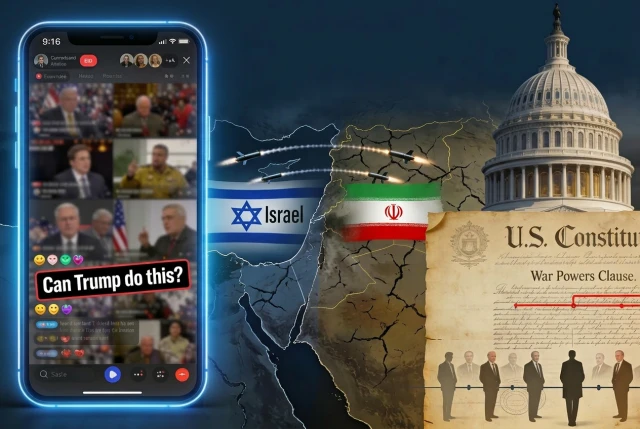
If you spend any time online, it feels like the whole world is asking one question right now: “Does Trump have the right to do this?”, to strike Iran alongside Israel without an explicit vote of Congress. In this first installment of a three-part series exploring the 2026 Israel-Iran conflict through history, law, and Biblical truth, we peel back the layers of the "TikTok mentality" to see what history actually records.
Clips fly by on TikTok, reels, and stories, usually framed as if this is the first time an American president has ever done such a thing. But history tells a different story, and for followers of Jesus, Scripture demands a different response.
Since 2024, Israel and Iran have moved from the shadows of proxy conflict into open confrontation. This reached a climax during the 12-day war in June 2025, when Israel struck Iranian nuclear and military sites. The United States joined with raids on facilities such as Natanz, Fordow, and Isfahan.
Now, in early 2026, the U.S. under President Trump has announced a broader operation against Iranian ballistic capabilities. None of this emerged in a vacuum. It stands on decades of threats, red lines, and promises made by leaders from both American parties. It is rooted in a history that spans nearly half a century, beginning with the 1979 Islamic Revolution when "Death to America" and "Death to Israel" became the official slogans of the Iranian regime. As we will explore in the next article, these were never mere words; they were the stated goals of a system designed for confrontation.
In the age of social media “pseudo-news” and “TikTok mentality,” history is repeatedly forgotten. It’s a fact. The U.S. Constitution gives Congress the power to declare war, yet since the Korean War in 1950, presidents of both parties have sent American forces into large-scale conflict without formal declarations.
In 2011, President Barack Obama joined a NATO campaign in Libya without new congressional authorization, arguing the air campaign didn't constitute "hostilities" under the War Powers Resolution. While legal scholars across the spectrum labeled it an "illegal war," the practical result was a reinforced trend of executive war-making.
So, when social media feeds suddenly 'discover' the War Powers Clause in 2026 and act as if President Trump is the first to ever act in this manner, they aren't necessarily defending the Constitution; rather, they are confessing their own ignorance or a case of collective amnesia.
Research shows that emotionally charged clips outrun careful reporting by a factor of six. As believers, we cannot be discipled by an algorithm. We are called to be “quick to hear, slow to speak, slow to anger” (James 1:19), not to outsource our discernment to a trending audio clip. Solomon warns us in Proverbs 18:17: “The first to state his case seems right, until another comes and examines him.”
When that long history is forgotten, constitutional arguments risk becoming little more than slogans, shared, reposted, and weaponized without understanding the framework they claim to defend.
Before we post, we must learn. Before we rage, we must repent.
As we look back at the real question of whether the United States had the authority to act. The deeper question now dominating the headlines is this: “Why did Israel strike Iran in the first place?”
In the next article, we move beyond the algorithm and the constitutional debate to examine the reality of Tehran’s nuclear ambitions, the legacy of Iran’s leadership, and the moral questions surrounding modern warfare.
You might also like to read this: