Do not become Edom: Why Christians must not turn against Israel

Obadiah does not teach Christians to canonize every act of the modern State of Israel. It does teach something many in the Church are forgetting: when God disciplines Israel, her brothers still have no right to gloat, plunder, isolate, or hand her over. That was Edom’s sin then. It remains Edom’s temptation now.
There are moments when the Church reveals not only what it believes, but what kind of heart it has become. This is one of those moments.
A real hardening is underway. Gallup’s February 2026 polling found that Americans now sympathize more with the Palestinians than with the Israelis. ADL’s 2024 antisemitism audit recorded 9,354 antisemitic incidents in the United States, the highest total since the organization began tracking them in 1979. And Human Rights Watch’s report on October 7 concluded that Hamas-led armed groups committed numerous war crimes and crimes against humanity against civilians in southern Israel. Public opinion does not settle theology. But it does shape moral atmosphere, and many Christians are now breathing an atmosphere thick with suspicion of Israel and casualness toward Jewish fear.
That is why Obadiah matters now. It is only 21 verses long, but it is a blade. Its target is Edom, descended from Esau, brother of Jacob. The point is crucial: Edom is not condemned merely as a foreign enemy. Edom is condemned as a brother who watched Jerusalem’s calamity, enjoyed it, entered the gate, and helped complete the humiliation. Britannica’s overview of Obadiah notes that the book is commonly tied to the Babylonian destruction of Jerusalem, when Edom was denounced for refusing to help Israel in the hour of disaster.
Judah judged; Edom condemned
And here the distinction must be made with total clarity: Judah really was under God’s judgment. Jerusalem did not fall because God had lost control of history. Judah had filled the land with idolatry, covenant-breaking, defiance, and injustice. Babylon was not an accident. Babylon was chastisement. Daniel’s vision even places Babylon as the golden head of imperial power—splendid in worldly glory, dreadful in force, yet still subordinate to the God of heaven.
But Obadiah’s thunder is precisely this: God’s judgment on Judah did not authorize Edom’s cruelty. Edom should have mourned. Edom should have sheltered fugitives. Edom should have opened mountain roads, not blocked crossroads. Edom should have said, “My brother is under God’s rod; I will not become the rod’s accomplice.” Instead, Edom stood aloof, gloated, looted, and handed over refugees. That is why Edom was judged. Judah was judged for rebellion. Edom was judged for savoring the judgment.
That distinction is not a footnote. It is the whole warning. Because many Christians now make Edom’s mistake in a more polished form. They do not usually betray Israel with swords. They do it with tone. They do it with posture. They do it by learning to sound severe without sounding brotherly. They watch Jewish grief become a spectacle, and somewhere under all the balanced language there is a terrible undertaste: she had it coming. Obadiah names that temptation. It is not prophecy. It is betrayal.
The Israel of Jesus’ day and the Israel of today

A great deal of Christian confusion begins when people speak as though modern Israel were a detached modern project, scarcely related to the Israel of Abraham, David, Isaiah, or Jesus. That will not do.
The Israel of Jesus’ day was not an abstraction. It was a Jewish people living in the land of their fathers, under Roman domination, yet still recognizably Israel. Britannica’s treatment of Judaism in the Roman period notes that under Roman rule, new Jewish groups in Palestine shared a common aim of seeking an independent Jewish state and were zealous for the Torah. Jesus did not minister inside a vague spiritual tradition floating above geography and covenant. He taught among the Jewish people in Judea, Galilee, and Jerusalem, in the same land bound to Abraham, Isaac, and Jacob by promise.
Nor did Jewish continuity in that land evaporate after Rome’s wars. Britannica’s entry on Roman Palestine notes that after the catastrophic revolts, Jews survived in Galilee and Tiberias became the seat of the Jewish patriarchs. That matters immensely. It means the line was battered but not broken. The people remained. The memory remained. The institutions remained. The covenant consciousness remained.
The continuity appears even in language. Britannica on the Hebrew language notes that Hebrew was revived as a spoken language in the nineteenth and twentieth centuries and is now the official language of Israel. That is one of the most astonishing civilizational continuities on earth: the language of the Hebrew Bible, guarded through long centuries of dispersion, spoken again in the ancestral land. The Declaration of the Establishment of the State of Israel states the point with historic force: Eretz-Israel was the birthplace of the Jewish people; there their spiritual, religious, and political identity was formed; and the modern state renewed Jewish independence after nearly two thousand years.
The land promise is not decorative
The land itself is not incidental in Scripture. God does not merely promise Abraham vague blessing. He promises land. He repeats that promise to Isaac and Jacob. He specifies it, reaffirms it, disciplines within it, and promises regathering after exile. Exile in the Torah is not cancellation of the land promise; it is covenant discipline inside it. Deuteronomy anticipates scattering and return. Jeremiah ties Israel’s continued national identity to the fixed order of creation. Ezekiel joins renewal to regathering. Amos ends with planting and permanence.
Christians may debate prudential politics. But it is not biblically serious to speak as though the land were a disposable prop in the very covenant history through which God chose to act. The New Testament does not erase this. It reorders the nations around Israel’s Messiah. Jesus is not the founder of a gentile religion detached from Jewish history. He is Yeshua, son of David, son of Abraham, born in Bethlehem, raised in Nazareth, presented at the Temple, keeping Israel’s feasts, teaching from Israel’s Scriptures, and declaring that salvation is from the Jews.
Equal salvation does not erase Israel—or creation
That is why Romans 10:12 and Galatians 3:28 must be read carefully. When Paul says there is no distinction between Jew and Greek in salvation, he does not mean Jews and Greeks cease to exist as meaningful realities. He means there is one Lord, one gospel, one way of salvation. Equal access to grace is not the abolition of history. It is the abolition of boasting.
And when Paul says there is neither male nor female in Christ, he is not erasing creation or teaching sexual interchangeability. He is announcing equal standing in Christ, not the collapse of created sex. The same apostle who wrote Galatians 3:28 still speaks elsewhere of husbands and wives, fathers and children, Jews and Gentiles. Equality in redemption is not metaphysical erasure. The gospel destroys superiority, not reality. It levels pride; it does not vaporize creaturely order or covenant history.
The Israel Jesus returns toward is not an imaginary Israel
If today’s Israel were merely a political accident, biblical eschatology would lose much of its concrete force. But Scripture does not end with Israel evaporating into abstraction. It ends with the God of Israel acting again in history toward Jerusalem, toward the Jewish people, and toward the nations gathered against them.
Zechariah does not describe a generic spiritual community under pressure. He describes Jerusalem surrounded, Judah under siege, the house of David mourning, and the Lord going forth to fight against the nations that come against that city. The same prophecy that speaks of Israel’s grief and repentance also speaks of the Lord’s intervention and kingship. The point is not difficult to see: the final drama of redemption does not bypass the Jewish people. It runs straight through them.
Paul says the same in Romans 11. Israel’s hardening is partial and temporary, not total and final. The Gentiles are grafted in, not enthroned as replacement owners of the root. And Paul climaxes with a promise that God’s covenantal mercy toward Israel is not exhausted: “all Israel will be saved.” Whatever debates remain about timing and sequence, Paul’s direction is unmistakable. The story ends not with Israel’s cancellation, but with Israel’s mercy.
Jesus Himself speaks this way. He does not talk as though Jerusalem were theologically irrelevant. He weeps over Jerusalem. He warns Jerusalem. And He says Jerusalem will not see Him again until she says, “Blessed is He who comes in the name of the Lord.” That is not the language of permanent severance. It is the language of judgment moving toward recognition.
Revelation, for all its symbolic density, does not flatten Israel into nothing. It gives us a holy city, a dragon raging against the woman and her offspring, a beastly system warring against the saints, and nations gathered in rebellion against God’s rule. One need not settle every millennial dispute to see the broad line: the end-times crisis is not anti-Jewish by accident. It is anti-Jewish because Satan hates the people through whom came the covenants, the Messiah, and the historical theater of God’s redemptive action.
That is why Christian coldness toward Israel is not merely a present moral failure. It is an eerie rehearsal for the end. And here Matthew 25 becomes especially searching. In the great judgment scene, the Son of Man separates the nations and treats their treatment of “the least of these my brothers” as treatment of Himself: hungry, thirsty, stranger, naked, sick, imprisoned. At minimum, the passage teaches that Christ so identifies with His people that to neglect them is to neglect Him. Many interpreters understand “my brothers” there to refer especially to Christ’s disciples or to His Jewish brethren in the tribulation setting that follows Matthew 24’s apocalyptic discourse. One need not resolve every interpretive dispute to grasp the blade-edge point relevant here: Jesus will judge the nations for how they treated those with whom He identifies in the hour of tribulation.
That should make Christians tremble. For what did Edom do when Jerusalem fell? It refused bread. It refused refuge. It refused brotherhood. It watched distress, then added to it. And what does Jesus condemn in Matthew 25? The refusal of food, water, shelter, visitation, and mercy in the day of need. The parallel is morally terrifying. Edom stood at the crossroads and handed over the vulnerable. Christ says that those who refuse Him in the vulnerable will hear, in the end, His refusal of them.
Israel, Iran, and the temptation to narrate Israel maliciously
This matters geopolitically as well, because many Christians now reduce every U.S. clash with Iran to one slogan: Israel dragged America into it. That line is rhetorically efficient. It is not historically serious.
Iran and Iran-backed forces have repeatedly attacked Americans and threatened strategic waterways central to global commerce. Reuters reported on March 27, 2026, that an Iranian strike on Prince Sultan Air Base in Saudi Arabia wounded U.S. troops, two seriously, and that hundreds of U.S. service members had been wounded in the broader conflict, with Americans also killed. That is not Israel forcing the United States into a private quarrel. Those are American casualties.
The maritime issue is just as concrete. A White House release from March 2025 said that it had been over a year since a U.S.-flagged commercial ship had safely sailed through the Suez Canal, the Red Sea, or the Gulf of Aden; that Red Sea traffic had fallen sharply; and that Houthi attacks had imposed major costs on shipping and supply chains. Those are not merely Israeli complaints. They are global trade, naval-security, and economic-stability concerns with direct American implications.
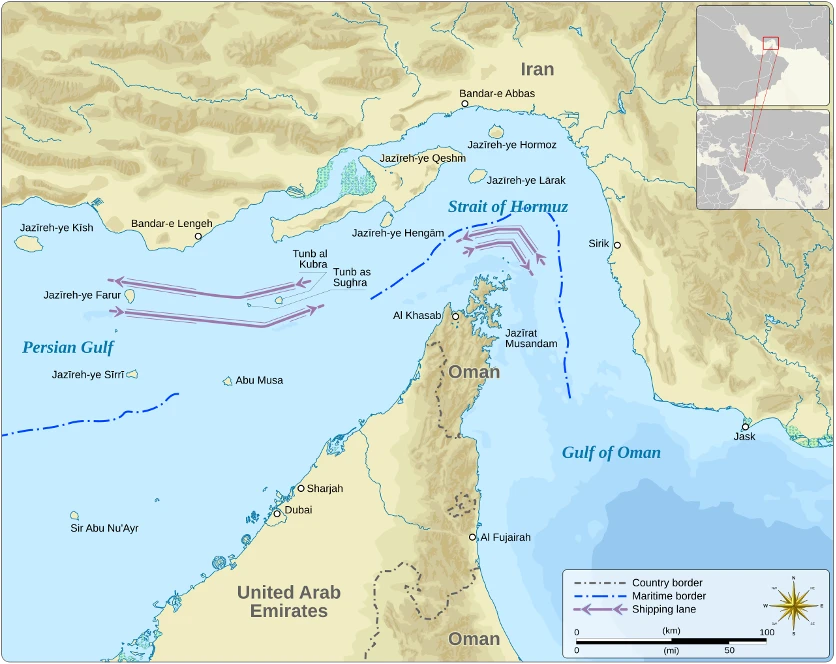
The Hormuz issue reinforces the point. Reuters reported that Iran said the Strait of Hormuz would remain open only to ships not linked to nations it deemed hostile, and noted that the strait handles about one-fifth of global oil and liquefied natural gas transit. In a separate Reuters report, Secretary of State Marco Rubio said U.S. objectives included destroying Iran’s missile and drone capabilities and securing free passage through Hormuz. Whatever one thinks of policy details, the United States plainly has interests of its own here: force protection, freedom of navigation, energy stability, and deterrence.
The nuclear dimension is no less serious. In its February 27, 2026 safeguards report, the IAEA said Iran’s stockpile included 440.9 kilograms of uranium enriched up to 60% U-235 and that the agency lacked full access needed to verify the current size, composition, or whereabouts of parts of that stockpile after military strikes. Again: one may argue over prudence, timing, or strategy. But one cannot honestly say the United States had no legitimate reason of its own to view Iran as a threat.
So the truthful formulation is not that Israel “made” America confront Iran. It is that Israel had reasons of its own, and the United States had reasons of its own. Their interests overlapped. That overlap does not prove manipulation. It proves intersecting strategic realities in the face of a real threat.
And that matters for Obadiah because Edom’s instinct was not simply to analyze Israel poorly. It was to interpret Israel’s distress in the most malicious possible way. That is the danger now. Once Christians begin assuming that every Israeli fear is theatrical, every Israeli danger exaggerated, and every American alignment with Israel evidence of coercion, they have already started down Edom’s road.
The Church must not become Edom with better branding
None of this means Christians must canonize every policy of every Israeli government. Ancient Judah was not sinless. Modern Israel is not sinless. Christians may and should speak about justice, prudence, civilians, restraint, and moral responsibility. But that is a different thing from covenantal contempt. Obadiah’s red line is not against all criticism. It is against the heart that savors a brother’s ruin.
So what should Edom have done when Jerusalem fell to Babylon? It should have hidden fugitives instead of trapping them. It should have opened roads instead of blocking crossroads. It should have given bread and water instead of directions to the executioner. It should have said, “My brother is under God’s judgment; I will not add my hatred to God’s fire.” That is the analogy Christians need.
When Israel suffers, Christians should not become rhetorical roadblocks. We should not become digital informants for Babylon. We should not join the nations’ ancient pleasure in Zion’s humiliation and baptize it as balance. We should pray, tell the truth, resist antisemitism, and refuse the old Edomite satisfaction that rises whenever Jacob is wounded.
Love Israel, then, not because Israelis are flawless. They are not. Love Israel because God is faithful. Love Israel because the Jewish people are not incidental to your faith but native to it. Love Israel because Abraham walked there, David ruled there, Isaiah prophesied there, the Temple stood there, Jesus taught there, died there, rose there, and will reign from there. Love Israel because the language of the prophets lives again in the land where those prophets first spoke. Love Israel because the Jewish people have not been erased by empire, exile, pogrom, Holocaust, or fashionable Western contempt.
And fear for the Church if it forgets this. For God did indeed send Babylon against Judah for covenant rebellion. But He then turned and judged Edom for savoring Jerusalem’s collapse, profiting from it, and handing over the fleeing remnant. That warning does not die in the sixth century B.C.; it widens toward all the nations and sharpens toward the end. The Messiah who came from Israel has not severed Himself from Israel, and the Judge who will return in glory will not be indifferent to how the nations treated those with whom He identifies in the day of tribulation.
The kingdom shall be the Lord’s. Not Edom’s. Not Babylon’s. Not Rome’s. Not the nations’. The Lord’s. And that is precisely why the Church must bless where God has bound His name, fear where God has spoken, and refuse, at all costs, the old Edomite pleasure of a brother’s fall.
You might also like to read this: