Are the Isaac Accords reframing ancient relationships for a modern world?
.jpg "Maayan Hoffman")




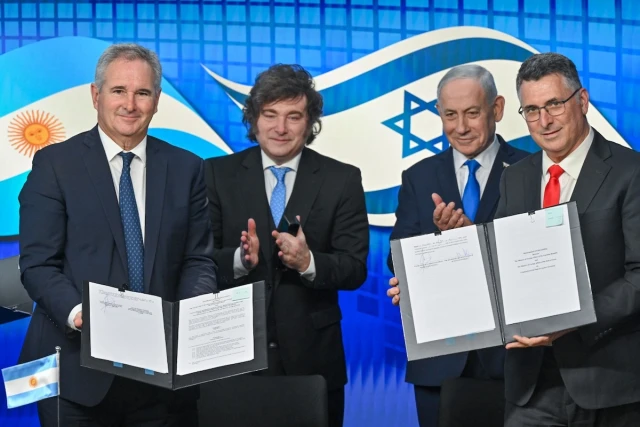
The religious and political implications of the Isaac Accords, signed last week between Israel and Argentina, run deeper than those of the Abraham Accords signed in 2020, at least according to some scholars.
“People today are more aware of the conflict between Arabs and Jews, which made the Abraham Accords especially resonant. But in terms of long-term significance and impact, the Isaac Accords carry greater weight,” explained Rabbi Prof. Jeffrey R. Woolf of Bar-Ilan University. “In the Bible, the relationship between Ishmael and Isaac is far from harmonious. Yet in the biblical narrative and in Jewish historical memory, Ishmael does not play a central role until the Arab conquests of the 7th century.”
In contrast, tensions surrounding the biblical figure of Isaac and his sons, Jacob and Esau, are more deeply rooted in both Judaism and Christianity and, therefore, may prove more difficult to navigate.
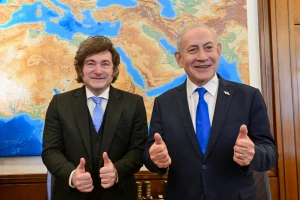
Ten days ago, Prime Minister Benjamin Netanyahu and Argentine President Javier Milei announced the launch of the Isaac Accords, which the Israeli government described as a “strategic framework aimed at strengthening cooperation between Argentina, Israel, and other like-minded nations in South, Central, and North America, the descendants of the Patriarch Isaac and nations founded on the Judeo-Christian tradition, countries that share common values of defending freedom, democracy, and the struggle against terrorism, antisemitism, and drug trafficking.”
This officially signed agreement is the first of its kind, with hopes that other countries will adopt it. To date, the term Isaac Accords is not yet widely recognized terminology in international diplomacy.
Woolf explained that the Isaac Accords can be understood as a symbolic framework for reconciliation between Jacob and Esau, whose relationship was marked by intense, deeply rooted conflict that began even before birth. Jacob and Esau were twins, born to Isaac and Rebekah. According to rabbinic tradition, Esau is associated with Edom, which later became linked to Rome and, as such, to the Christian world. Jacob, meanwhile, is identified with the people of Israel. In this sense, the Judeo-Christian tradition is seen as emerging from these two sons of Isaac.
“Jewish-Christian relations are embodied in, represented, and expressed in the constant struggle between Jacob and Esau,” Woolf told ALL ISRAEL NEWS.
The tension between Jacob and Esau is often understood as a struggle over identity and legitimacy, from the biblical story of Isaac’s blessing to later theological disputes between Judaism and Christianity.
“Today, the struggle between Judaism and Christianity surrounds the question of the acceptance or the rejection of Jesus, but even before that, the question became who is the real Israel,” Woolf went on.
He noted that, historically, Jews suffered persecution at the hands of Christians, including during the Inquisition, the Crusades, and the Holocaust, even more so than at the hands of Muslims.
He added that there was a longstanding theological tension within parts of Christianity regarding the existence of the Jewish people. However, according to Woolf, a shift has taken place in some Christian circles in recent decades, particularly following the founding of the State of Israel, moving away from what is known as Replacement Theology toward Restoration Theology.
Replacement theology holds that the Church replaced national Israel as God’s chosen people and, as Woolf explained, was based on the idea that the continued existence of the Jewish people posed a theological challenge. A straightforward reading of the Letters of Paul led some to conclude that, after the death of Jesus, the historical role of the Jewish people had come to an end.
Restoration theology, by contrast, maintains that God still has a distinct plan for the Jewish people in their land.
On the other hand, according to Prof. Elitzur Bar-Asher Siegal of the Hebrew University of Jerusalem, the term Isaac Accords could also imply that Jews and Christians are even closer than Jews and Muslims, since Abraham was the father of all monotheistic faiths, but Isaac and his sons, Jacob and Esau, were one generation closer.
“Jews and Christians are closer relatives,” Siegal explained.
He added that using another biblical name for an accord reflects how Netanyahu and the more right-wing, conservative, and religious leadership in Argentina are intertwining religion, war, and diplomacy. He said they are bringing the Bible into the international sphere to frame current events not only in political terms, but also in religious ones.
Prof. Alberto Spektorowski of Tel Aviv University agreed. He told ALL ISRAEL NEWS that governments in Latin America are moving further to the right or becoming more ideologically conservative, and that the name Isaac Accords reflects that trend.
However, this does not mean that the Isaac Accords will lack practical value. Woolf said that if all goes well, the Abraham and Isaac Accords will “complement each other beautifully” because, at their core, they are about peace, respect, and mutual support between the three great monotheistic religions, nothing more and nothing less.
“I'm actually very intrigued by the fact that there is an audience or market for recasting the relations between the Jews and the Christian West in biblical terms in a world which everybody predicted was going to go totally secular,” Woolf added.
He said that if these accords continue, they send a new message: that the “People of the Book,” as Muslims refer to Jews and Christians, can live side by side in this modern world. This, Woolf said, “is a very serious game changer in terms of the long-term peace and prosperity of the Middle East.”
Siegal concurred. He said that Muslims, Jews, and Christians are all part of one extended family, and that making peace, rather than war, is the natural path forward.
In that sense, while the Abraham Accords focused on geopolitical breakthroughs, the Isaac Accords may be aiming for something more foundational, a reimagining of ancient relationships in a modern world.
You might also like to read this: