Who are Iran’s proxies – and how does the war with Israel impact them?
As Iran goes, so goes the axis of resistance




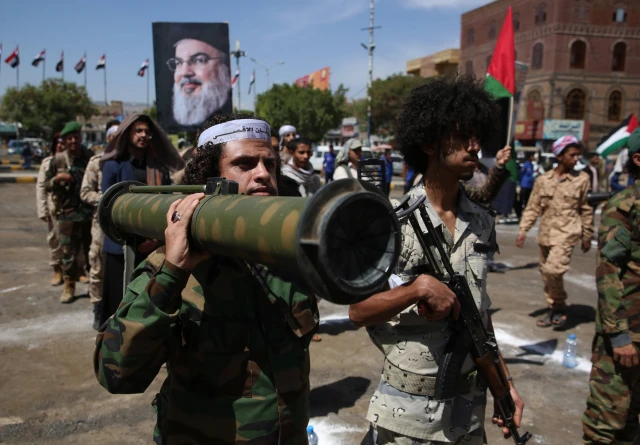
The opening salvos of the U.S.-Israel war against Iran took aim at what Israeli military and political officials have long referred to as the “head of the octopus” of an intricate proxy network – Iran’s axis of resistance.
Now with the Islamic regime in a fight for its own survival, the burning question is which of its proxies will join the war and come to its aid, or whether they can survive independently should the regime crumble.
The decline of these proxies – Hezbollah in Lebanon, the Houthis in Yemen, Hamas in Gaza, and militias in Iraq and Syria – is likely one of the desired outcomes of those who launched the war, said Sima Shine, a former Mossad official and Iran expert.
“Iran was very weak entering the war and getting out of the war, it will be much worse. So the capabilities of Iran to support the proxies is very low,” she told ALL ISRAEL NEWS during a briefing hosted by MediaCentral.
“If there is a change to the regime, or even within the regime with changing policies – there are varieties of scenarios that we can foresee – those proxies might be in a situation where they don’t get any economic support from Iran, financial support and no military support,” she said. “In this case they would be in a very difficult situation.”
Here is a breakdown of the Iranian proxies, some of which have already been active in this current conflagration – and some of which have seemingly gone dark.
HEZBOLLAH JOINS THE FRAY
“Hezbollah is the jewel in Iran’s proxy crown,” said Shmuel Bar, a former senior Israeli intelligence officer and Middle East Strategic Affairs expert.
On Monday night, Hezbollah entered the fray with a missile launch at Israel, drawing a massive Israeli response that could escalate into a protracted conflict and even a ground war.
Based in southern Lebanon, Hezbollah is Iran’s frontline against Israel. The terror group is the most heavily armed non‑state militia and was, at one point, believed to have 100,000 fighters and an arsenal of 150,000-200,000 rockets and missiles.
Bar contends that several factors depleted Hezbollah in recent years including the overthrow of Basher al-Assad’s regime in Syria in late 2024 – cutting off a major supply route for Iranian weapons – and a year of devastating military conflict with Israel after Oct. 7, 2023.
This current outbreak effectively ends American efforts to broker a diplomatic solution following the November 2024 ceasefire. Under that framework, Lebanon had committed to disarm the terror group. Now, Israel will likely aim to do so militarily, or at least create conditions on the ground that make it easier for the Lebanese army to do so.
“Israel doesn’t want to occupy Lebanon,” Bar told ALL ISRAEL NEWS during a press briefing with MediaCentral. “The goal is to weaken Hezbollah enough so that the Shiite population turns its back on them.”
Bar estimates that in the current campaign, Israel will seek to “take out as much as possible of Hezbollah’s mid‑range capabilities” and cripple its infrastructure, enabling the Lebanese army to assert control over the group.
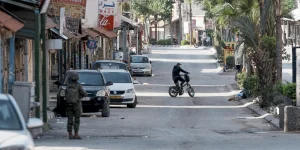
This week, the IDF Arabic spokesperson issued an evacuation order for hundreds of thousands of citizens in southern Lebanon, indicating Israel’s intention to deploy more troops ahead of a possible ground invasion.
WHERE ARE THE HOUTHIS?
When the war began on Saturday, many presumed that the Houthis in Yemen would begin launching their Iranian-supplied long-range missiles at Israel.
Aside from a condemnation of the U.S.-Israeli attacks on Iran, the group has been quiet as of day 6. According to various media reports, the Houthis leadership is split as to how to respond or whether to take an active role at all.
“The Houthis are a different issue and have different connections with Iran,” Shine said.
Though both parties deny a proxy relationship, Iran reportedly provides the Houthis with a wide range of missiles and drones. U.S. and Saudi officials say Iran supplies funding, weapons, training and technical know‑how, including drones and missiles used against Saudi Arabia, the United Arab Emirates, Red Sea shipping and, more recently, Israel.
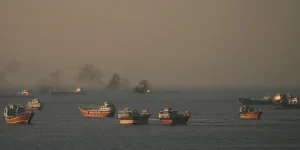
During the Israel-Hamas war, the Houthis battered Israel with long-range missiles and drones, and terrorized ships in the Red Sea, pirating several and sinking a few.
Last year, Israel struck Houthi targets including airports, port facilities and some of the group’s leadership taking out 13 high-ranking officials, including Yemeni Prime Minister Ahmed al-Rahawi.
PROXIES IN IRAQ
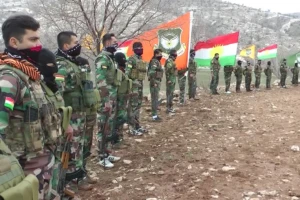
Swift to respond after the opening launches in Tehran were Iranian-backed militias in Iraq. Some of these groups have claimed drone strikes targeting U.S. assets in Iraq including bases in Irbil, the northern Iraq’s Kurdish region and in Jordan.
The Islamic Resistance in Iraq (IRI), Saraya Awliya al Dam, Kataib Hezbollah, Kataib Sayyid al Shuhada, and Harakat Hezbollah al Nujaba all announced they were joining the fighting.
“The Iraqi militias are trying to get a hold on the Iraqi system and are not willing to be integrated into the formal military – and the same goes for Hezbollah in Lebanon, even worse,” Shine said. “All of them will be suffering from a lack of financial support, equipment training and also ideological back up.”
RADIO SILENCE FROM HAMAS… FOR NOW
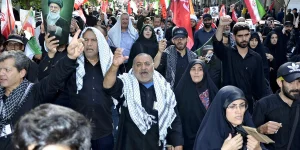
Hamas mourned the death of Supreme Leader Ayatollah Ali Khamenei, condemned Israeli attacks on Lebanese territory as a “dangerous escalation" and called on Arab and Muslim countries to unite against Israel.
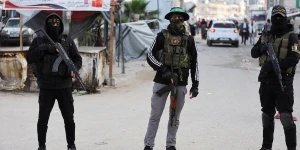
However, the terror organization in Gaza hasn’t made any attempt to get involved itself. It is anyone’s guess whether that is due to an exhausted weapons supply after a grueling two-year war, concern over losing power in Gaza or fear that military engagement could give Israel justification to renew its war in the Strip.
Hamas not only received financial backing from Iran, but also refuge. Iran funded the tunnel network and rocket arsenal that Hamas amassed in the Gaza Strip. It also welcomed its leader Ismail Haniyeh, who was assassinated in Tehran while attending the inauguration of Iranian President Masoud Pezeshkian in 2024.
DISARRAY AND UNCERTAINTY
The weakening of Iran’s “axis of resistance” could result in the gradual unraveling of its proxy system across the region. Bar noted that these developments factor into a larger geopolitical shift that will impact several nations across the Middle East.
If the U.S. and Israel succeed in severely damaging the Islamic Revolutionary Guard Corps (IRGC), which plays a crucial role in managing and supporting these proxies, the disintegration of these groups could follow – fundamentally altering Iran’s ability to project power beyond its borders.
You might also like to read this: