








War with Iran fuels stock market optimism in Israel, analysts warn prolonged conflict could undermine confidence
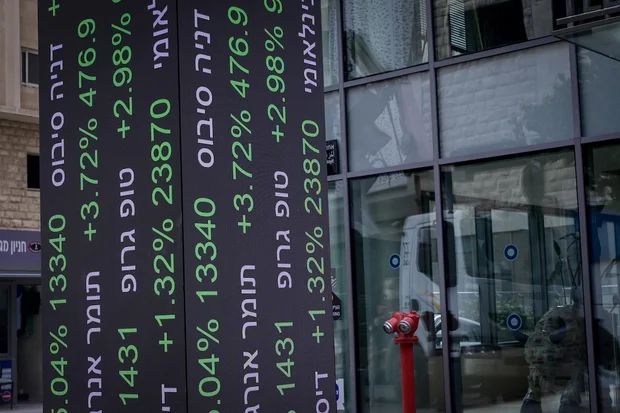
Market investors are betting that the ongoing war with Iran could strengthen the Israeli stock market and potentially become a game changer for the economy. At the same time, analysts warn that a prolonged conflict could have negative financial consequences.
Historically, the Israeli economy and the Tel Aviv Stock Exchange have tended to perform well following conflicts in the Middle East. The stock market surged in October after the Gaza ceasefire and the release of the remaining 20 Israeli hostages.
Amit Attar, deputy CEO and chief investment officer at More Mutual Funds, explained that the Israeli market has had a positive growth development since Israel's Operation Rising Lion offensive against Iran last June.
“Since the events of last June, we have been in a very impressive streak of gains on the local exchange, with January especially strong,” Attar stated.
“There is no doubt that part of the gains in recent months reflected market and investor expectations of progress in the campaign against Iran, whether in coordination with the United States or not. In a certain sense, the market has already priced in a scenario in which the Iranian risk is reduced, and now we are seeing something that is beginning to materialize,” he explained.
Israel’s economy has traditionally carried higher geopolitical risk than other developed nations due to its location in the Middle East.
While earlier conflicts did not fully resolve long‑standing regional tensions, Attar said that a significant change in Iran’s political landscape could potentially improve Israel’s geopolitical position and its economic prospects.
“If we indeed see a dramatic change in Iran’s standing, this could significantly reduce Israel’s geopolitical risk. The economic implications could be substantial – less funding for Hezbollah and Hamas, greater regional stability and more foreign capital flowing here and supporting the stock market.
He said that, over the past year, foreign investors – including those from Gulf countries – have begun investing in Israel and its stock market. Analysts say that if geopolitical risks ease, investment from abroad could increase further, though it remains too early to assess the full impact of the ongoing conflict on the Israeli market.
Aviel Azuelos, head of investments at Profound Investment House, noted that the length of the conflict will be a key factor influencing the Israeli economy.
“There is no doubt that in the short term uncertainty has increased,” Azuelos said. “The airspace, and probably the maritime space as well, will be closed for an unknown period, and a possible missile impact could significantly slow business activity in the economy,” he explained.
The investment expert warned that a prolonged war would potentially undermine the confidence of investors in the Israeli economy.
"In a scenario in which the operation drags on or fails to achieve the desired results, we will see the market as a whole decline, and foreign investors will most likely reduce their holdings in the Israeli market."
Rafael Gozlan, chief economist at IBI Investment House, highlighted the significant increase in capital flowing into the Israeli market since last October.
“In the past six months, the local market has posted excess performance, partly against the backdrop of a decline in the risk premium and a strengthening of the shekel. We have seen significant capital inflows into the local market," Gozlan explained.
"There is no doubt that much of the good news has already been reflected in prices. Beyond the short term, the main importance lies in the question of regime change in Iran, as this is a central factor that will affect the economy’s risk premium, including the attainment of additional diplomatic agreements, and from there also the economy’s growth potential," he concluded.
Popular article:
interview Easter message of resurrection hope amid war at Jerusalem's Garden Tomb

biblical commentary Let my people go: a Passover message for today
4 IDF soldiers killed, 2 wounded in fighting in southern Lebanon, as Israel eliminates dozens of Hezbollah terrorists
Receive latest news & updates
A message from All Israel News
Help us educate Christians on a daily basis about what is happening in Israel & the Middle East and why it matters.
For as little as $10, you can support ALL ISRAEL NEWS, a non-profit media organization that is supported by readers like you.
Latest articles:
Thailand turns to Israeli anti-drone technology to counter growing battlefield threat
Israeli fighter jets flew to Iranian border in ‘power projection,’ deterrence exercise ahead of elections next week
Israel targets nuclear fusion leadership as AI drives soaring energy demand

Israel's Sheba Medical Center climbs to 6th in global smart-hospital rankings
Israeli intel chief Zini travels to France to give counterterrorism advice amid violent riots – report