Syrian President Al-Sharaa says normalization talks with Israel collapsed at final stage




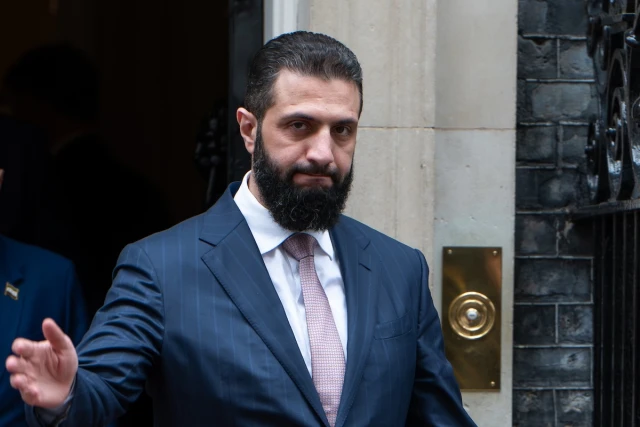
Syrian President Ahmed al-Sharaa told UK officials that Israel backed out of normalization talks with his government “at the last minute,” Israeli media reported on Tuesday.
“We tried direct and indirect dialogue and negotiations,” Al-Sharaa said during an event hosted by the Chatham House Royal Institute of International Affairs in London. “We reached good points, but Israel changed its mind at the last minute.”
Syria has launched attacks on Israel in 1948, 1967, and 1973, and the two countries remain technically at war, with Damascus not officially recognizing Israel. Al-Sharaa, who has a past linked to ISIS-affiliated jihadist groups, assumed power in December 2024 following the collapse of the Assad regime, which had ruled for 54 years. Under Assad, Syria was a key ally of Iran, serving as a central hub for Tehran’s regional and proxy operations.
Al‑Sharaa, who has been critical of Tehran’s role in Syria’s civil war, acknowledged that Iran’s military involvement in the conflict enabled the previous regime’s dominance over the Syrian people, and he stressed that his government’s concerns were with Iran’s presence in Syria rather than with the regime itself.
He argued that Damascus has “maintained restraint” in its ties with Tehran amid the Iran war, which has impacted most countries in the region.
“Iran has a problem because it is trying to develop ballistic missiles and nuclear bombs and influence other countries,” Al-Sharaa said. While criticizing Iran's aggressive policies, the Syrian president stressed that his country prefers diplomatic negotiations “over wars that will lead to additional risks.”
"As long as Syria is not attacked by any party, it will remain outside any conflict,” he added.
Before the fall of the Assad regime, Syria played a central role in Tehran’s transfer of arms to its powerful terrorist proxy Hezbollah in neighboring Lebanon. However, the new Syrian regime, which opposes Hezbollah, has largely shut down the country as a smuggling route for Iranian weapons to the group.
Al-Sharaa asserted that Syria remains committed to defending its borders and preventing the smuggling of weapons to Hezbollah and other Tehran-loyal terrorist groups. He noted that Syria had paid a high price for the rise of Hezbollah, which had played a central role in earlier efforts to fight against opponents of the former Assad regime.
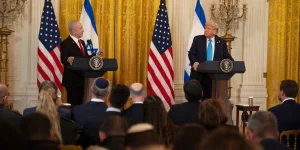
Washington previously placed a bounty on Al-Sharaa due to his history as a member of a jihadist terrorist group. However, in 2025, U.S. President Donald Trump met with the new Syrian leader, restored diplomatic ties with Damascus, and began efforts to normalize relations between Syria and Israel.
The Israeli government has indicated a willingness to improve relations with Syria, while voicing concerns over Syria’s continued hosting of anti-Israel jihadists and Al-Sharaa’s close ties with Turkey. Speaking on condition of anonymity in June 2025, an Israeli official said the country was exploring a potential security agreement and, possibly, broader peace with Damascus.
“It is better for us that the Syrian government is close to the U.S. and Saudi Arabia,” the Israeli official stated at the time. However, Israeli leaders remain skeptical about whether the new Syrian regime is genuinely a force for peace and moderation.
You might also like to read this: