Iraq denies receiving warnings of impending Israeli strikes on its territory




In recent weeks, the Iraqi government has received warning messages from an Arab country and a Western country stating that Israel is planning to carry out a series of extensive military strikes on Iraqi territory in the near future, the Saudi newspaper Asharq Al-Awsat reported this Friday. In response to the reports, Iraq’s official news agency published a statement in the name of the Iraqi Intelligence Service denying the claim that warning messages regarding imminent Israeli strikes in Iraq had been received.
Iraqi sources told the newspaper that the message delivered to Baghdad by the intelligence agency of a Western country came in the form of a comprehensive and detailed intelligence document prepared in Israel. The document reportedly included precise information about pro-Iranian militias, allegedly detailing senior militia figures, shadow operatives working in their vicinity, individuals managing financial and commercial businesses linked to the militias, and government institutions under militia influence.
The Iraqi sources said that “the scope and accuracy of the information stunned Iraqi officials,” with one stating that “informing the Iraqis of the nature of the information Israel possesses came at a critical time.”
According to the report, the Western intelligence agency informed Iraqi officials that Israel is on the verge of launching a broad operation in Iraq against the militias, and that Shiite politicians who reviewed the document “were reminded of the pager explosions in Lebanon.”
The warning messages received by Iraq prompted the Shiite parties that make up the alliance known as the “Coordination Framework” to take steps aimed at resolving the issue of weapons held by the militias.
A senior Iraqi official said that a country considered friendly to Iraq updated Baghdad about the content of the threat, leading Shiite factions to make concessions. The report claimed that the planned strikes would target government institutions linked to Shiite factions, the umbrella organization of Shiite militias (the Popular Mobilization Forces), and individuals with economic and military influence, as well as drone and missile sites, warehouses, and training camps.
Asharq Al-Awsat also claimed that it is believed the two messages accelerated political statements by Shiite militias calling for weapons to be centralized exclusively in the hands of the state. However, the militias requested time and freedom of action to complete the dismantling of their military capabilities – a matter disputed among Shiite faction and movement leaders – on a national basis and without external pressure from international actors.
Will the militias disarm?
In recent days, a number of leaders of pro-Iranian militias and figures close to the Iranian axis in Iraq have begun calling for “the concentration of weapons in the hands of the state,” a surprising development given that many of them had until recently spoken of the need for “resistance” against the American “occupation” (U.S. forces present in Iraq at the request of the Iraqi government). The first to issue such calls were Shiite politician Ammar al-Hakim (head of the “Wisdom Movement” party) and the head of the Federal Supreme Court, Faiq Zaidan, who is identified with the pro-Iranian axis and has been responsible for many rulings that protected militia interests.
Last night, militia leaders themselves joined the chorus. Qais al-Khazali, leader of the Asai'b Ahl al-Haq militia, one of the most prominent pro-Iranian militias, said at a party “victory” event celebrating the militia’s success in the recent elections that “the issue of ‘restricting weapons to the state’ is a state slogan, and it is the slogan of a strong Iraq, and we believe in this slogan.”
Al-Khazali stressed, however, that this must be done by an “Iraqi decision,” and that only Iraq will determine how and when it is carried out – meaning without international pressure, and especially without American pressure. Following al-Khazali, leaders of the pro-Iranian militias Ansar Allah al-Awfiya and Kataib al-Imam Ali also called for limiting weapons to the state, linking this to their electoral achievements, which they said make them part of the state and therefore impose greater responsibility on them.
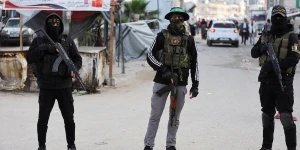
Other militias, led by Kata'ib Hezbollah and al-Nujaba, which are identified with a more hardline approach, rejected the call. In a statement, Hezbollah said that “resistance is a right and its weapons remain in the hands of its fighters, and talk of understandings with the government will only come after the withdrawal of all occupation forces, NATO, and the U.S. army, and after guaranteeing the protection of our people and holy sites from the threat of Jolani’s gangs and the Peshmerga” (a reference to Syria and the Kurds).
A senior figure in the al-Nujaba militia, known as “Abd al-Qader al-Karbala’i,” claimed that the Americans are “disregarding” an agreement requiring their forces to withdraw and are continually interfering in Iraq’s internal affairs – actions he said oblige the militia to retain its weapons.
You might also like to read this: