Hanukkah and Jesus

It is striking how much the book of Daniel speaks about prophetic times linked to the confrontation with the Greek empire: Alexander, the kingdoms that succeeded him, and Antiochus Epiphanes, a foreshadowing figure of the Antichrist. In this context, the festival of Hanukkah takes on particular significance, both for Jews and for Christians.
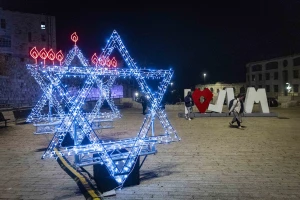
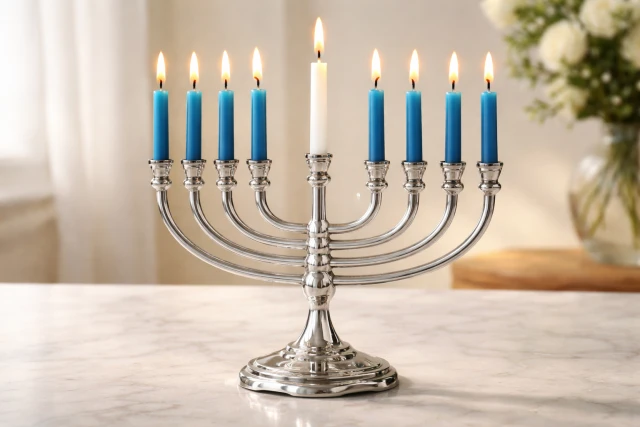
Hanukkah commemorates the victory of the Maccabees and the purification of the Temple in Jerusalem after Greek domination in the second century BCE. At the re-dedication of the Temple, a small flask of oil—enough for only one day—burned miraculously for eight days. To remember this miracle and this spiritual victory, Jews light an additional candle each evening of the festival on the Hanukkiah, the nine-branched menorah, proclaiming that light triumphs over darkness.
Antiochus did not seek merely to dominate Judea, but to erase Jewish identity through Hellenization. This struggle over identity runs through the centuries. Even today, Israel faces it, as does the Church when it cuts itself off from its Hebrew roots in favor of a theology shaped by Hellenism: replacement theology, an amillennial worldview, and at times ecclesial models inherited more from Babylon than from Jerusalem.
Judah Maccabee opened a decisive breach by defeating the Greek army, making possible the purification of the Temple and the restoration of worship. Makabi (from which the term Maccabee is derived) is an acronym formed from the first letters of the biblical verse: “Mi kamokha ba’elim YHWH” (Exodus 15:11) — “Who is like You among the gods, O LORD?”
The idea of a breach is also found in the prophet Micah (2:13): “The one who breaks open the way will go up before them; they will break through, pass through the gate… Their king will pass on before them, the LORD at their head.” In this verse, three figures appear: the Poretz, the one who makes the breach, opens the gate, and breaks down strongholds; the King of kings; and the LORD God.
At Hanukkah, Jesus is in Jerusalem, in the Temple: “Then came the Festival of Dedication at Jerusalem. It was winter, and Jesus was in the temple courts walking in Solomon’s Colonnade” (John 10:22). John’s Gospel surprisingly emphasizes this setting. The question asked by the religious authorities is direct: “If you are the Messiah, tell us plainly.” In other words: “Are you the Poretz, the One who opens the breach?” Jesus answers not with a slogan, but with a progressive revelation: “I am the gate,” “I am the good shepherd,” “The Father and I are one.” John 10 thus becomes like a parable, a living midrash on Micah 2:13.
Hanukkah also speaks of our spiritual DNA. Without roots, a tree withers. The Church needs to recover the fullness of biblical revelation in order not to be swept away by doctrinal viruses. Chuck and Karen Cohen write in The Roots of Our Faith:
“To avoid being blown about by every wind of doctrine, we need the whole of God’s revelation to strengthen our faith… Without roots, a tree is cut off from its source of life. This reality reflects the condition of a large part of the Christian Church.”
Finally, if Jesus is the Gate, He is also the One who knocks at the door. In Laodicea, He addresses religious but lukewarm Christians, calling them to restored fellowship. He does not come merely to convey a doctrine, but to reveal the Jewish people with whom He identifies (John 4:22), the Father who embraces us with His loving arms, and the Spirit who sets hearts ablaze. He is the Poretz and the King of kings, the Shamash of Hanukkah—the One who illuminates the world.
On this first day of Hanukkah, we stand with the Jewish community in Australia in their grief following this deadly attack, and we pray for the soldiers in Israel, who remain on the front lines.
You might also like to read this: