Israel’s defense tech boom: From battlefield to global markets


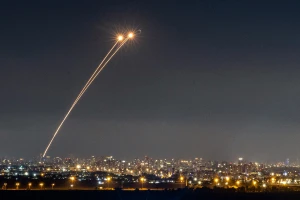
Necessity, it is often said, is the mother of invention. Few modern examples illustrate this more clearly than the development of Israel’s missile defense systems. In the summer of 2006, as rockets fell across northern Israel during the Second Lebanon War, engineer Chanoch Levin – then working at Rafael Advanced Defense Systems – returned to a home shaken by impact. There was, at the time, no effective technological solution to intercept short-range rockets. The prevailing doctrine relied on deterrence or retaliation.
Levin proposed a system that many within the defense establishment initially dismissed as impractical. Yet within five years, a team of several hundred engineers delivered what became the Iron Dome – a system that would go on to redefine short-range air defense. Its success did more than protect population centers; it altered the strategic calculus, allowing policymakers greater flexibility in responding to asymmetric threats.
That origin story is more than historical detail. It captures the underlying dynamic that continues to shape Israel’s defense sector today: innovation driven by operational necessity, refined under real conditions, and subsequently exported to a world facing increasingly similar challenges.
The Israeli defense industry was already a significant player before the current cycle of conflict. Companies such as Elbit Systems, Rafael, and Israel Aerospace Industries had long established themselves in areas such as unmanned systems, missile defense, and electronic warfare. What has changed over the past two and a half years is not the capability itself, but the extent to which it has been demonstrated in sustained operations. The operational tempo faced by the Israel Defense Forces has effectively turned these systems into continuously tested platforms, a factor that increasingly weighs on procurement decisions abroad.
The numbers suggest that demand is no longer driven by short-term cycles. Much of the detail around defense procurement remains undisclosed, given the sensitivity of contracts and customers. Publicly traded companies therefore offer one of the clearest windows into the pace of growth. Elbit Systems, Israel's largest listed company by market value, provides a useful benchmark. Its backlog, which stood at $13.7 billion at the end of 2021, rose to $28.1 billion by the close of 2025. The increase reflects continued momentum in international orders, as noted by the company’s CFO, Kobi Kagan. Around 72% of the backlog originates from outside Israel, with more than half scheduled for delivery over 2026 and 2027.
This shift – from domestic necessity to global adoption – is echoed across the sector. Few examples illustrate it more starkly than Next Vision Stabilized Systems. Listed in 2021, the company has seen its share price rise by roughly 6,000%, securing its inclusion among Israel’s largest listed companies and eventual promotion into the TA-35 index. Its products – stabilized imaging systems for unmanned platforms – sit at the core of modern drone operations. As of March 2026, Next Vision reported an order backlog of approximately $288 million, representing a 185% year-on-year increase.
The company’s trajectory reflects broader structural trends. Modern conflicts have shifted toward unmanned, distributed systems that prioritize scalability and cost efficiency. Defense planners, particularly in the United States, are increasingly focused on high-volume, lower-cost drone fleets, alongside efforts to replace Chinese-made components in sensitive systems. Against that backdrop, the addressable market for drone camera technologies is projected to expand from around $14 billion in 2025 to $24 billion by 2029, while the broader drone market is expected to grow from $45 billion to $76 billion over the same period.
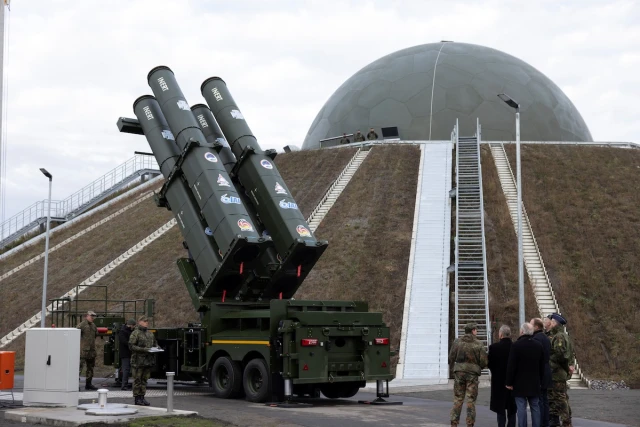
Israeli air defense is undergoing a similar transformation. Its layered architecture has evolved over time, beginning with systems such as the Iron Dome for short-range threats and extending to higher-tier capabilities, including the Arrow Weapon System, developed by Israel Aerospace Industries, and David’s Sling, jointly developed by Rafael Advanced Defense Systems and Raytheon. Together, these systems form a multi-layered shield designed to intercept threats at varying ranges and altitudes.
Recent developments, however, point toward a new phase. Israel has begun deploying high-energy laser systems designed to intercept rockets, drones, and other short-range threats at a significantly lower cost per engagement. In May 2025, the Ministry of Defense reported that these systems had successfully intercepted multiple targets during live operations. Rafael has since unveiled variants such as the Iron Beam 450, alongside mobile systems including the 10kW Lite Beam and the 50kW Iron Beam-M, capable of being mounted on vehicles. These systems, deployed operationally toward the end of 2025, are intended to address a central challenge in modern warfare: the cost imbalance between inexpensive offensive systems and costly defensive interceptors.
Analysts have increasingly framed this as an economic problem as much as a military one. Seth G. Jones, writing for CSIS, has highlighted the “cost asymmetry” inherent in drone and missile warfare, where relatively inexpensive systems can impose disproportionate costs on defenders. Meanwhile, Jack Watling of RUSI has emphasized the importance of continuous adaptation in modern conflict. Israeli systems, shaped by repeated operational use, appear aligned with both.
Not surprisingly, the financial markets have taken note. The Tel Aviv Stock Exchange launched a dedicated defense index in November 2025, grouping companies exposed to military and security demand. The index has risen by roughly 33% since inception, reflecting investor conviction that the current cycle is structural rather than temporary.
The performance of the defense index suggests that investors see more than a short-term response to conflict. Backlogs are expanding, delivery schedules extend several years into the future, and demand is increasingly international.
That shift helps explain why Israeli companies are gaining ground. The sector was already established, but the past two and a half years have accelerated its relevance. Systems developed under pressure – tested frequently and adjusted quickly – are now being applied to a wider set of security challenges beyond Israel.
Israeli defense companies have spent years operating under constraints of limited budgets, short response times, and constant operational pressure. Those same conditions – cost sensitivity, the need for rapid deployment, and proven reliability – are now shaping procurement priorities in Europe and elsewhere, making technologies designed for Israel’s security environment increasingly suited to a broader market.
You might also like to read this: