Israeli builders say foreign workers have improved construction efficiency, safety





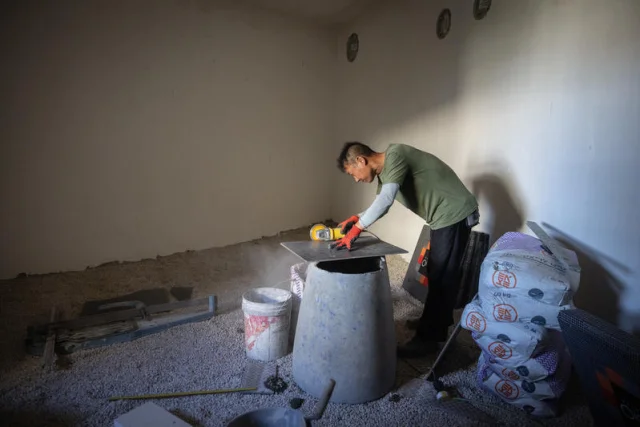
Since the Oct. 7, 2023, Hamas attack, Israel’s construction industry has undergone a major shift in its workforce, with foreign laborers replacing many of the Palestinian workers who previously entered Israel for work.
Zeev Salant and Baruch Hadad, co-CEOs of Omer Construction and Engineering, established in 1986, say the construction industry has seen improvements in productivity, safety and efficiency since Palestinian workers were largely replaced by foreign labor over the past nearly three years.
In an interview with The Jerusalem Post this week, Salant said the company has been doing better with foreign laborers, particularly those from China, who have helped extend working hours and improve workplace safety.
“The state of the workforce in our industry is better for us than it was before the war. "We're better off without Palestinian workers,” he said.
He said Palestinian workers who previously entered Israel from the West Bank had to pass through checkpoints each morning to reach construction sites by 6:30 a.m. According to Salant, delays and the need to return through the checkpoints before dark limited the working day, while foreign workers have allowed construction sites to operate for longer hours.
In addition, he said, the Palestinian laborers "celebrated the Muslim holidays and also took time off on the Jewish holidays. This is no longer the case. Work now begins at the site at 6:30, 6:45 at the latest – and continues until 7 p.m. The laborers also work on Fridays, not to mention that work safety and quality have improved immeasurably. As far as we're concerned, the current situation is much better than it used to be."
Salant also attributed improvements in workplace safety to the shift in the workforce. "As soon as we switched to foreign manpower, safety improved immeasurably because they are more disciplined. With foreign workers, it's easier to keep safety under control."
Hadad similarly welcomed the shift to foreign labor, citing improvements in construction quality, staffing and project timelines. He said foreign laborers “have many advantages: quality, the number of managerial staff that must be kept on the site to obtain the required quality, and construction time. In my opinion, these factors are making projects more economically worthwhile than in the past. We still have a shortage of workers, but if this trend continues, the construction industry will experience a significant upgrade.”
Hadad said the government had previously restricted the recruitment of foreign workers.
“The government did not allow us to bring high-quality foreign personnel until the war began and the entry of Palestinian workers was halted. That was the situation."
The two executives also discussed higher construction-material costs and bureaucratic challenges facing the industry since the outbreak of the war.
Hadad said the war and the resulting disruptions made it difficult for the company to meet its original timetable, while the construction industry was effectively shut down for months. He said the disruption had significant financial consequences for construction companies, affecting profitability and creating additional challenges that the industry has continued to address.
“The war and the ensuing crises were certainly real problems,” Hadad said. “It was very difficult to meet the original timetable, and the state is overlooking the objective difficulties and refusing to recognize them.”
Omer's Chief Financial Officer Gideon Kahlon said the company has continued expanding its portfolio despite the challenges, including through urban renewal projects, including residential plazas and public buildings.
“In recent years, we have built a very substantial portfolio, but it is well known that development is something that takes years, especially urban renewal. We now have 13-14 urban renewal projects as well as development projects,” Kahlon said.
An estimated 115,000 foreign workers are currently employed in Israel's construction industry, including a significant number from China.
You might also like to read this: