Egypt's Christians under fire: Sectarian violence & lack of official support plague ancient Coptic community




Earlier this year, a report by the U.S. State Department’s Commission on International Religious Freedom (USCIRF) drew attention to the systematic restrictions of religious freedom against Egypt’s Christian community.
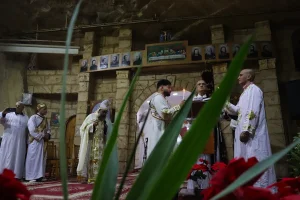
The complex set of challenges for the ancient Coptic church was encapsulated by a violent sectarian attack that took place on July 8 in the village of El-Tal El-Qibliya in the Minya Governorate, highlighting the dangerous combination of mob violence and the systematic lack of a response – if not outright complicity – from authorities.
Bishop Makarios of Minya sounded the alarm via a post on 𝕏, writing that “some extremists are now in Al-Til al-Qibliyya village in Minya, assaulting the Copts, smashing the priest's car, preventing worshippers from leaving the church, and cutting off the electricity.”
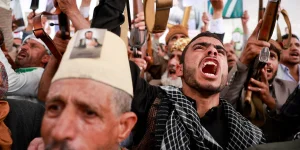
The “extremists” were a crowd of Muslim locals who chanted “we don’t want a church,” pelting the building and nearby homes of their neighbors, Coptic Christians, with stones.
A church source familiar with the events told the news outlet Al Manassa that worshippers were wounded after being hit by stones, and that the priest’s car had been destroyed.
On July 8, 2026, extremists attacked Copts in Al-Tal Al-Quibly Village, Minya Governorate by blocking worshippers from leaving a house where they gathered to pray for years. They also cut electricity, smashed the priest’s car, and threw stones at families, injuring people.… pic.twitter.com/HD1mUPOxyM
— Coptic Solidarity (@CoptSolidarity) July 10, 2026
A resident of the village told the Egyptian Initiative for Personal Rights (EIPR), “Our children have the right to learn the word of God at this age. We want to take them to a Sunday school. We want them to find a place to make friends, play, and feel embraced.”
The incident and its background shed light on the long history of suffering of Egypt’s ancient community of Coptic Christians. While Christian worship was never banned outright, the Ottoman Empire and then the Egyptian state haven’t allowed the construction of new churches for hundreds of years.
This despite Christians always having been an unusually large minority in Egypt, compared to other states in the region. According to a Wall Street Journal report from 2015, “The Egyptian government estimates about 5 million Copts, but the Coptic Orthodox Church says 15–18 million. Reliable numbers are hard to find but estimates suggest they make up somewhere between 6% and 18% of the population.”
This forced thousands of Christians around the country to travel long distances to the next church for prayers and worship, causing financial difficulties and overcrowding, and also leading to the widespread practice of “home churches,” where Christians, who mostly live concentrated in their own neighborhoods, designated one home as a makeshift church.
According to a report about the incident by EIPR, this is what happened in El-Tal El-Qibliya, with authorities and the village's Muslim residents being well aware of this practice.
In 2016, the government passed a law attempting to regulate and legalize many of these churches. The status of some 3,800 churches and affiliated church buildings has since been regulated, according to the Main Committee for the Legalization of Churches.
عاجل:
— Anba Macarius (@AnbaMacarius) July 8, 2026
يقوم بعض المتطرفين الآن في قرية التل القبلية بالمنيا، بالاعتداء على الأقباط وتحطيم سيارة الكاهن ومنع المصلين من الخروج من الكنيسة وقطع التيار الكهربائي.
كان قد تم إبلاغ المسئولين عدّة مرات بتحرُّشات متعدّدة سابقة، موثقة بصور وفيديوهات تؤكد تكرُّر الاعتداءات.
حمى الله مصرنا.
However, USCIRF noted that “there are many sites facing regulatory issues, including 2,000 pending legalization requests for churches and other Christian facilities,” stressing that this is “in stark contrast to the government’s demonstrated capacity to rapidly authorize and implement large-scale religious construction projects for Muslim houses of worship.
In the past year alone, approximately 926 mosques were created or maintained, bringing the total number of refurbished mosques to 13,971” since 2014.
The incident in El-Tal El-Qibliya exactly exemplified the combined pressure from local sectarian violence and official lack of action, as it was local residents who violently opposed the existence of the church despite official approvals from the authorities.
The church's priest, Father Pavlos Kamal, had repeatedly warned security authorities of earlier incidents of incitement and harassment during religious services, but to no avail, EIPR reported.
Bishop Makarius also wrote on 𝕏 that “officials had been notified several times of previous multiple harassments, documented with photos and videos confirming the recurrence of the assaults.”
Finally, a large-scale attack was triggered when a church-affiliated truck parked in front of the home of a local non-commissioned police officer, who began arguing with two Christians.
Several other Muslim residents joined the altercation and began beating them, and the situation escalated to the point where a mob pelted Christian-owned houses, including the church building, with stones, and cut off the electricity in the area.
In a follow-up post, Bishop Makarius wrote that “Security forces arrived at the village, and the instigators and participants in the riot events were arrested, and investigations are underway with them. The damages have also been documented, and the injured have been sent for treatment.”
However, EIPR said that four Christians were also detained, including the two who were initially assaulted, and another who was detained while filming the events. They were released the next day – but only after withdrawing their complaints.
“The story of Tal al Qibliya is not unique. It closely mirrors the experiences of many other villages in Minya and across Egypt,” wrote Layla Khaled on the news website Daraj.
She listed several similar incidents connected to the church issue, for example, in the village of Al Azib, also in Minya Governorate, Muslim locals began harassing the Christian community that wanted to construct a church.
Eventually, the home of one Coptic family was burned, other homes were hit with stones and Molotov cocktails, and a mob marched through the Christian neighborhood chanting, “Long or wide, we’ll bring the church down.”
Construction was suspended after security forces restored order in the town.
On October 22, a mob of 200-300 Muslim villagers attacked Christian Coptic homes and properties in the city of Alminya following rumors of a romantic relationship between an 18-year-old Christian boy and a Muslim girl.
— Dan Burmawi (@DanBurmawy) October 27, 2025
Attackers threw stones, smashed windows, looted homes, and…
Other incidents of harassment caused by various pretexts have long haunted the Christian community in Egypt.
Dan Burmawi, Jordanian Christian and CEO of the think tank Ideological Defense Institute (IDI), wrote in October of last year that “a mob of 200-300 Muslim villagers attacked Christian Coptic homes and properties in the city of Al-Minya following rumors of a romantic relationship between an 18-year-old Christian boy and a Muslim girl.”
According to him, the mob “threw stones, smashed windows, looted homes, and set fire to Christian-owned agricultural fields.” As in nearby El-Tal El-Qibliya, police arrived late and then arrested several attackers as well as Christians.
Rather than prosecuting the attackers via a regular court, authorities allowed a “customary reconciliation session” that ruled to exile the Christian boy, banish his and another Christian family for five years, and demand reparations from the victims, Burmawi wrote.
According to EIPR, Minya Governorate is a hotspot for anti-Christian attacks, listing 50 incidents of discrimination and sectarian violence between 2017 and 2021.
Martin Morawetz, Secretary General of ecumenical aid organization Christians in Need (CiN), told Catholic website Kathpress that the situation for Christians improved slightly after Abdel Fattah al-Sisi came to power in 2013, though it has worsened recently.
“Since the outbreak of the Iran war, we have seen a significant increase in hostility and attacks against the Christian community in Egypt,” Morawetz said.
Particularly alarming, Morawetz added, “is that children are now among the attackers, throwing stones or insulting Christians.”
“The Egyptian state must take decisive action against religiously motivated violence, prosecute the perpetrators, and guarantee the protection of all citizens regardless of their religious affiliation,” he urged.
Help more people find our reporting from Israel! Leave a quick Google review of our website HERE .
You might also like to read this: