








Israel condemns UNESCO decision recognizing Sebastia as Palestinian heritage site, says it aims to 'erase Jewish history'
Decision represents ‘continued politicization of UNESCO,’ foreign ministry says
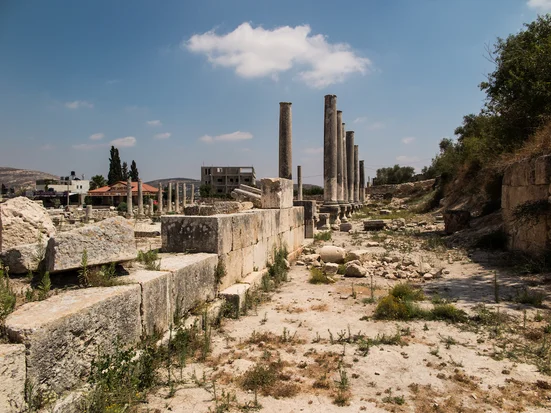
Israeli leaders decried the recent decision at a UN Educational, Scientific and Cultural Organization meeting to list Sebastia in Samaria on both the World Heritage List and the List of World Heritage in Danger, saying the UN body ignores “the ancient Jewish presence and connection” to the site.
Nina Ben-Ami, Israel’s Deputy Director General for UN and International Organizations, addressed the body before its decision, saying, “Israel firmly opposes the Palestinian cynical request to classify Sebastia as a heritage site in danger.”
She noted that the Palestinian submission of the site to UNESCO “deliberately ignores” the established historical connection of the site to Jewish and Israeli history.
“Sebastia is the historical, biblical capital of the ancient Kingdom of Israel, from the 9th century BCE,” Ben Ami told the body. “Sebastia, also known as Samaria, appears in the Bible many times, first in the book of Kings, which describes how King Omri bought the hill, where he built the city Shomron.”
She also noted its connection to Christian traditions regarding the burial of John the Baptist.
“According to Christian tradition, it is where John the Baptist was laid to rest in 30 AD,” Ben Ami said, noting that the biblical “King Ahab and Queen Jezebel reigned there.”
“There is a long pattern of Palestinian attempts to disguise the fact that the people of Israel are indigenous to the land of Israel; to undermine the legitimacy of the existence of Israel as the national home for the Jewish people,” the Israeli ambassador noted.
Sebastia, located on a hill near Nablus (biblical Shechem), has consistently been identified by scholars and archeologists as the site of ancient Samaria.
As described in the book of 1 Kings, King Omri established the capital of the biblical Kingdom of Israel in Samaria (later renamed Sebastia) as part of his efforts to unite the northern kingdom under his authority.
King Omri is mentioned in contemporary records, such as the Mesha Stele, discovered in 1868, and in Assyrian records which refer to Israel as the “house of Omri.”
According to the biblical account, Omri’s son Ahab became one of Israel’s most infamous kings, leading the nation further into the worship of other gods and engaging in confrontations with prophets, such as Elijah.
The site contains remains from multiple historical periods, including the Iron Age, Assyrian, Persian, Hellenistic, Roman, Byzantine, and Islamic eras.
Sebastia is also the site where John the Baptist was buried according to some Christian and Muslim traditions.
Foreign Minister Gideon Sa’ar, in an event marking Guatemala’s recognition of the City of David as an important Jewish heritage site last week, said the Palestinian leadership is trying to “rewrite history.”
“The Palestinian leadership and those who assist it in international institutions are not merely trying to rewrite history. They are trying to fabricate an entirely false narrative,” Minister Sa’ar said. "Erasing and denying the Jewish connection to this land.”
“No political decision can erase the history of the Jewish people in the Land of Israel.”
— Israel Foreign Ministry (@IsraelMFA) July 24, 2026
From Foreign Minister @gidonsaar’s remarks at the ceremony marking Guatemala’s recognition of the City of David as a heritage site, held in parallel with UNESCO’s discussion of the… pic.twitter.com/vT0NYiu2q8
Minister Sa’ar said that Sebastia, “bears witness to the Kings of Israel. It holds the evidence of our people’s deep historical roots in this land.”
“No vote in an international organization can change what lies beneath our feet,” he added.
The Foreign Ministry said the decisions regarding Sebastia, and Lebanon’s Beaufort Castle, “reflect the continued politicization of UNESCO and the new low to which the Organization has descended, as well as the ongoing erosion of its credibility.”
The ministry said that “Instead of safeguarding the cultural heritage of humanity, the Committee has once again chosen to serve as a platform for advancing one-sided Palestinian political initiatives against Israel, in a disgraceful attempt to erase the clear Jewish connection to the Land of Israel.”
The Israeli government acknowledges the risk of destruction to Sebastia, but accuses the Palestinian Authority of causing permanent damage to the site through construction projects, and also of failing to safeguard its artifacts.
The PA built a road and a playground on parts of the site in recent years. Israeli authorities have also accused the PA of ignoring artifact looting from the site, a common problem in archeological sites within Judea and Samaria, due to the lack of clear oversight and authority by a central archeological body.
For that reason, the government advanced a bill intended to create a civil antiquities authority for Judea and Samaria, to help preserve and oversee sites which are not currently under the authority of a civilian organization.
The Foreign Ministry also decried UNESCO’s decision to blame Israel for destruction at the site of Beaufort Castle in Lebanon, saying, "The decision concerning Beaufort Castle in southern Lebanon illustrates a profound moral failure.”
“For years, the Hezbollah terrorist organization systematically transformed the historic Crusader fortress into a military stronghold, constructed a vast network of terror tunnels beneath the site, and launched hundreds of rockets, missiles, and unmanned aerial vehicles against Israeli civilians from the compound,” the Ministry accused. “Lebanon allowed a terrorist organization to exploit a heritage site on its sovereign territory for military purposes, yet UNESCO chose to ignore the systematic abuse of the site and instead place the blame on Israel, which is defending its citizens.”
UNESCO previously listed the Tell es-Sultan site in Jericho, identified with the biblical city of Jericho, as a Palestinian Heritage site, without any reference to its significance for Jewish and Israeli history.
Popular article:
interview Easter message of resurrection hope amid war at Jerusalem's Garden Tomb

biblical commentary Let my people go: a Passover message for today

4 IDF soldiers killed, 2 wounded in fighting in southern Lebanon, as Israel eliminates dozens of Hezbollah terrorists

Receive latest news & updates
A message from All Israel News
Help us educate Christians on a daily basis about what is happening in Israel & the Middle East and why it matters.
For as little as $10, you can support ALL ISRAEL NEWS, a non-profit media organization that is supported by readers like you.
Latest articles:

North American Jewish organizations to recruit 100 professionals to combat antisemitism

‘No need’ for pre-election Iran strike, IDF chief says as gov’t, opposition trade blame for potential escalation – report

terror attack 2 Israeli soldiers killed, 2 terrorists eliminated in Hebron shooting; IDF says much larger attack was prevented

analysis A people dwelling securely? Israel’s strategic standing, 3 years after Oct 7

Hamas on wheels: What I found in Dearborn reveals a troubling history and a battle over Israel