








Bumper wheat harvest hailed as 'very good news for Israeli agriculture'
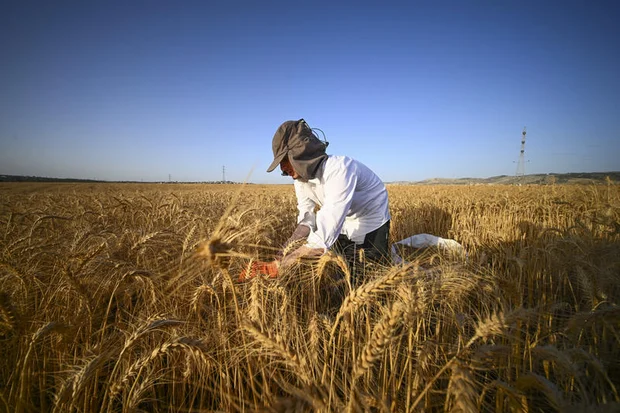
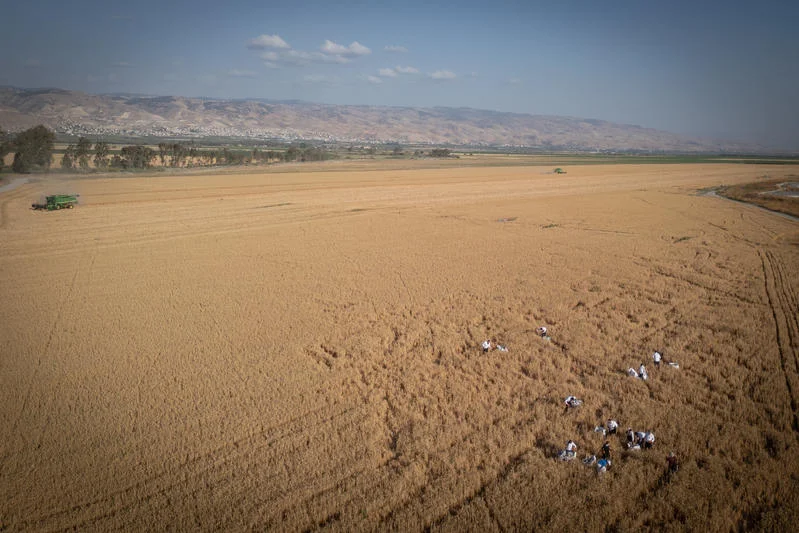
While Israel typically produces 80,000 to 100,000 tons of wheat per season, this year's yield is predicted to reach 140,000 tons, according to a review by the Agriculture and Food Security Ministry’s Extension Service.
Experts assess that this year will smash the previous record of 126,000 tons, largely due to the way rain has fallen gradually throughout the season in intervals, according to a Ministry of Agriculture document in Hebrew obtained by ALL ISRAEL NEWS.
Israel typically receives most of its precipitation between October and May, leaving the summer months parched and dry. However, this year’s distribution of rainfall was almost perfectly timed, especially in drier areas in the south where 70% of wheat is grown, according to officials.
Some 450 milliliters (nearly 18 inches) of rain fell in the Negev region, some of which fell at the start of the season in the fall, helping the seeds take root, and then again in March, providing the ideal conditions for the best-quality crop.
The resulting harvest is estimated to be a 55% larger crop than average, a huge relief to farmers following a particularly challenging winter season. Moreover, the wheat quality is proving to be exceptional so far.
Now Israel is in a position to store more grain than usual, especially as some that would usually be lower-grade and suitable for animals has reached standards qualifying it for Israel’s emergency reserves.
Responding to the developments, Yuval Lipkin, head of the Agriculture Ministry Food Security Administration, explained, “Wheat is one of the most strategic crops for Israel’s food security,” adding, “this is very good news for Israeli agriculture.”
Countries in more temperate climates have to dry their wheat carefully, which takes time and money, but Israel’s hot summers work well for drying out the wheat naturally, so it can be stored for long periods without spoiling.
At the Organisation for Economic Co-Operation and Development (OECD) international conference on food security of the future in May, Lipkin emphasized the importance of storing food for an uncertain future.
“The reality in the past years illustrates just how our food security cannot be taken for granted,” he said. “Israel is working to strengthen… local production as a central anchor, alongside development of tools for managing risks and improving supply chains.”
“The combination of a strong food security policy and dialogue and collaboration on the international scene is the key to building stable food systems over time.”
The event held in Paris brought together representatives from OECD countries to discuss solutions for sustainable provision of nutrition worldwide.
Israeli farmer Ben Gross of Givat Yoav in the Golan Heights expressed his commitment to farming despite the constant challenges and unknowns that plague the profession.
“In my view, growing wheat and other crops, and keeping agricultural land active, is Zionism,” he said. “No slogans. I truly believe that. It does not matter whether it is one dunam or 1,000.”
Agriculture is deeply ingrained in the culture of Israel even back to biblical times, as reflected in the yearly cycle of feasts which follow the seasons of planting and harvest. The Feast of Weeks, Shavuot, is a time of first fruits and harvest, and the fall feasts also are celebrations of the fruit of the land, in particular the seven species promised in Deuteronomy, and recognize God’s goodness:
“For the Lord your God is bringing you into a good land, a land of brooks of water, of fountains and springs, flowing out in the valleys and hills, a land of wheat and barley, of vines and fig trees and pomegranates, a land of olive trees and honey, a land in which you will eat bread without scarcity, in which you will lack nothing, a land whose stones are iron, and out of whose hills you can dig copper. And you shall eat and be full, and you shall bless the Lord your God for the good land he has given you” (Deuteronomy 8:7-10).
The Gezer calendar, an archaeological relic dating back to 925 B.C., lists advised sowing and reaping times according to Israel’s early and latter rains and gives us a glimpse into ancient Israeli agricultural practices, showing how modern farmers are as dependent as their ancestors were on the rain.
Neighboring countries could rely on the Nile and Euphrates rivers, but Israel has always had little in the way of fresh water available, except that which falls from the sky, replenishing the Sea of Galilee, and then flows down to the Dead Sea.
Modern Israel now has great expertise in water technologies, developing desalination and drip irrigation systems which have made the desert bloom, but ultimately agricultural success still requires rain, which is something no one can control.
“This season was a reminder of how dependent agriculture is on nature,” Yaniv Blushtein from Kibbutz Beit Kama reflected after 30 years of farming. “It is also a major achievement compared with last year, when there was almost nothing to harvest in the Negev.”
Tom Koren, an experienced farmer growing wheat and barley at Kibbutz Shoval, stressed the importance of providing enough grain to store for the future.
“The wheat we grow enters the State of Israel’s emergency reserves,” he said. “I would like more people to know that and understand how meaningful it is.”
Is All Israel News’ faithful reporting important to you? Be part of it—help us continue by becoming a $5/month supporting partner.
Popular article:
interview Easter message of resurrection hope amid war at Jerusalem's Garden Tomb

biblical commentary Let my people go: a Passover message for today

4 IDF soldiers killed, 2 wounded in fighting in southern Lebanon, as Israel eliminates dozens of Hezbollah terrorists

Receive latest news & updates
A message from All Israel News
Help us educate Christians on a daily basis about what is happening in Israel & the Middle East and why it matters.
For as little as $10, you can support ALL ISRAEL NEWS, a non-profit media organization that is supported by readers like you.
Latest articles:
North American Jewish organizations to recruit 100 professionals to combat antisemitism

‘No need’ for pre-election Iran strike, IDF chief says as gov’t, opposition trade blame for potential escalation – report
terror attack 2 Israelis critically wounded, 2 terrorists killed in Hebron shooting; IDF says larger attack was prevented
analysis A people dwelling securely? Israel’s strategic standing, 3 years after Oct 7

Hamas on wheels: What I found in Dearborn reveals a troubling history and a battle over Israel