Israel races to take out Iran’s military & production sites as Trump insists talks with regime are ‘going very well’
Israeli officials express uncertainty over Trump's intention, IDF seeks to damage regime as much as possible




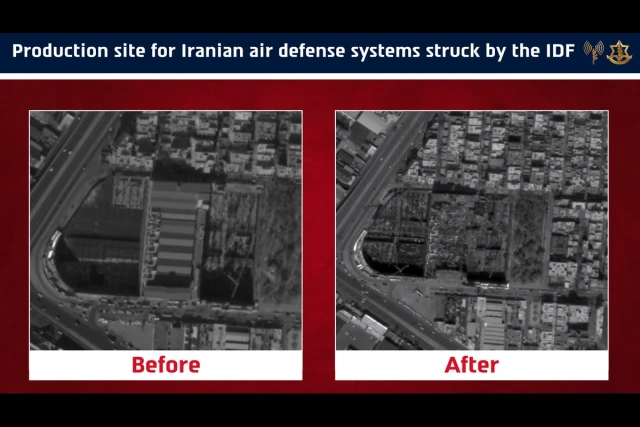
The Israeli military is racing to take out as much of Iran’s military equipment – and the production facilities necessary to rebuild it – amid uncertainty over how long U.S. President Donald Trump intends the war to continue.
The president reiterated in a Truth Social post on Thursday that talks over a ceasefire with Iran “are ongoing and, despite erroneous statements to the contrary by the fake news media and others. They are going very well.”
“They’re lousy fighters, but they’re great negotiators,” he quipped in his opening remarks at the cabinet meeting, insisting, “They are begging to make a deal. Not me.”
However, Iranian representatives have roundly denied that talks are ongoing, while a regime official told Reuters on Thursday that the 15-point U.S. proposal was “one-sided and unfair,” serving only US and Israeli interests, and lacking “the minimum requirements for success.”
President Trump on Iran: "They want to make a deal. The reason they want to make a deal is they have been just beat to shit." pic.twitter.com/vIYjf5IlFQ
— CSPAN (@cspan) March 26, 2026
Amid this uncertainty, the Israel Defense Forces has shifted the focus of its bombing campaign from aiming to undermine regime stability to deepening the destruction of the regime’s production capability, attempting to ensure the military rebuilding process after the war will take as long as possible, The Wall Street Journal reported
The IDF’s daily updates about its airstrikes in Iran have reflected that shift, with the most recent updates showing a focus on production sites rather than individual soldiers and checkpoints of internal security forces, as before.
Sources told the WSJ that Israel’s leadership believes Trump could end the war soon. But sources close to Prime Minister Benjamin Netanyahu told Ynet News on Thursday evening that Israel’s political and military leadership remains uncertain about Trump’s intentions and how much time is left to achieve all of its goals in Iran.
🎯STRUCK: Iran’s central explosives production facility in Isfahan, used by the regime to develop materials for weapons.
— Israel Defense Forces (@IDF) March 24, 2026
The site had been previously targeted, and recent efforts to restore its capabilities were identified.
In parallel, dozens of additional targets were struck,… pic.twitter.com/txvFgng2wH
“At present, the positions of Tehran and Washington make the likelihood of an agreement somewhere between slim and nonexistent. Still, Trump could surprise us,” an Israeli official told The Jerusalem Post.
On Thursday, Trump declared, “As per Iranian Government request, please let this statement serve to represent that I am pausing the period of Energy Plant destruction by 10 days to Monday, April 6, 2026, at 8 P.M., Eastern Time.”
However, unnamed mediators told the WSJ that the regime had not made such a request and continues to demand more concessions before even agreeing to the suggested in-person meeting in Pakistan.
Meanwhile, an official from one of the mediating countries told The Times of Israel (TOI) he thinks Trump is leaning toward ordering a U.S. ground operation in the Gulf to ramp up military pressure further.
Thousands of Marines and Paratroopers of the 82nd Airborne Division are due to arrive in the theatre of operations in the coming days.
But another official from a mediating country told TOI that capturing and holding on to Kharg Island would drag out the war by several weeks, while both officials agreed that the regime is unlikely to capitulate, regardless.
Several reports this week suggested that Gulf leaders, particularly from Saudi Arabia and the United Arab Emirates, want the U.S. to go all the way to toppling the regime instead of negotiating an end to the war.
⚓️🔴ELIMINATED: The IRGC Navy Commander Alireza Tangsiri, in a precise IDF strike in Bandar Abbas. pic.twitter.com/ubrIhNbLL2
— Israel Defense Forces (@IDF) March 26, 2026
On Thursday and Friday, most Israeli strikes in Iran focused on production sites. However, an overnight strike also eliminated the commander of the IRGC Navy and his intelligence chief, in a strike apparently meant to weaken Iran’s ability to continue the blockade of the Strait of Hormuz, as well as defend against a potential capture of the islands in the area.
On Thursday, the IDF said that more than 1,000 production-related targets have been struck so far as part of a campaign that includes “the systematic targeting of production lines, with the aim of degrading the regime’s manufacturing, development, and research capabilities across its military industries.”
On Friday morning, the Israeli forces struck Iran’s central site for the production of missiles and sea mines in the central city of Yazd.
🎯STRUCK: 2 key naval cruise missile production sites in Tehran.
— Israel Defense Forces (@IDF) March 25, 2026
IAF fighter jets targeted facilities used by the Iranian regime to develop and manufacture long-range naval cruise missiles capable of destroying targets at sea and on land. pic.twitter.com/RhYP6QTDFt
“The site was used for the planning, development, assembly, and storage of advanced missiles intended for launch from cruise platforms, submarines, and helicopters toward both mobile and stationary maritime targets. This is the site in which the Iranian Navy develops the majority of their missiles and sea mines,” the IDF explained.
The WSJ also reported that the Israeli military has already begun returning to some targets to deepen the damage.
U.S. Central Command said the American and Israeli strikes have badly damaged or destroyed most of the regime’s facilities to build missiles, drones and warships.
CENTCOM Chief Adm. Brad Cooper said on Wednesday that his forces had hit 10,000 targets in Iran and that Israel had struck “thousands more.”
You might also like to read this: