









Iran threatens to strike Dimona nuclear site if US & Israel seek regime change in the country
Regime also threatens to target energy infrastructure across the Middle East
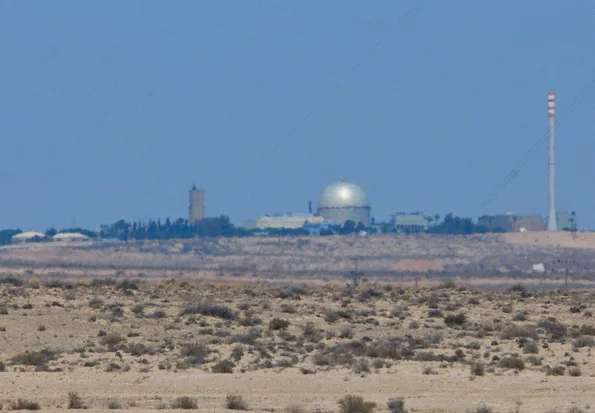
Iran has threatened to target Israel's Dimona nuclear facility if Israel and the United States try to overthrow the regime in the Islamic Republic, the regime-affiliated ISNA news agency reported on Wednesday, citing an Iranian military official.
The Dimona facility in the Negev desert is Israel's main nuclear research center and is widely believed to home to an undeclared nuclear weapons program. The Dimona nuclear facility has long been considered one of the most sensitive strategic infrastructure facilities in the Middle East, the Israeli government never officially acknowledging the presence of a nuclear weapons facility at the site.
In recent days, Prime Minister Benjamin Netanyahu and President Donald Trump have said that the objective of the current operation against the Iranian regime is to “create the conditions for the Iranian people to replace the regime.”
Both Israel and the U.S. have targeted facilities and infrastructure associated with the Islamic Revolutionary Guard Corps over the past few days, in order to weaken regime and security forces ahead of possible attempts by Iranians citizens to overthrow the government.
⭕️The IDF has carried out a series of strikes on the Basij and internal security command centers in Tehran belonging to the Iranian terror regime.
— Israel Defense Forces (@IDF) March 4, 2026
The targeted command centers were used by the Iranian regime to maintain control throughout Iran.
The IDF also struck the regime’s… pic.twitter.com/nvlq72W6vJ
The Basij militia is one of the primary security agencies the regime used to brutally repress protests in January, with multiple documented incidents of security officials firing on unarmed protesters, leading to thousands of deaths.
🎯STRUCK: A large Iranian terror regime military compound in eastern Tehran.
— Israel Defense Forces (@IDF) March 4, 2026
Struck command centers in the compound include:
* The IRGC headquarters
* The Intelligence Directorate headquarters
* The ‘Basij’ headquarters
* The 'Quds Force' headquarters
* The Internal Security… pic.twitter.com/XBvXqks29R
The Iranian official also warned that if Washington and Israel go ahead with such a scenario, Iran's "final effective missiles" will target all energy infrastructure across the Middle East.
“This is a scenario for which we have already prepared,” the official warned.
The Iranian regime has struck out at a number of Gulf states and Middle Eastern countries with U.S. military facilities since the start of the U.S. and Israeli operations on Saturday.
Several analysts have warned that these strikes on regional energy infrastructure could escalate the military action against the regime, as many of these states are reliant on oil and gas for their economies.
Abdulaziz Sager, Chairman of the Saudi-based Gulf Research Center think tank told Reuters, “The Gulf states now face stark choices: to join the United States more openly in its war effort - allowing their skies and territory to be used and potentially participating in military operations - or risk further escalation on their own soil.”
Meanwhile, Ebtesam Al-Ketbi, President of the Emirates Policy Center, said that Gulf countries cannot afford a prolonged war which threatens their economies.
"If the strikes continue at this pace, and the Gulf cannot withstand a prolonged conflict, disruption to oil shipping lanes or closure of the Strait of Hormuz, it would be natural for other countries to step in, because global interests would be directly affected,” he stated.
Qatari foreign ministry spokesman Majed Al Ansari warned on Wednesday that “All the red lines have already been crossed,” following Iranian attacks on Qatar’s oil and gas industry.
He claimed that Qatari leadership was weighing a potential retaliation.
“When it comes to possible retaliation, all options are with our leadership,” he said. “But we have to make it very clear that attacks like these will not go unanswered and cannot go unanswered.”
The United Arab Emirates, which has born the brunt of Iran’s ballistic missile attacks since the start of the conflict, has so far declined to join the U.S. and Israel in striking Iran, relying instead on its sophisticated air defense systems.
Popular article:

interview Easter message of resurrection hope amid war at Jerusalem's Garden Tomb
biblical commentary Let my people go: a Passover message for today
4 IDF soldiers killed, 2 wounded in fighting in southern Lebanon, as Israel eliminates dozens of Hezbollah terrorists
Receive latest news & updates
A message from All Israel News
Help us educate Christians on a daily basis about what is happening in Israel & the Middle East and why it matters.
For as little as $10, you can support ALL ISRAEL NEWS, a non-profit media organization that is supported by readers like you.
Latest articles:

Israeli intel chief Zini travels to France to give counterterrorism advice amid violent riots – report

Founding trustee of Oxford’s Islamic studies department believed Muslims should ‘continue the work of Hitler’
'Peaceful dialogue is not a crime:' Petition urges Lebanon to abolish its Israel Boycott Law
Israeli defense companies expand global reach with new deals in Cyprus, Germany and Canada

Netflix’s ‘The Diplomat’ appears to pay tribute to slain Israeli hostage Hersh Goldberg-Polin