Hormuz remains sticking point in US-Iran conflict, as American forces maintain Middle East presence
Iranian leaders claim US ‘suffered strategic and heavy defeats’ during recent conflict




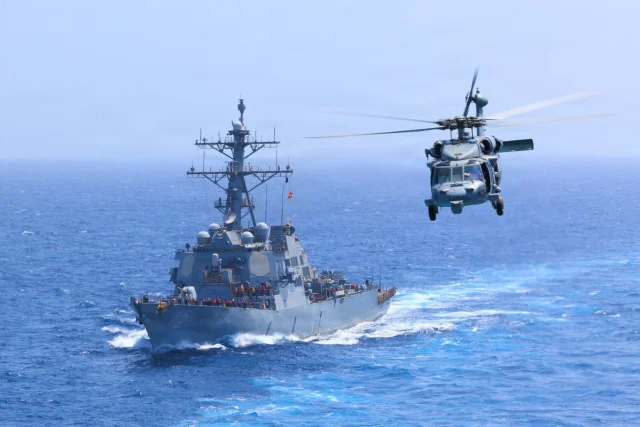
With no apparent agreement in sight, the Strait of Hormuz continues to be the focal point of the ongoing conflict between the United States and the Islamic Republic of Iran.
Iranian leaders rejected recent claims by President Donald Trump that the U.S. could take control of the strait, and declare it an American territory following the war.
Iranian Deputy Foreign Minister Kazem Gharibabadi dismissed Trump’s comments as “fanciful delusions” in a series of tweets to 𝕏.
“The Strait of Hormuz cannot be seized by tweet, nor by aircraft carrier, nor by issuing an order, nor by an election speech,” Gharibabadi wrote to social media. “Iran neither fears threats nor cowers before displays of power.”
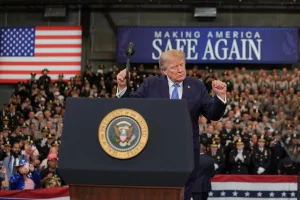
President Trump had made the claim of declaring the strait U.S. territory during a political speech at a police academy in Garden City, New York.
Gharibabadi also claimed that the U.S. has suffered defeat in the conflict, rather than Iran.
“Up to this point, you have suffered strategic and heavy defeats,” Gharibabadi continued. “The Strait of Hormuz has been Iranian, is Iranian, and will remain Iranian; this strait will only be closed and opened under Iran's command, and as long as you do not accept the reality of defeat and cease your fanciful delusions, Iran will continue to enforce the blockade.”
In his speech, Trump claimed that the U.S. controls passage through the Strait of Hormuz.
“We have the blockade. No ships get through unless we want them to,” he stated.
According to reports in Reuters, traffic through the strait has slowed to a near standstill, following further Iranian attacks on vessels departing the Persian Gulf, combined with the U.S. blockade on traffic to Iranian ports.
Both the Islamic Republic and the U.S. have claimed to control traffic through the strait since the end of active hostilities in April.
On Saturday, Ebrahim Azizi, head of the Iranian Parliament’s National Security Commission wrote on X that “The U.S. President ought to worry about his own security rather than his endless bluffing regarding the Strait of Hormuz; before he ends up hiding in a food truck.”
Azizi was referring to the incident in which President Trump changed planes during a visit to Turkey for the NATO summit. According to recent reports, Trump was smuggled between planes on a catering truck to avoid detection.
While Trump was seen boarding the older Air Force One, the Washington Post reported that the President actually departed that plane in a catering truck and eventually boarded an Air Force C-32A, following unspecified threats and the Secret Service's recommendation.
In another development, the United Arab Emirates news agency WAM reported attacks on two vessels affiliated with the Abu Dhabi National Oil Company (ADNOC).
The UAE Foreign Ministry blamed the Islamic Revolutionary Guard Corps (IRGC) for the attacks, calling them “acts of piracy.”
“Targeting commercial shipping and using the Strait of Hormuz as a tool of economic coercion or blackmail represents acts of piracy by Iran’s Revolutionary Guard Corps,” the ministry said in a statement on Saturday.
At the same time, the unresolved issue of the Strait of Hormuz has become a concern for the U.S. administration, with the Pentagon moving the Pacific-based aircraft carrier USS George Washington to the Middle East to relieve the USS Abraham Lincoln, which has been in the region since late January.
The USS Lincoln arrived to support the operations against Iran, which launched a month later. The USS Lincoln has been at sea for a record-setting deployment of over 240 days, leading to reports of supply and mental health issues aboard the vessel.
🚫 CLAIM: Over the past 48 hours, multiple media outlets have reported several false claims related to USS Abraham Lincoln's (CVN 72) deployment to the Middle East. One report alleged seven Sailors died in a brawl aboard the aircraft carrier and others have recently suggested a… pic.twitter.com/U1Hg6l1pjN
— U.S. Central Command (@CENTCOM) August 13, 2026
President Trump denied the reports of problems aboard the vessel when asked by reporters, saying the deployment was “not nearly long enough.”
He also acknowledged the transfer of another carrier to replace the Lincoln, saying, “That ship is moving right now, or very shortly, and it's being replaced with another very similar ship.”
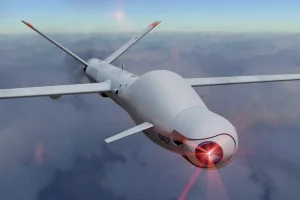
At the same time, the continued Iranian threat was seen in the recent announcement by U.S. Central Command (CENTCOM), of the establishment of a “multinational attack drone task force.”
According to CENTCOM, the unit, called Task Force Falcon Strike, “will employ one-way attack drones consisting of unmanned systems from above, on, and below the sea operated by military support staff from the United States and regional partners.”
The new task force complements another unit, called “Task Force Scorpion Strike,” which was the U.S. military's first dedicated one-way attack drone squadron in the Middle East, and which began operations in December 2025. The task force also participated in Operation Epic Fury and during strikes on Iranian port facilities in July, CENTCOM said.
The establishment of a multinational task force also demonstrates the U.S. goal of increasing regional partner involvement in confronting threats, while allowing the U.S. military to focus on the growing Chinese threat in the Pacific.
You might also like to read this: