Israel takes laser weapons airborne



Elbit Systems is enjoying one of the strongest periods in its history. The Israeli defense company has accumulated a record $32 billion order backlog as governments around the world increase military spending. But while much of today's demand is for ammunition, drones, electronic warfare and other existing weapons, Elbit is using its current strength to invest in something considerably more ambitious: powerful lasers capable of being carried by helicopters and fighter aircraft.
The idea sounds futuristic, but Israel has already moved laser weapons beyond the laboratory.
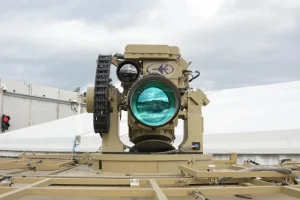
In December 2025, Israel's Ministry of Defense delivered the first operational Iron Beam system to the Israel Defense Forces. The Iron Beam is designed to use a high-power laser to destroy rockets, mortars and unmanned aircraft. Rafael Advanced Defense Systems is the main developer and system integrator, while Elbit supplies the high-power laser source.
The significance goes beyond adding another weapon to Israel's air-defense network.
Systems such as Iron Dome protect Israel by firing interceptor missiles at incoming threats. They have proved highly effective, but every interception requires a missile costing tens of thousands of dollars. A laser works differently. Once the equipment is installed, firing it requires primarily electricity rather than another missile.
That potentially changes the economics of air defense.
The spread of inexpensive drones has made the problem increasingly important. A military can find itself using a sophisticated and expensive interceptor against a much cheaper incoming threat. Lasers offer the possibility of dealing with at least some of those threats without consuming limited stocks of interceptor missiles.
They will not make systems such as Iron Dome obsolete. Lasers have limitations, including atmospheric conditions that can interfere with the beam. They also need enormous amounts of power and sophisticated cooling equipment. Instead, Israel intends lasers to operate alongside conventional missile defenses, allowing the most appropriate weapon to be used against each threat.
Elbit now wants to take the concept one step further – into the air.
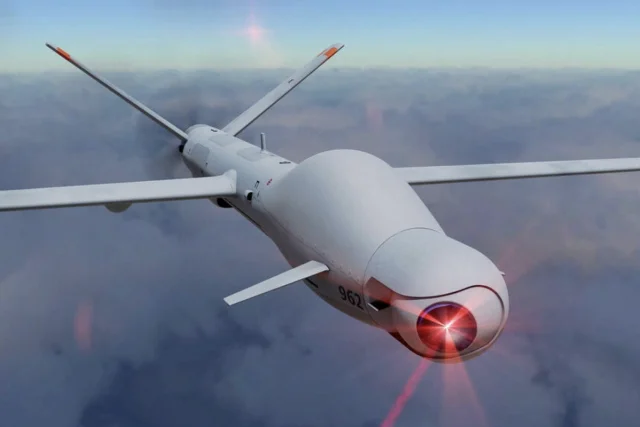
The company is developing high-power laser systems for both helicopters and fighter aircraft. CEO Bezhalel "Butzi" Machlis said, following Elbit's latest results, that the helicopter system should become operational "relatively soon," although the company has not disclosed a precise timetable or detailed performance specifications.
The concept is important because putting a laser on an aircraft could overcome some of the limitations of keeping one on the ground.
A ground-based laser has to engage threats from a fixed location and fire through the lower atmosphere. An aircraft can move toward the area where the threat is coming from and operate at altitude. In principle, this could allow drones or cruise missiles to be attacked farther from the territory or forces being protected.
Elbit believes the implications could be substantial.
"I believe that this airborne High Power Laser would be a game changer in the way countries address threats such as UAVs, swarms and cruise missiles," Machlis told analysts in November 2025. He said the company sees directed-energy weapons as "a future growth engine."
Its ELOP business has worked with laser and electro-optical technologies for decades. More importantly, Israel demonstrated the basic principle of airborne laser interception five years ago. In 2021, the Ministry of Defense and Elbit successfully used a high-power laser installed on a light aircraft to intercept unmanned aircraft during tests.
The challenge since then has been turning an experimental system into a weapon practical enough to be carried and used by operational military aircraft.
That is considerably harder than simply building a more powerful laser.
A laser weapon has to generate enough concentrated energy to damage a target while keeping the beam precisely focused on it. The difficulty becomes greater when both the target and the aircraft carrying the laser are moving. The system must identify the target, track it and keep the beam concentrated on the correct point long enough to destroy it.
Then there is the problem of heat. High-power lasers generate enormous amounts of it, and that heat must be dissipated quickly. On an aircraft, where space, weight and electrical power are limited, engineers cannot simply add larger generators and cooling systems. Elbit, therefore, needs to make the weapon not only powerful enough to destroy its target but also compact, light and reliable enough to operate in the air.
The timing for developing such a weapon could hardly be better.
Drones have rapidly become one of the defining weapons of recent conflicts. Russia and Ukraine have demonstrated how relatively inexpensive unmanned aircraft can be produced and deployed in enormous numbers. Israel has faced repeated drone attacks from several directions, including long-range UAVs launched by Iran and its proxies.
The challenge becomes even greater with drone swarms. Air-defense systems designed for a smaller number of expensive aircraft or missiles can potentially be overwhelmed when confronted with large numbers of cheap targets.
A laser offers one particularly attractive characteristic in such circumstances: it does not need to be reloaded after every shot, as a missile launcher does. As long as sufficient electrical power is available and the system can manage the heat it generates, it can theoretically continue engaging targets.
That helps explain why directed-energy technology is attracting interest well beyond Israel. The United States and other militaries are also developing laser weapons as they search for more economical ways of countering drones and other airborne threats. Elbit therefore faces competition, but it is pursuing a technology for which there could eventually be a substantial international market.
The company's current financial position gives it room to do so.
Elbit's revenue increased 16% from a year earlier to $2.29 billion in the second quarter of 2026. Its order backlog reached $32 billion, up from $23 billion a year earlier, with 73% coming from customers outside Israel. Europe has become an important source of new business as governments rebuild military capabilities following Russia's invasion of Ukraine.
Machlis says demand extends considerably further. "We see record demand all over the world," he told Globes, pointing to Europe, the United States and Asia-Pacific.
Elbit is responding by expanding factories, increasing automation and investing more heavily in research. Research and development spending reached $159 million in the second quarter, compared with about $130 million a year earlier.
The weapons responsible for much of Elbit's growth today are not necessarily those that will drive the company a decade from now. Current wars have created enormous demand for ammunition, drones, electronic warfare equipment and existing air-defense systems. Elbit is effectively using part of the opportunity created by that demand to finance technologies intended for the next battlefield.
Airborne lasers remain one of the riskier bets.
High-power laser weapons have been under development internationally for decades, and technical demonstrations have not always translated into practical military systems.
Israel's experience with the Iron Beam, however, makes that gap smaller than it once appeared. High-power lasers are no longer simply an experimental technology. The first operational ground system has been delivered, while Elbit's laser technology already forms part of it.
Moving that capability from the ground to helicopters, and eventually to fighter aircraft, would represent a much bigger technological leap. Elbit’s $32 billion backlog gives the company something valuable as it works toward that goal: time and money. Existing products are generating record orders while research spending is rising. If its airborne laser becomes operational and attracts international customers, the company could find itself supplying a new category of air-defense weapons at precisely the moment militaries are searching for cheaper ways to defeat an increasingly large number of drones and missiles.
That may ultimately be the more important story behind Elbit's current success. Today's defense boom is generating record demand for weapons developed years ago. It is also giving the company the resources to develop technologies that could shape the battlefield long after the current surge in orders has passed.
You might also like to read this: