Exploring the history and importance of biblical Beersheva






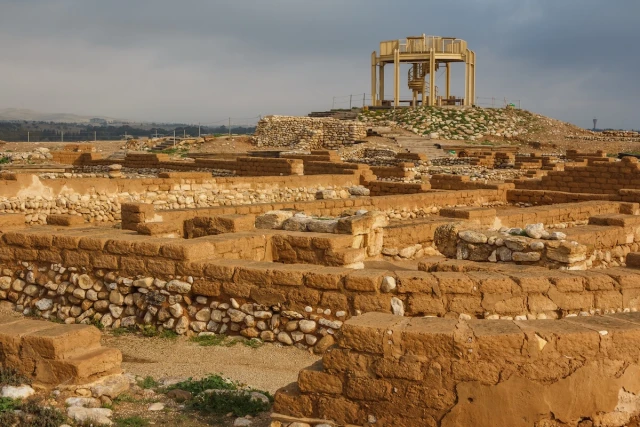
Beersheva has been the marker of Israel’s southern border for much of history, and tour guide Levi Simon has taken ALL ISRAEL NEWS correspondent, Oriel Moran, to explore the city and its ancient past.
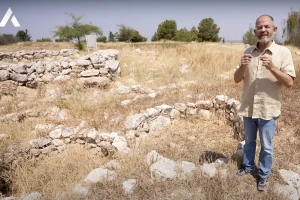
“Today we're going to walk in the steps of our forefathers, see the promises they had with their neighbors, see the importance of the wells that they had here,” Simon begins as they set off in Israel’s Negev Desert.
“We're going to climb up this artificial mound called a tel.” A tel, he explains, is a mound made of multiple layers, telling the story of each time the city had been built, destroyed, and then reconstructed over and over again.
The reason so many civilizations came and went in that location was due to the presence of water, as the ancient wells testify. The Hebrew word “be'er” means well, which accounts for the first half of the name, and the “sheva” part has two meanings, explained in the book of Genesis. The first relates to the word for swearing an oath (sheva) and the second to the number seven (also sheva). Both of these concepts appear in Genesis 21 when the servants of Abimelech seize the seven wells of Abraham. The dispute is settled with an oath and the gift of seven lambs.
“So Abraham took sheep and oxen and gave them to Abimelech, and the two men made a covenant. Abraham set seven ewe lambs of the flock apart. And Abimelech said to Abraham, “What is the meaning of these seven ewe lambs that you have set apart?” He said, “These seven ewe lambs you will take from my hand, that this may be a witness for me that I dug this well.” Therefore that place was called Beersheba, because there both of them swore an oath. So they made a covenant at Beersheba” (Genesis 21:27-31).
Later on, Abraham’s son Isaac has a similar well-related incident with Abimelech, except this time the Philistines ask Isaac for peace and even for mercy. The dispute is settled after Isaac agrees to a covenant of peace and they exchange oaths once again. However this time more wells are dug as Isaac’s servants report finding more water:
“That same day Isaac's servants came and told him about the well that they had dug and said to him, “We have found water.” He called it Shibah; therefore the name of the city is Beersheba to this day” (Genesis 26:32-33).
The Hebrew word shiva is also linked to the word for fulfillment and satisfaction, which is pertinent due to all the promises God gives regarding that landmark. Time and time again we see biblical promises about the Land sworn to Israel from Dan in the north to Beersheva in the south.
Some say Abraham and Isaac had seven wells at Beersheva although the true number is disputed. Today it is possible to still see the remains of Abraham’s ancient well, and also an enormous water cistern that would have been sufficient to hold water for the entire city in times of siege.
“Before us we can see a well which is the same well that was outside of Beersheva, just on the outskirts of the original gate of the city,” Simon tells Moran, explaining it was for cattle so that people didn't have to come into the city in order to quench the thirst of their livestock.
“When your sheep are grazing in a land it means you're taking someone else's territory. And the fights that they had was exactly what we're looking at right here, a well inside of the desert, a place where water is essential for survival and every single inch matters,” he explains.
“We just walked through the entrance gate of the city, which was the most important place and the most protected place. Here we have the official gate. The important place where the seats of the judges would have stood,” says Simon. The city gate was where kings and dignitaries would sit and meet, and where Abraham likely carried out his negotiations with Abimelech.
“Every corner you turn you see something new and magnificent,” Moran marveled, taking in the sights as they surveyed the ancient remains of enormous storerooms and houses built into the city walls from days gone by. “It's absolutely magnificent to think about all the civilizations that were here in the time of Abraham,” she said.
“Beersheva's power was its ability to store water and we're about to go into a 20 meter (about 66 feet) deep and 700 square cubic meter wide water system,” Simon explained, before going down deep into the bronze age cistern.
In the ancient structure, built in the time of the Patriarchs, Moran is reminded of Israel’s past. “I'm thinking about Abraham and the exact moment when God called him to go from the location where he called him from to the Promised Land. And you have to understand, this wasn't an easy thing because everywhere you go, you need to find a source of life, right? You need to find water,” she mused, reflecting on how God provided for our ancestors.
While Eilat is the most southerly point of Israel today, Beersheva was the last point where bountiful water could be found before hitting acres of unyielding desert. “The desert was this large part of land which they couldn't logistically cross with brutal military force, simply because of the logistical inability… to bring enough water for soldiers to make it through this ginormous desert,” said Simon.
This brutal reality was encountered in recent history when the ANZACs fought the Battle of Beersheva against the Ottoman Turks in 1917. With no other sources of water around, the Antipodean armies were forced to storm Beersheva with its wells, the alternative being certain death.
Despite the impossible odds, their calculated risk paid off. The road was opened for the allies to go on to conquer Jerusalem, liberating Israel from centuries of Muslim rule and paving the way for Israel to be reborn. The Jewish people are now back in the land of their forefathers, from Dan to Beersheva, just as God promised.
You might also like to read this: