Christmas in Bethlehem - Where the true message gets lost in politics


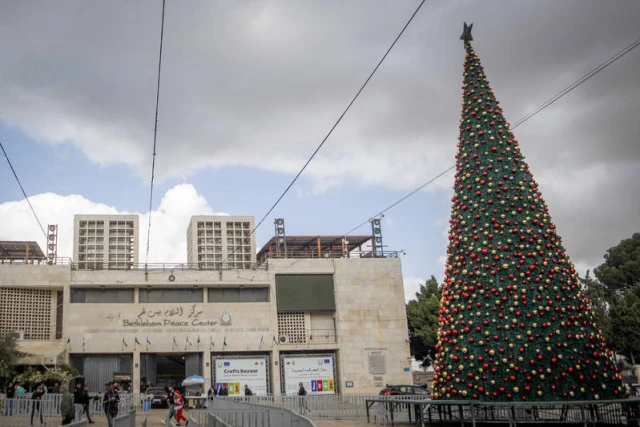
Every Christmas season, I loved visiting Bethlehem. One year, I stood in the Manger Square, watching the lights twinkle on the towering Christmas tree. Carols mingled with marching bands, and the faces around me were full of joy and smiles, cameras flashing everywhere.
Yet inside, a quiet question lingered: Does anyone still remember why Jesus was born? In the city where salvation began, the decorations seem to overshadow the message, and the celebration often forgets the newborn baby himself.
Modern Claims: Jesus as “Palestinian”
Every year, images circulate showing Jesus wearing a Palestinian keffiyeh, or being depicted on the cross with the Palestinian flag behind Him, soldiers in the background. Phrases like, “Jesus was Palestinian” or “the message of Christmas came from Palestine” spread widely, making Christ seem more like a political or national symbol than the Savior.
But is this what the Bible actually says? Was Jesus’ identity tied to the politics of a particular land or people?
The truth is, early Christians never thought this way, and the Scriptures never present it. These ideas are a modern invention, emerging in a political context where some sought to use Jesus as a symbol of national struggle or resistance. But Jesus didn’t come to lead an earthly revolution—He came to spark a heavenly one in the human heart.
The Biblical and Historical Jesus
The Bible is clear:
“The book of the genealogy of Jesus the Messiah, the son of David, the son of Abraham.” (Matthew 1:1)
“For the Messiah is descended from the Jews according to the flesh.” (Romans 9:5)
Jesus was born in Bethlehem of Judea, a descendant of David, during the time when the region was under Roman rule. The name “Palestine” didn’t exist yet; it only came over a century later when the Roman Emperor Hadrian renamed the region to erase Israel’s identity.
Calling Jesus “Palestinian” is not only historically inaccurate, it also reduces His mission to an earthly identity, while He came to offer salvation to the whole world. As He Himself said:
“For God so loved the world that He gave His one and only Son, that whoever believes in Him shall not perish but have eternal life.” (John 3:16)
Jesus didn’t come to save one nation, but all who believe in Him, from every language, people, and tribe. He is the Son of Man, the Savior of the world—not a political symbol or a flag.
Christmas in Bethlehem Today: Between Symbol and Message
Every year, we hear phrases like, “The message of Christmas came from Bethlehem” or “The message of hope came from Bethlehem.” But is today’s “hope” the same as what the angel announced to the shepherds?
That night, there were no cameras or glittering decorations—just an open sky and a voice saying:
“I bring you good news of great joy that will be for all the people: today in the city of David a Savior has been born to you; He is the Messiah, the Lord.” (Luke 2:10-11)
The great joy wasn’t in the lights or the ornaments—it was in the birth of the Savior. Today, many speak of “peace” and “hope,” but they forget that true peace comes only from Christ, and real hope is found not in slogans, but in the empty cross and the empty tomb.
When Leaders Bargain With Faith
It’s painful that this distortion of meaning isn’t just among ordinary people—it reaches some Christian leaders, too. During Christmas, speeches often mix faith with politics, prioritizing human approval over God’s truth. Jesus is spoken of as a symbol of national unity or resistance, rather than the Savior who reconciles us to God.
Pulpits can become platforms for agendas instead of beacons of light and truth. As Christ warned:
“No one can serve two masters.” (Matthew 6:24)
When leaders compromise faith to please people, the message they were given is lost. What should be a celebration of salvation turns into a political event, where even the holiest stories are used for temporary purposes. But truth cannot be sold or bartered. Christmas is not a diplomatic occasion—it is a heavenly declaration of God’s salvation for the world.
The Message We Need to Hear
Christmas celebrations are beautiful, but even more beautiful is understanding why Jesus came. He didn’t come to change politics; He came to change hearts. He didn’t carry a flag; He carried a cross. He didn’t build a nation; He established a kingdom within every believer.
True Christmas doesn’t happen in decorated streets—it happens when Christ is born in the heart. Only then does the meaning of Christmas come alive, when darkness is banished by the light of salvation.
Bethlehem Today: A Reminder for Our Hearts
Bethlehem, once the stage for the greatest event in history, has become more of a historical symbol than a place where Life was born. Yet God still calls each of us, just as He called the shepherds two thousand years ago:
“Come and see the newborn.”
Jesus is neither Palestinian, Roman, nor Western. He is the Son of God incarnate, come to reconcile us to the Father. In a world full of noise, His cry from the cross remains the one message that saves:
“It is finished.”
This is the true message of Christmas. Not about land or politics, but about a God who loved humanity enough to come Himself.
Let this Christmas in Bethlehem be the start of a new birth—not just in the town, but in hearts longing for light.
Finally:
I used to think Christmas was just a beautiful story celebrated every year. Then I discovered it’s about a God who loved me enough to die for me, opening the door of salvation without conditions. Only then did I realize Christmas is not a season—it’s life. And no other joy compares to the joy born in the heart with Christ.
Is All Israel News’ faithful reporting important to you? Be part of it—help us continue by becoming a $5/month supporting partner.
You might also like to read this: