When the sirens break the Seder
A wartime meditation on covenant, fire, sound, and the stubborn nearness of the God of Israel

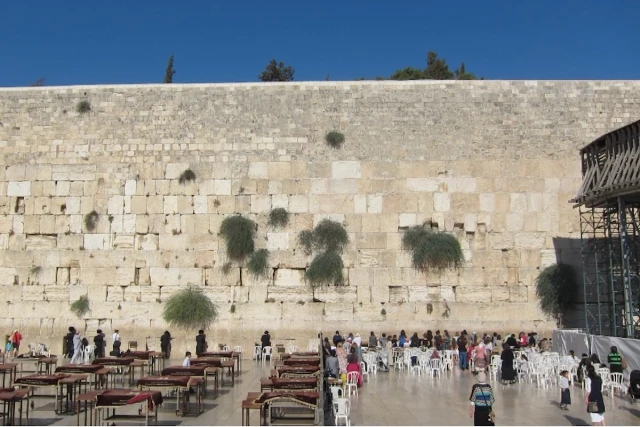
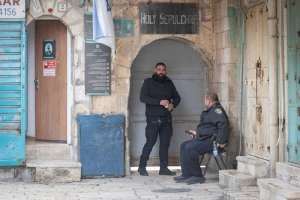
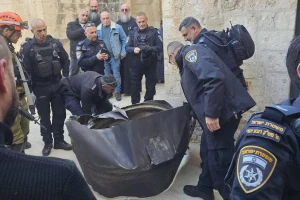
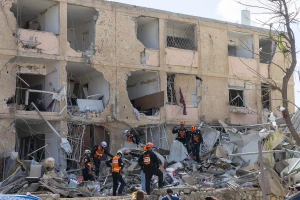
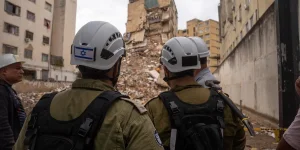
Before the youngest voice can finish the Ma Nishtanah, the siren cleaves the room. That is how Passover has come to Israel this year: Jerusalem subdued and half-silenced, Old City shutters down, holy places restricted, smoke rising from the strike in the Ne'ot Hovav industrial zone near Beer Sheva, missile fragments lying in roads, schoolyards, and olive groves, and, closing the circle further still, the Houthis entering the war from Yemen. Israel is trying to keep feast-time with one ear turned toward impact.
Any honest word for Israel must begin there—not above this hour but inside it. Missiles do not enter only airspace. They enter the mouth as metal, the stairwell as cold concrete under the palm, the lungs as dust and chemical smoke, the ear as that descending metallic shriek that teaches the body to move before the mind has finished thinking. The safe room has entered the liturgy. Families count children before they count courses. A grandmother's blessing now shares the room with alert tones, emergency instructions, and the small practical choreography by which frightened people keep one another alive.
What Israel needs in such an hour is not panic and not cliché, but a harder biblical sentence: the God of Israel has not vacated Israel. He is not a mascot draped over events, not an alibi for every policy, not a narcotic slogan meant to quiet grief. The prophets would reject all of that. But Scripture rejects the opposite error too: the idea that God withdraws every time Israel is morally mixed, politically divided, spiritually thin, frightened, secular, compromised, or less faithful than it should be. If that were the rule, the story would have ended in the wilderness.
The God of Israel is not an abstraction. He is the God who called Abram out of Ur, who heard Abel's blood from the ground, who wrestled Jacob through the night, who went before Israel in cloud and fire, who caused His Name to dwell in Jerusalem, and who, as the psalm says, 'shall neither slumber nor sleep.' That line matters in wartime. Israel's enemies can make a people sleepless. They cannot make its Keeper drowsy.
“Behold, He that keepeth Israel shall neither slumber nor sleep.”
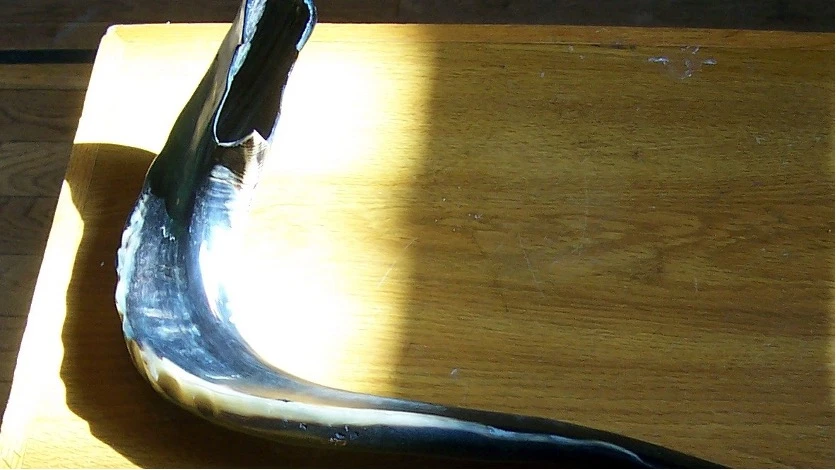
Israel therefore should not look for God only in spectacular ruptures of nature. Scripture knows the sea split and the fire fell, but more often it teaches a wounded people to notice God in covenantal detail: warning that arrives in time, mercy at the edge, remnant, interruption, memory, and the stubborn refusal of Jewish history to disappear. The shofar trains this kind of hearing. It is not polished music but an animal cry taken into obedience, breath driven through horn until alarm becomes summons. A civil-defense siren is not a shofar; one is circuitry and steel, the other breath and bone. Yet both break ordinary time. Both tell the body that history has entered the room. Israel needs another sound beneath the siren as well: not comfort, but form. Something like an Asaf Zohar phrase at the piano—disciplined, unsentimental, refusing collapse into noise. The left hand holds ground. The right hand keeps a line of meaning alive above dread.
Consider Elijah. He passes through Beer Sheva, goes a day's journey into the wilderness, lies down under a broom tree, and asks to die. 'It is enough.' The prophet sounds less like a hero than like a man whose inner world has caved in. He believes he is alone; he believes covenant has narrowed to one exhausted life. And what does God do? He feeds him before He instructs him. He lets him sleep. He speaks to him. Then comes the devastating correction: there are still seven thousand in Israel whom Elijah did not know. Elijah thought he was standing in the last ash of fidelity. He was wrong. God had preserved a remnant the prophet could not see.
That lesson is painfully current. Many Israelis do not live inside active covenant obedience. Many are secular. Many reach for religious language only in grief, memory, or emergency. Many devout Jews look at the nation's fractures and feel more rebuke than confidence. Yet Beer Sheva is biblical again not because pilgrims can find it on a map, but because fear, exhaustion, smoke, and divine address have returned there together. The God who found a broken prophet on that road has not forgotten the road.
Or take one of the most terrible scenes in Scripture: the siege of Samaria. The famine grows so severe that Deuteronomy's covenant curses seem to rip open in public. Mothers eat their children. Siege deforms even the grammar of love. Then four lepers move from the city's edge toward the Aramean camp because starvation has already chosen for them. They expect death and discover that God has already acted. The enemy has fled. Deliverance first appears not to the king, not to the generals, not to the healthy and honored, but to excluded men at the gate. That pattern matters now. God often lets His mercy surface first at the edges—among the overlooked, the exhausted, the already frightened, the people who know they are not in control. Sometimes the first sign of deliverance is not triumph but interruption: one more warning in time, one more door opened, one more child counted, one more neighbor hammered awake.
The furnace scene deepens the pattern. More precisely, it is Daniel's three friends—Hananiah, Mishael, and Azariah—who are thrown into the blaze. They are not kept from the fire; they are met within it. The empire heats the furnace seven times hotter, the soldiers carrying them in are consumed, and yet the faithful are seen walking in flame with a fourth presence beside them. Isaiah says the same thing in another key: not that Israel will never enter waters or fire, but that God will be with His people there. That is one of Scripture's hardest consolations. God does not always prove His faithfulness by preventing the furnace. Sometimes He proves it by making the furnace inhabited.
The pattern recurs across Scripture. Israel worships the calf, yet the covenant is renewed. The wilderness generation complains and dreams of Egypt, yet the cloud does not immediately depart. Judges records recurring national collapse, yet God keeps raising deliverers. Ezekiel speaks to a disgraced people and says restoration will come for God's holy name's sake. Leviticus dares to say that even in the land of their enemies God will not utterly cast Israel away or break His covenant with them. Jeremiah ties Israel's continuity to the fixed order of sun and moon. Hosea gives the cry of divine reluctance to let Ephraim go. So yes: it may be said soberly, not sentimentally, that God remains with Israel even when much of Israel is not yet fully with Him.
That covenantal refusal must also be spoken through Jewish history after the Bible. The God of Israel is not a museum label pinned to Jewish grief after the fact. Before Him, the ash of Buchenwald, Dachau, and Auschwitz is neither lost to the wind nor stripped of a name. The God who heard Abel's blood has not become numb because murder learned bureaucracy, timetables, and ovens. To say that God is still with Israel is not to bleach Jewish suffering. It is to say that covenant has already passed through flames, ghettos, camps, and crematoria without God Himself surrendering the names of His people.
And here the poets are not ornamental but necessary. Yehuda Amichai's 'Ecology of Jerusalem' knows the city as a place so laden with prayer, memory, and argument that the air itself can become hard to breathe. Zelda's 'Each of Us Has a Name' reminds Israel that every person in the shelter is a name before God, not a statistic. Rahel's 'To My Land' teaches that fidelity to the land may be offered not only in spectacle, but in small and stubborn acts: a path trodden, a tree planted, a tenderness kept. These poets help Israel hear what war tries to drown. The nation is still made of names, not categories; breath, not abstractions; kitchens, stairwells, songs, trembling bodies, remembered blessings, and unfinished prayers, not merely strategic maps.
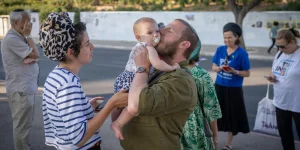
So where, in minute detail, is the God of Israel now? In the warning that comes in time. In the shelter that still opens. In the mother who gathers children with one hand and steadies the candlesticks with the other. In the father who counts heads before he pours the second cup. In the medic running toward smoke and in the volunteer driving medicine south. In the Haggadah page wrinkled by frightened fingers. In the smell of wine, candle wax, concrete dust, and iron in one room. In the body's old knowledge that it has been summoned again. In the strange fact that the Psalms, which may have looked like literature yesterday, sound today like weather.
He is also in Israel's terrible continuity. That Moses, Elijah, Isaiah, Jeremiah, Ezekiel, Amichai, Zelda, and Rahel still speak to living Jews is not ordinary history. That Jerusalem remains Jerusalem, and that families still set a Seder table under missiles, is covenant under pressure: fidelity pitched too low for triumphalism and too stubborn for despair.
You might also like to read this: